
NEFT, RTGS or IMPS: Which Bank Transfer Option Should You Use? Know Limits, Speed and Key Differences
Sending money from one bank account to another has become quick and convenient, thanks to digital banking. Whether you are paying a family member, transferring money for a purchase or moving a large amount between accounts, banks provide several electronic fund-transfer options.
Among the most common are NEFT, RTGS and IMPS. Although all three allow customers to transfer money electronically, they work differently when it comes to settlement, transaction size and the situations for which they are best suited.
Choosing the right method can make a transfer more convenient and, in some cases, faster. Here is a simple explanation of the differences between NEFT, RTGS and IMPS in 2026.
What Is NEFT and How Does It Work?
NEFT stands for National Electronic Funds Transfer. It is a nationwide electronic payment system used for transferring funds between eligible bank accounts.
Unlike RTGS, where transactions are settled individually in real time, NEFT transactions are processed through batches at frequent intervals.
NEFT is available 24 hours a day, seven days a week and throughout the year, including Sundays and bank holidays.
One of its biggest advantages is accessibility. There is no RBI-prescribed minimum amount required to initiate an NEFT transaction.
For the maximum amount, customers should check their bank's own limits, particularly when transferring money through internet or mobile banking, as individual banks can impose channel-specific restrictions.
Why Choose NEFT?
NEFT can be suitable when there is no requirement for individual real-time gross settlement and you want a widely available bank-to-bank transfer mechanism.
It can be used for relatively small transfers as well as larger transactions, subject to the bank's limits and security controls.
For example, if you need to transfer money to another bank account and do not specifically require RTGS settlement, NEFT can be a convenient option.
Customers should nevertheless verify beneficiary details carefully before approving the transaction.
What Is RTGS?
RTGS stands for Real Time Gross Settlement and is primarily designed for transferring large-value funds.
The words "real time" mean transactions are processed without waiting for batch settlement, while "gross settlement" means each eligible transaction is settled individually rather than being grouped with other transactions.
The minimum amount for an RTGS transaction is ₹2 lakh.
RTGS is therefore generally used when a customer needs to transfer a substantial sum, such as for a property-related payment, business transaction or another high-value financial requirement.
Like NEFT, RTGS is available round the clock, including weekends and holidays.
Is There an Upper Limit for RTGS?
At the RBI system level, RTGS does not have a prescribed maximum transaction ceiling.
However, this should not be interpreted to mean that every customer can transfer an unlimited amount through their bank's mobile application or internet-banking platform.
Banks can impose their own transaction limits based on the channel, account type and security policies.
If you are planning a particularly large transfer, checking the bank's daily and per-transaction limits beforehand can prevent delays.
What Is IMPS?
IMPS stands for Immediate Payment Service and is operated by the National Payments Corporation of India.
As its name suggests, IMPS is designed to facilitate immediate interbank fund transfers.
The service operates 24x7, making it useful when money needs to reach another account quickly, including during nights, weekends and bank holidays.
IMPS is widely available through mobile banking and internet banking services provided by participating banks.
For customers who need to make an urgent small or medium-value bank transfer, IMPS can be particularly convenient.
What Is the Maximum IMPS Transfer Limit?
IMPS can support transactions of up to ₹5 lakh under the broader system framework, subject to applicable rules.
However, the actual amount a customer can send may be lower because banks are permitted to set their own limits for different accounts and digital channels.
Therefore, if you need to transfer ₹4 lakh or ₹5 lakh through IMPS, check the limit displayed by your bank before assuming the entire amount can be sent in a single transaction.
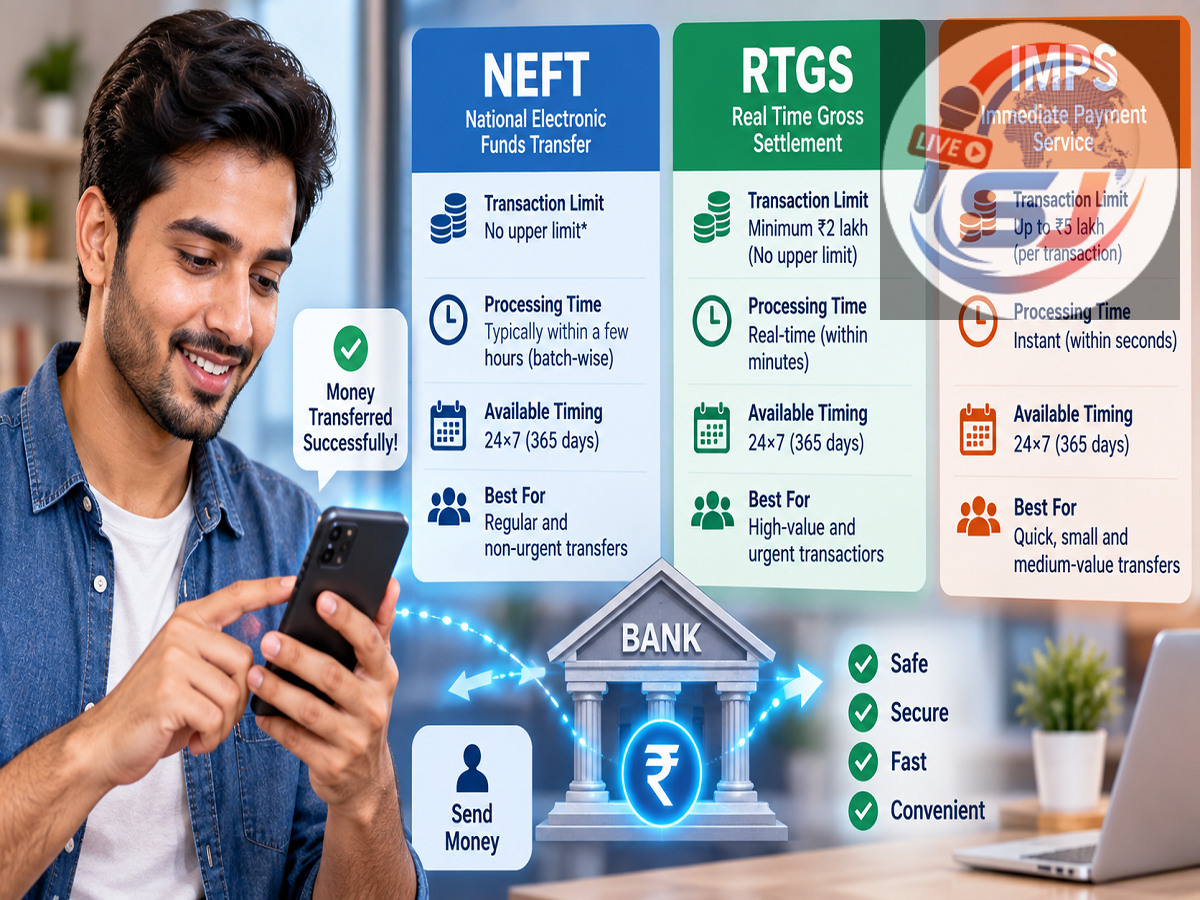
NEFT vs RTGS vs IMPS: Quick Comparison
The easiest way to choose between these payment methods is to compare their main features.
| Feature | NEFT | RTGS | IMPS |
|---|---|---|---|
| Full Form | National Electronic Funds Transfer | Real Time Gross Settlement | Immediate Payment Service |
| Availability | 24x7 | 24x7 | 24x7 |
| Settlement | Batch-based at frequent intervals | Individual real-time settlement | Immediate |
| Minimum Amount | No RBI-prescribed minimum | ₹2 lakh | Depends on bank/system rules |
| Maximum Amount | No RBI-prescribed system ceiling; bank limits may apply | No RBI-prescribed maximum; bank limits may apply | Up to ₹5 lakh under the broader framework; bank limits may vary |
| Best Suited For | General bank transfers | Large-value transfers | Urgent small-to-medium transfers |
Which Is Better for Transfers Below ₹2 Lakh?
For a bank transfer below ₹2 lakh, NEFT or IMPS can generally be considered because RTGS has a minimum transaction requirement of ₹2 lakh.
The choice between NEFT and IMPS can depend on how quickly the recipient needs the funds and what facilities your bank provides.
If immediate transfer is important, IMPS may be convenient. If there is no particular urgency, NEFT can also serve the purpose.
Which Option Is Better for Large Payments?
For transfers of ₹2 lakh or more, RTGS becomes an available option and is particularly suited to large-value payments requiring individual real-time settlement.
NEFT may also be available for larger transfers because there is no RBI-prescribed maximum NEFT ceiling, although the customer's bank may have its own digital transfer limits.
This means RTGS is not automatically the only method available once a transaction exceeds ₹2 lakh. The best choice depends on the amount, urgency and limits imposed by the bank.
Do Banks Charge for NEFT, RTGS and IMPS?
Charges can depend on the transfer method and the channel used.
For online NEFT and RTGS transactions initiated by savings-bank customers, customers should check the applicable RBI and bank rules. IMPS charges, if any, can vary among banks and account types.
Banks may also apply different charges for branch-based transactions or specific services.
Instead of assuming that all three methods are always free, customers should review the fee displayed by their bank before confirming the payment.
Check Beneficiary Details Before Sending Money
Regardless of whether you use NEFT, RTGS or IMPS, entering the correct beneficiary information is essential.
Check the recipient's account number, name, bank and IFSC details, wherever required, before authorising a transfer.
For a new beneficiary or a particularly large transaction, consider sending a small test amount first where practical.
Never approve a transaction merely because someone calling you claims to be from your bank. Also avoid sharing OTPs, internet-banking passwords, card PINs or other confidential credentials.
Which Money Transfer Method Should You Choose?
There is no single transfer method that is best for every situation.
NEFT is a flexible option for general bank transfers and does not have an RBI-prescribed minimum amount. RTGS is designed for large-value transfers starting at ₹2 lakh and provides individual real-time settlement. IMPS is useful when an eligible transfer needs to be completed immediately, including outside normal banking hours.
Before transferring money, compare the amount, urgency, bank-specific transaction limit and applicable charges.
Understanding these differences can help you select the right payment method instead of simply choosing whichever option appears first on your mobile or internet-banking screen.