
MP Bhavantar Yojana 2026: Soybean Farmers to Get MSP Price Difference, Check Payment Rules and Dates
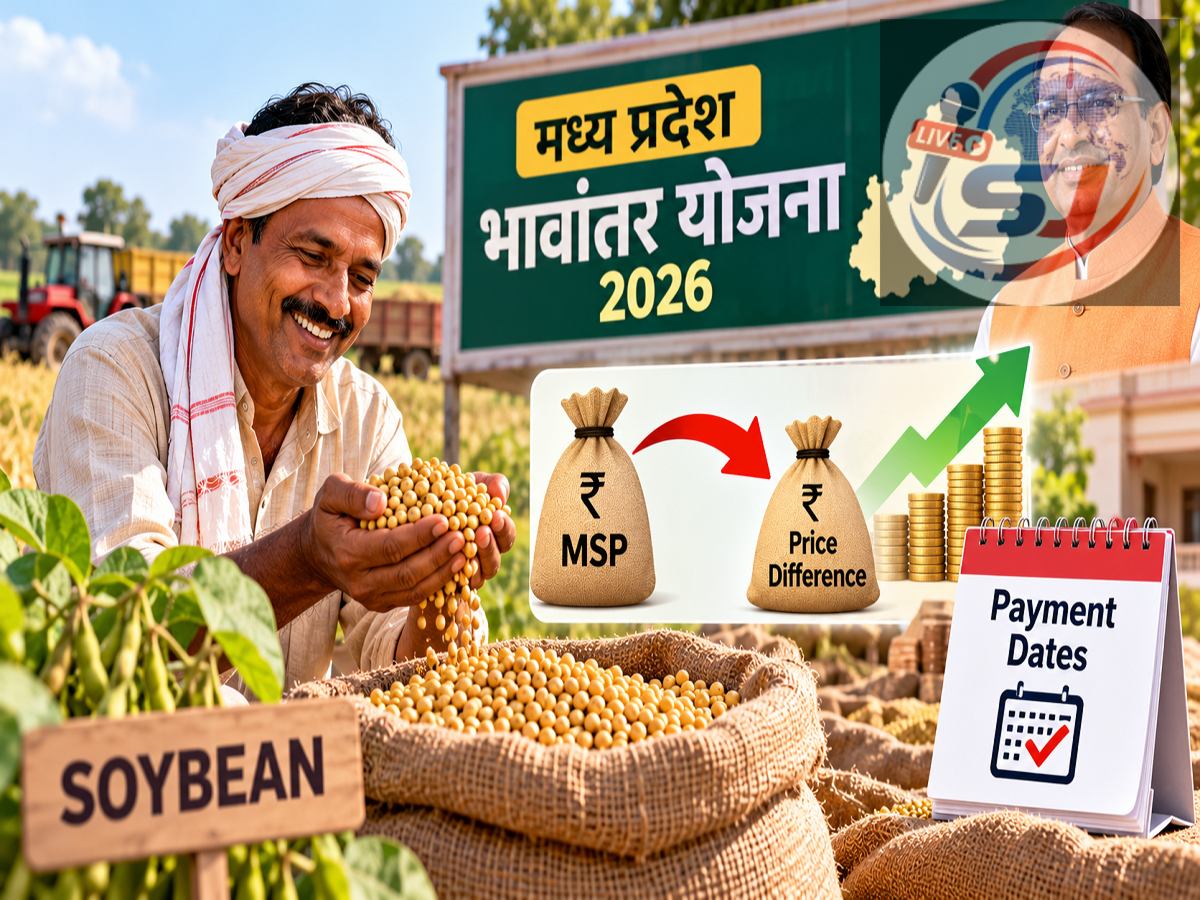
Madhya Pradesh Bhavantar Yojana 2026: The Madhya Pradesh government has approved the implementation of the Bhavantar Payment Scheme for soybean farmers during the Kharif 2026 season. The decision, taken by the state cabinet led by Chief Minister Mohan Yadav, aims to protect farmers from financial losses when soybean prices in agricultural markets fall below the Minimum Support Price (MSP).
Under the scheme, eligible farmers will receive financial assistance based on the difference between the MSP and the applicable market price or government-declared model rate.
The compensation will be transferred directly to farmers' registered bank accounts through the Direct Benefit Transfer (DBT) system.
The scheme is being implemented in accordance with the Price Deficiency Payment Scheme (PDPS) guidelines under the Central Government's Pradhan Mantri Annadata Aay Sanrakshan Abhiyan (PM-AASHA).
However, farmers must meet registration, crop-sale and quantity-related conditions to qualify for payment.
Here is everything soybean growers need to know about the scheme, including registration requirements, important dates, model-rate calculations and payment procedures.
MP Bhavantar Yojana 2026: What Has the Government Approved?
The Madhya Pradesh cabinet has approved the implementation of a price-difference compensation mechanism for soybean farmers.
The objective is to provide financial protection to eligible growers who sell their produce in notified agricultural markets at prices below the applicable MSP.
Under the scheme, farmers will continue selling their soybeans through the prescribed market system.
If the sale price falls below the MSP, compensation may be calculated according to the government's model-rate formula.
This arrangement differs from direct government procurement at MSP because the farmer sells the produce in the market and receives a separate compensation payment when eligible.
The scheme is intended to reduce the impact of market-price fluctuations on agricultural income.
MP Soybean Bhavantar Scheme 2026: Important Dates
| Particulars |
Details |
|---|---|
| Scheme Name |
Bhavantar Payment Scheme |
| State |
Madhya Pradesh |
| Crop Covered |
Soybean |
| Agricultural Season |
Kharif 2026 |
| Registration Portal |
E-Uparjan |
| Reported Registration Deadline |
October 17, 2026 |
| Notified Sale Period |
October 22, 2026 to January 15, 2027 |
| Payment Method |
Direct Benefit Transfer |
| Implementing Framework |
PM-AASHA Price Deficiency Payment Scheme |
| Model Rate |
Based on weighted average mandi prices |
Important: The registration deadline mentioned in the October 6 report was October 17, 2026, which has already passed as of October 19. Farmers who missed it should check for an official extension rather than assume registrations are still open.
Farmers Must Register Through the E-Uparjan Portal
According to the cabinet decision described in the report, soybean farmers were required to register through the Food Department's E-Uparjan system.
Registration is important because it allows the authorities to verify farmers' identities, land records, crop details and eligible quantities.
The registered agricultural area will also be used to determine the maximum quantity for which compensation may be payable.
Farmers who have already registered should ensure that their information is accurate.
They should verify their land details, bank account information and crop registration status through the authorised channels.
Farmers who have not completed registration should contact the relevant local agricultural or procurement authorities to determine whether any extension or correction window has been announced.
When Can Farmers Sell Soybeans Under the Scheme?
The notified soybean sale period is scheduled to begin on October 22, 2026, and continue until January 15, 2027.
During this period, eligible farmers can sell their produce in designated agricultural markets in accordance with the scheme's requirements.
The government may revise the sale period if necessary.
Farmers should therefore monitor official announcements for any changes in the dates or market arrangements.
Selling soybeans outside the prescribed conditions may affect eligibility for compensation.
How Will Bhavantar Compensation Be Calculated?
The Bhavantar scheme uses a model-rate mechanism to determine compensation.
The model rate is based on soybean prices recorded across agricultural markets in Madhya Pradesh.
For the first 14 days of the notified sale period, the model rate will be calculated using the weighted average of prices across the state's mandis.
After that, the rate will be determined daily using the weighted average prices from the preceding 14 days.
The applicable model rate will be displayed on the E-Mandi system.
This mechanism is intended to reduce the possibility of compensation being determined solely by unusually low prices in an individual transaction.
Three Situations That Determine How Much Farmers Receive
The compensation amount will depend on the relationship between the actual selling price, the MSP and the declared model rate.
1. Soybean Sold at or Above MSP
If a farmer sells soybeans at a price equal to or higher than the applicable MSP, no Bhavantar compensation will be payable.
This is because the farmer has already received at least the support-price amount through the market sale.
2. Selling Price Below MSP but Above Model Rate
If the actual selling price is below MSP but higher than the model rate, compensation will be calculated using the difference between MSP and the actual selling price.
3. Selling Price Equal to or Below Model Rate
If the farmer sells soybeans at a price equal to or below the declared model rate, compensation will be calculated using the difference between MSP and the model rate.
This means selling at an exceptionally low price will not necessarily result in a larger compensation payment.
Bhavantar Yojana Payment Calculation: An Example
Consider a purely illustrative situation in which the applicable MSP is ₹5,000 per quintal and the declared model rate is ₹4,500 per quintal.
These are hypothetical figures used only to explain the formula, not the officially notified soybean MSP or model rate for the season.
| Actual Sale Price |
Model Rate |
Illustrative MSP |
Compensation per Quintal |
|---|---|---|---|
| ₹5,100 |
₹4,500 |
₹5,000 |
₹0 |
| ₹4,800 |
₹4,500 |
₹5,000 |
₹200 |
| ₹4,500 |
₹4,500 |
₹5,000 |
₹500 |
| ₹4,300 |
₹4,500 |
₹5,000 |
₹500 |
In this example, a farmer selling soybeans at ₹4,800 per quintal would receive ₹200 per quintal as compensation.
However, a farmer selling at ₹4,300 would still receive ₹500 per quintal because the payment would be based on the difference between MSP and the model rate.
The final amount would also depend on the eligible quantity and the government's applicable verification rules.
How Will the Eligible Soybean Quantity Be Determined?
The government will not necessarily provide compensation for an unlimited quantity of soybeans sold by a farmer.
According to the report, the eligible quantity will be determined using the farmer's registered agricultural area and the state-level average productivity figure prescribed by the department for the previous year.
This approach is intended to establish a reasonable quantity limit based on the land registered for soybean cultivation.
Farmers should ensure that their registered area accurately reflects their eligible landholding and crop details.
What Happens if Soybeans Were Sold Before October 22?
The scheme also includes a provision for soybean sales made between October 1 and October 21, 2026.
According to the reported rules, quantities sold during this earlier period will be deducted from the farmer's total eligible quantity.
Bhavantar compensation will then be payable only on the remaining eligible quantity sold under the scheme's prescribed conditions.
For example, if a farmer's total eligible quantity is 40 quintals and 10 quintals were already sold during the earlier period, the remaining quantity eligible for compensation would be limited to 30 quintals.
This example assumes that all other eligibility conditions are satisfied.
How Will Farmers Receive the Bhavantar Payment?
The Madhya Pradesh Mandi Board will transfer the approved compensation directly to farmers' registered bank accounts.
The DBT system is intended to reduce intermediaries and provide a traceable payment process.
Farmers should ensure that their bank details are correct and that their accounts are active.
Incorrect account information or unresolved verification issues may delay payments.
The report does not specify a fixed date for the first compensation transfer.
Farmers should therefore wait for official announcements regarding payment schedules.
Government Approves Financial Support for Scheme Implementation
The report states that compensation payments will initially be supported through the Price Stabilisation Fund operated by the State Agricultural Marketing Board.
If the available funds are insufficient, the state government has approved a provision to extend an interest-free credit limit of ₹1,500 crore to the Mandi Board for one year.
This financial arrangement is intended to support the implementation of the compensation scheme.
However, the ₹1,500 crore figure represents a credit facility for the implementing agency, not a fixed amount that will be distributed equally among farmers.
Individual payments will depend on eligible sales and the prescribed compensation formula.
How Will the Government Monitor the Scheme?
Implementation committees will oversee the scheme at the state and district levels.
According to the report, the state-level committee will operate under the chairmanship of the Chief Secretary.
At the district level, committees will be headed by the respective District Collectors.
These arrangements are intended to coordinate implementation, monitor market transactions and support the payment process.
The use of model rates and registered sale records is also expected to improve transparency.
What Should Soybean Farmers Do Now?
Farmers who have already registered should keep their registration acknowledgement and verify their crop and land details.
They should also follow official instructions about notified mandis, eligible sale dates and documentation requirements.
Before selling their produce, farmers should check the applicable market price and the model rate displayed through the authorised system.
Maintaining accurate sale records will be important if any payment discrepancy arises.
Those who missed the October 17 registration deadline should check whether the state government has announced an extension or any special provision for pending applications.
MP Bhavantar Yojana 2026: Key Takeaway
The Madhya Pradesh government's approval of the Bhavantar scheme is an important development for soybean farmers facing uncertain market prices.
The programme aims to compensate eligible growers when soybean prices fall below the applicable MSP.
The scheme's main benefit is a price-difference payment, calculated according to the actual selling price and government-declared model rate, rather than a guaranteed purchase of every farmer's produce at MSP.
The notified sale period runs from October 22, 2026, to January 15, 2027, while the originally reported registration deadline was October 17.
Farmers should verify their registration status, follow official mandi instructions and keep their bank details updated to avoid problems with compensation payments.
Disclaimer: This article is based on the supplied October 6, 2026 report. Farmers should verify the latest registration deadlines, notified mandis, MSP, model rates and payment conditions through official Madhya Pradesh government channels before making sale decisions.