LPG to PNG Switch: Government Pushes New Rules, Know What Gas Consumers Need to Do
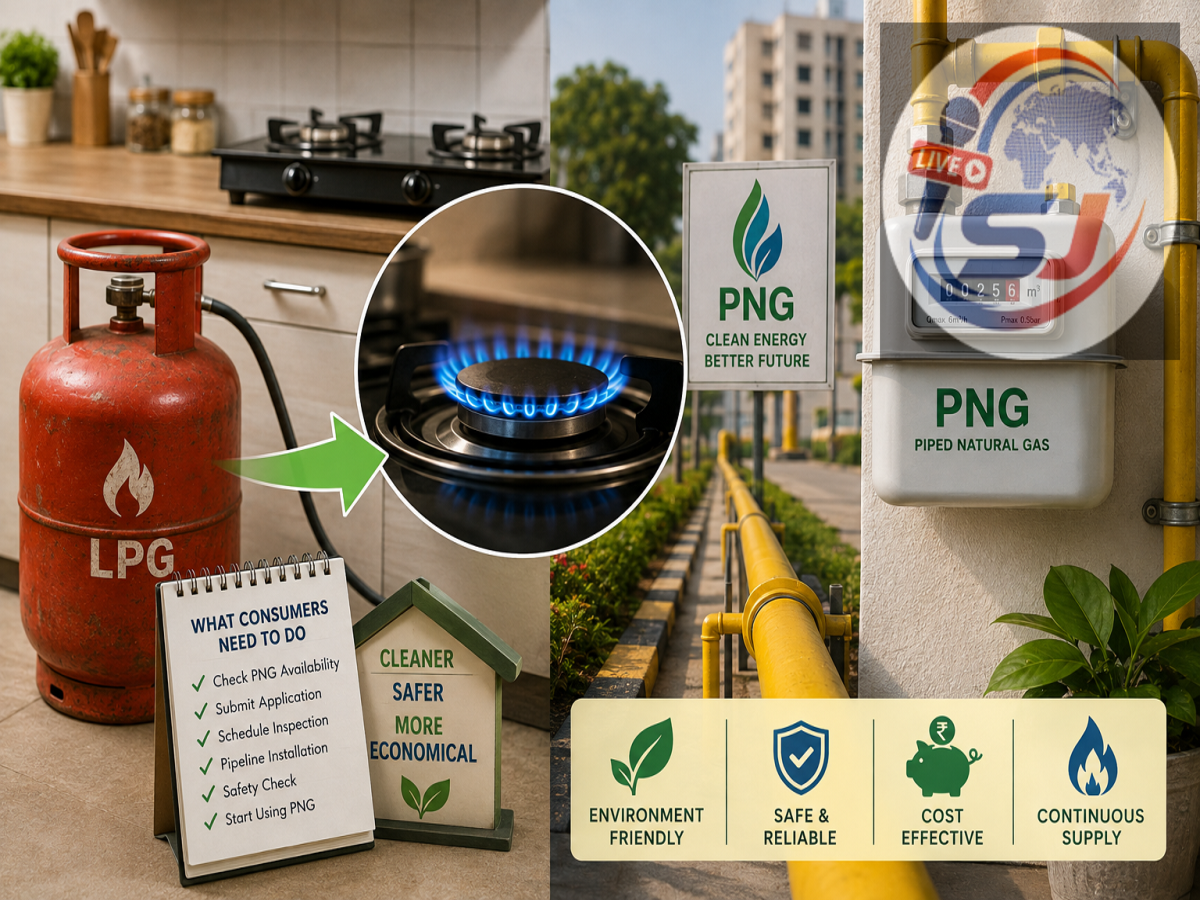
Households using LPG cylinders in areas where piped natural gas is already available may need to pay closer attention to new government rules. The Centre is accelerating its push to move domestic consumers from LPG to PNG in locations covered by city gas distribution networks, with states and Union Territories being asked to support the transition at the district level.
The move is aimed at expanding the use of piped gas, reducing the logistical burden of transporting LPG cylinders and making better use of the gas pipeline infrastructure already created across the country. The Petroleum Ministry has described PNG as a cleaner, safer and more efficient cooking fuel.
However, consumers should understand that the latest framework is more specific than simply asking everyone to immediately give up LPG. Rules introduced in 2026 deal particularly with households that already have both PNG and domestic LPG connections.
Government Wants Faster Shift From LPG to PNG
In an August 21 letter to the chief secretaries of states and Union Territories, Petroleum Secretary Neeraj Mittal sought district-level administrative support for faster adoption of domestic PNG.
States have been asked to facilitate coordination among city gas distribution companies, oil marketing companies and consumers. Appointment of nodal officers at the district level is also part of the effort to make implementation smoother.
The government believes that increasing PNG consumption in areas where pipelines are already available will improve the utilisation of gas infrastructure and reduce dependence on cylinder-based distribution.
Can You Keep Both LPG and PNG Connections?
This is one of the most important questions for consumers.
An amendment to the LPG Control Order notified in March 2026 introduced restrictions on retaining a domestic LPG connection while also having a PNG connection. Under the amended framework, consumers with PNG connections are restricted from continuing to take domestic LPG refills in the manner permitted earlier.
The government subsequently introduced another amendment in May to make the transition more convenient for consumers. Under those provisions, a domestic LPG consumer who obtains PNG can apply to terminate the LPG connection or obtain a transfer voucher that can be used to restore the LPG connection later if the person moves to an area where PNG is unavailable.
This provision can be especially useful for tenants, transferable employees, students and families that may shift between cities.
Will Your LPG Connection Be Automatically Cancelled?
Consumers should be careful with claims suggesting that every LPG connection in a PNG-covered locality will automatically disappear without any process.
The current policy is clearly intended to discourage households from maintaining active LPG and PNG connections simultaneously where piped gas is available. But implementation involves coordination among oil marketing companies, city gas distributors and local authorities.
Consumers who receive an official communication regarding migration should follow the instructions within the specified timeline and contact their LPG distributor or city gas provider if they need clarification.
It is advisable not to rely on forwarded social media messages or unofficial notices while surrendering an LPG connection.
What Happens After You Get a PNG Connection?
Once PNG becomes operational at a household, the consumer may have to regularise the existing LPG connection according to the applicable rules.
The options introduced by the government include terminating the LPG connection or obtaining a transfer voucher for possible restoration in a non-PNG location later.
Before surrendering equipment or completing documentation, consumers should confirm the procedure with their authorised LPG distributor because the security deposit, cylinder and regulator may need to be handled according to the oil marketing company's rules.
Why Is the Government Promoting PNG?
There are several reasons behind the policy.
PNG is supplied directly to homes through pipelines, which eliminates the need to book and physically deliver cylinders. It can also reduce transportation and distribution requirements for oil marketing companies.
The government has been expanding city gas distribution infrastructure and wants households in connected areas to actually use the pipelines created through substantial public and private investment.
Another objective is energy security. India's LPG supply chain can be affected by developments in international energy markets because the country depends significantly on imported energy.
Middle East Supply Concerns Have Added Urgency
The recent push has also come against the backdrop of disruptions and uncertainty in the Middle East.
Reports on the government's initiative have linked the accelerated LPG-to-PNG transition to concerns about LPG supply pressures arising from disruptions around the Strait of Hormuz, an important energy shipping route.
Reducing the logistical burden associated with LPG and increasing the use of domestic gas distribution infrastructure can provide policymakers with greater flexibility during periods of international supply uncertainty.
That said, the LNG and natural gas markets themselves are also internationally connected, so PNG should not be viewed as completely insulated from global energy developments.
Pipeline Expansion Is Also Being Accelerated
The Centre has taken separate steps to make it easier to expand gas pipelines.
In March 2026, the government notified the Natural Gas and Petroleum Products Distribution (Through Laying, Building, Operation and Expansion of Pipelines and Other Facilities) Order, 2026.
The framework is intended to speed up approvals for pipeline infrastructure, address delays relating to land access and support faster last-mile expansion of PNG networks into residential areas.
This means the LPG-to-PNG policy is not limited to existing consumers; it is part of a broader effort to expand piped gas availability.
What Should LPG Consumers Do Now?
If PNG is not available in your locality, there is generally no reason to assume that you must immediately surrender your LPG connection merely because of the government's broader push.
If your house already has an operational PNG connection, however, you should check the latest requirements with your authorised LPG distributor and PNG provider.
Consumers should also preserve any transfer voucher or documentation issued while discontinuing an LPG connection because it may be useful if they later move to a location where piped gas is not available.
Most importantly, do not surrender a cylinder or make any payment on the basis of an unsolicited phone call, WhatsApp message or unofficial link.
LPG-to-PNG Rules Are Changing How Cooking Gas Is Delivered
The Centre is clearly moving towards wider adoption of piped natural gas in urban areas where infrastructure is available. States are being asked to support the transition, pipeline approvals are being accelerated and rules have been tightened around simultaneously maintaining active PNG and LPG connections.
For households, the biggest practical change is that having both services active may no longer be permitted in the same way as before.
Consumers who already have PNG should therefore verify their LPG status and complete the official process if required. Those without access to PNG should continue following the rules applicable to their existing LPG connection until piped gas becomes available in their area.
Disclaimer: This article is intended for general information. LPG and PNG regulations, implementation timelines and consumer procedures may change. Consumers should verify the latest instructions from the Ministry of Petroleum and Natural Gas, their authorised oil marketing company and local city gas distributor before taking action.