Lakhpati Didi Scheme: Rural Women Can Build Annual Income of ₹1 Lakh, Know Eligibility and How to Get Started
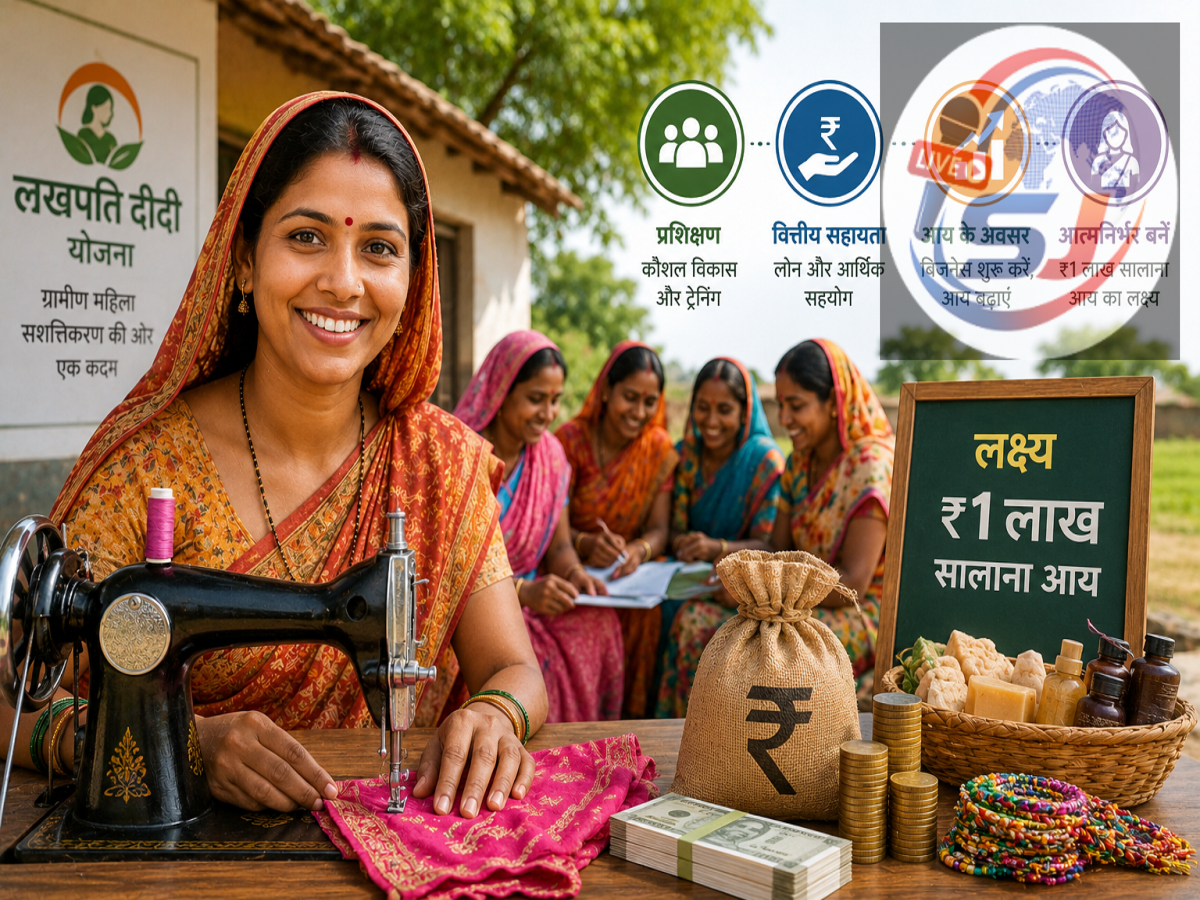
For millions of women living in rural India, financial independence does not necessarily mean finding a salaried job. Dairy farming, agriculture, food processing, tailoring, handicrafts and small local businesses can also become reliable sources of income. The Lakhpati Didi initiative has been designed around this idea by helping women associated with Self-Help Groups (SHGs) develop sustainable livelihood opportunities.
One important point needs to be understood clearly: Lakhpati Didi is not a scheme under which the government simply deposits ₹1 lakh into every woman's bank account. Instead, the initiative aims to help eligible rural women build sustainable livelihoods that can generate an annual household income of at least ₹1 lakh.
Training, access to finance, skill development, technology, market linkages and support through different government programmes form an important part of this model.
What Is the Lakhpati Didi Initiative?
The Lakhpati Didi initiative is closely linked with the Deendayal Antyodaya Yojana–National Rural Livelihoods Mission (DAY-NRLM).
The programme focuses on women who are part of the rural Self-Help Group network and seeks to strengthen their income-generating activities.
The objective is not merely to help a woman earn well for one month or during a particularly successful season. The emphasis is on creating a livelihood that remains economically sustainable across multiple business or agricultural cycles.
A woman recognised as a Lakhpati Didi is expected to achieve an annual household income of ₹1 lakh or more on a sustainable basis.
Does the Government Give ₹1 Lakh Directly?
No. This is one of the most important facts for applicants to understand.
The term "Lakhpati Didi" can sometimes create the impression that every eligible woman receives ₹1 lakh as direct financial assistance. That is not how the initiative works.
Instead, the government and rural livelihood network work towards helping SHG women increase their income through suitable economic activities.
Depending on the activity and available programmes, assistance may include skill training, access to institutional credit, financial literacy, technical support and opportunities to connect products with larger markets.
The ₹1 lakh figure represents an income target, not a universal cash grant.
Who Can Become a Lakhpati Didi?
The initiative primarily focuses on rural women associated with Self-Help Groups under the rural livelihood mission framework.
Therefore, joining or being associated with the local SHG network is an important starting point.
Women can potentially undertake different livelihood activities depending on their skills, local resources and market opportunities.
For example, a woman involved in dairy farming may be supported in improving livestock management, arranging finance, improving productivity and finding better markets for milk and related products.
Similarly, women producing pickles, spices, papad, handicrafts, garments or other locally made products can receive support aimed at improving production, packaging, business management and market access.
How Can Women Reach the ₹1 Lakh Annual Income Target?
The Lakhpati Didi model encourages women to create sustainable sources of income instead of depending entirely on a single activity.
A rural household, for example, may combine farming with dairy, poultry, food processing or another micro-enterprise.
This diversification can reduce the risk of income falling sharply if one activity performs poorly.
The programme's broader approach is based on combining skills, finance, technology, market access and convergence with other government schemes.
Therefore, the goal is not simply to provide a short training course. Women are expected to receive support that can help them turn their skills and available resources into viable economic activities.
What Types of Businesses Can Women Start?
The livelihood activity can vary significantly depending on the village, market demand, available resources and the woman's skills.
Possible activities can include:
-
Dairy and livestock farming
-
Poultry and goat rearing
-
Agriculture and allied activities
-
Vegetable and fruit cultivation
-
Food processing
-
Pickle, papad and spice production
-
Tailoring and garment-related work
-
Handicrafts and handmade products
-
Local retail and service businesses
-
Other suitable micro-enterprises
There is no single business model that every Lakhpati Didi must follow. The focus is on identifying an activity capable of generating stable income.
Why Are Self-Help Groups Important?
Self-Help Groups form the backbone of the initiative.
SHGs allow rural women to organise themselves into small groups, develop regular saving habits and improve their access to formal banking and credit facilities.
The group network can also make it easier for women to access training, business guidance and information about government programmes.
For women who have never operated a business before, an SHG can provide a support system where they can learn from other members and gradually develop financial and entrepreneurial skills.
How to Apply for the Lakhpati Didi Initiative
Unlike some government schemes, there may not be a simple nationwide application process where every woman fills out one form and receives a fixed amount.
A rural woman interested in becoming a Lakhpati Didi should generally begin by connecting with her local Self-Help Group and the DAY-NRLM network.
She can contact her SHG, Village Organisation, Cluster Level Federation or officials associated with the State Rural Livelihood Mission in her area.
Information about the initiative is also available through the government's official Lakhpati Didi platform.
Women who are not currently members of an SHG can first enquire about joining an eligible Self-Help Group operating in their village.
Training Plays a Major Role
One of the most important parts of the initiative is identifying the right livelihood opportunity for each woman.
Simply providing finance may not be enough if the beneficiary does not have the necessary technical or business skills.
Training can therefore cover areas such as production, livestock management, financial literacy, enterprise development, packaging, marketing and the use of relevant technology.
The exact support can differ depending on the livelihood activity and programmes available in a particular state or district.
Access to Finance Can Help Expand a Business
A small enterprise often needs working capital to purchase raw materials, equipment, livestock or other inputs.
SHGs and the rural livelihood ecosystem can help eligible women improve access to institutional finance and other financial support mechanisms.
However, women should carefully understand the terms of any loan before borrowing. A loan should not be confused with a government grant.
Borrowing should ideally be linked to a realistic business plan that has the potential to generate sufficient income for repayment as well as household earnings.
Market Linkages Are Equally Important
Producing a good product is only half the challenge. Women also need customers.
For this reason, market linkage is an important element of the Lakhpati Didi approach.
A woman making spices, handicrafts or processed foods may be able to earn more if her products move beyond a limited village market.
Better packaging, branding, participation in exhibitions and fairs, digital selling opportunities and connections with organised markets can potentially help an SHG enterprise reach more customers.
Millions of Rural Women Are Part of the SHG Ecosystem
The Lakhpati Didi initiative operates within the much larger DAY-NRLM ecosystem, which has organised crores of rural households through lakhs of Self-Help Groups across the country.
The scale is significant because the initiative is not focused only on providing temporary financial relief. Its broader objective is to enable women to establish sustainable livelihoods and strengthen their participation in the rural economy.
As women begin generating their own income, the impact can extend beyond the individual business. It can potentially improve household savings, children's education, financial decision-making and the family's ability to deal with unexpected expenses.
What Should Women Remember Before Getting Started?
The most important thing is to avoid misleading claims promising an instant ₹1 lakh government payment under the name of Lakhpati Didi.
The initiative is fundamentally about helping SHG women build sustainable annual income of ₹1 lakh or more, rather than distributing the same amount as a one-time benefit.
Women interested in participating should contact their local SHG or rural livelihood mission officials, identify a suitable livelihood activity and understand what training, finance and market support may be available.
With the right combination of skills, financial planning and market access, a small village enterprise can grow into a dependable source of income. That sustainable economic opportunity—not a one-time cash payment—is the central idea behind the Lakhpati Didi initiative.