
KVIC Schemes 2026: How Khadi and Village Industries Support Rural Jobs, Traditional Crafts and Small Businesses
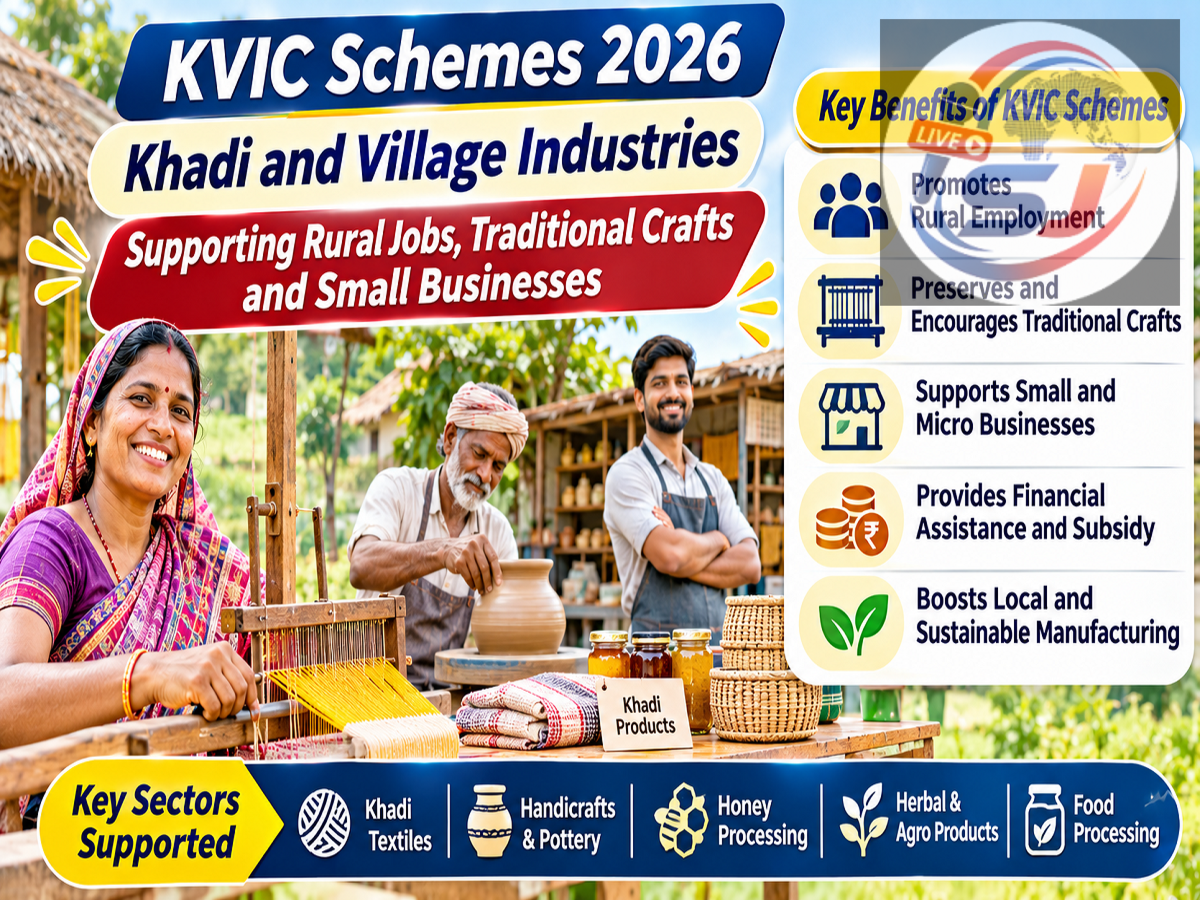
KVIC Schemes 2026: The Ministry of Micro, Small and Medium Enterprises (MSME) has highlighted the important role of the Khadi and Village Industries Commission (KVIC) in strengthening rural communities, supporting traditional craftsmanship and encouraging entrepreneurship across India.
In an official social media communication shared on November 4, 2026, the ministry emphasized KVIC's contribution to empowering rural communities while preserving India's rich heritage of traditional skills.
The initiative reflects the government's broader focus on promoting self-employment, supporting village-based industries and creating economic opportunities through the MSME sector.
From khadi production and traditional handicrafts to small manufacturing activities, KVIC supports efforts to strengthen rural livelihoods and encourage local enterprise development.
What Is the Khadi and Village Industries Commission?
The Khadi and Village Industries Commission is a statutory organization established under the Khadi and Village Industries Commission Act, 1956.
It functions under the Ministry of Micro, Small and Medium Enterprises, Government of India.
KVIC works to promote and develop khadi and village industries, particularly in rural areas.
Its activities focus on supporting employment opportunities, encouraging traditional skills and helping village-based enterprises become economically sustainable.
The organization also contributes to the promotion of khadi products and the development of local production networks.
Through various programmes, KVIC seeks to connect traditional craftsmanship with modern business opportunities.
Government Highlights KVIC's Role in Rural Development
The Ministry of MSME's latest communication emphasizes two important aspects of KVIC's work: empowering rural communities and nurturing India's traditional craftsmanship.
Many rural households depend on small-scale production, agriculture-related activities, handicrafts and other local enterprises for their livelihoods.
Supporting these activities can help diversify income opportunities and encourage entrepreneurship beyond major urban centres.
KVIC's programmes aim to strengthen the economic potential of village industries while preserving skills passed down through generations.
The ministry's announcement is an awareness message about KVIC's role. It does not announce a new recruitment drive, a fresh subsidy amount or a separate application deadline.
How Does KVIC Help Generate Rural Employment?
Village industries can create employment opportunities close to people's homes.
This can be particularly important in areas where access to large industrial establishments or formal employment opportunities is limited.
KVIC supports activities associated with khadi production, village industries and eligible rural enterprises.
These activities may involve spinning, weaving, processing, manufacturing, packaging, marketing and other business operations.
By supporting local enterprises, KVIC contributes to efforts aimed at improving rural livelihoods.
The extent of employment generated depends on the individual programme, enterprise viability, market demand and implementation conditions.
Major KVIC-Related Programmes and Initiatives
Several government programmes and initiatives are associated with the development of khadi and village industries.
| Programme or initiative | Main objective |
|---|---|
| Prime Minister's Employment Generation Programme (PMEGP) | Support eligible new micro-enterprises through credit-linked assistance |
| Khadi Vikas Yojana | Promote and strengthen the khadi sector |
| Gramodyog Vikas Yojana | Support the development of village industries |
| Honey Mission activities | Encourage eligible beekeeping and honey-related livelihood activities |
| Traditional craft and production support | Strengthen relevant skills, production and enterprise development |
The availability of assistance depends on the current guidelines and eligibility requirements of each programme.
Not every applicant or enterprise qualifies for every benefit.
PMEGP: Financial Assistance for New Micro-Enterprises
The Prime Minister's Employment Generation Programme is an important credit-linked subsidy initiative implemented through the relevant government framework.
It aims to support eligible individuals and institutions in establishing new micro-enterprises.
Under PMEGP, financial assistance is linked to approved projects and bank financing, subject to programme rules.
The scheme covers eligible manufacturing and service-sector activities.
Applicants must satisfy the relevant age, eligibility, project cost, contribution and other conditions.
The subsidy percentage can differ according to beneficiary category and whether the project is located in a rural or urban area.
Importantly, PMEGP assistance is not an automatic cash grant available merely by registering a business.
Loan approval and subsidy eligibility depend on the prescribed verification and sanction process.
How Does KVIC Support Traditional Craftsmanship?
Traditional craftsmanship is an important part of India's cultural and economic heritage.
Many communities possess specialized skills in weaving, spinning, handmade products and village-based manufacturing.
KVIC's work aims to encourage the continued use and development of such skills.
Support may include training, improved production practices, enterprise development and market-related assistance under applicable programmes.
These efforts can help traditional producers adapt to changing consumer preferences while maintaining the distinctive character of their products.
However, the support available to individual artisans depends on the specific scheme and its eligibility conditions.
Why Is Khadi Important for India's Rural Economy?
Khadi is closely associated with India's history, self-reliance and traditional textile production.
It is generally produced through hand-spinning and hand-weaving processes, subject to the applicable definitions and standards.
Khadi-related activities can provide livelihood opportunities across different stages of production and distribution.
These may include yarn preparation, spinning, weaving, processing, tailoring and retailing.
The sector also offers opportunities for product development and marketing.
Promoting khadi can help sustain traditional skills while supporting economic activity in rural communities.
Can Women Entrepreneurs Benefit From KVIC Programmes?
Women entrepreneurs and self-help groups may be eligible to participate in various government-supported enterprise development initiatives.
Depending on the scheme, eligible women applicants may receive access to training, credit-linked assistance or other support mechanisms.
PMEGP, for example, includes provisions for special categories of beneficiaries under its applicable guidelines.
However, eligibility, subsidy rates and project conditions must be verified through the official programme documentation.
Women interested in starting small businesses should review the relevant scheme requirements and evaluate the financial viability of their proposed enterprise.
How to Apply for KVIC-Related Schemes
The application process depends on the specific programme.
For example, applicants interested in PMEGP can access the official online application facilities through the designated government portal.
The general process may involve:
-
Visiting the official KVIC or relevant scheme website.
-
Selecting the applicable programme.
-
Reading the eligibility and application instructions.
-
Preparing the required project or business information.
-
Completing the online application where available.
-
Uploading the prescribed documents.
-
Submitting the application for the relevant verification and approval process.
Applicants should use only official portals and authorized channels.
The Ministry of MSME's latest communication does not announce a new common application process for all KVIC schemes.
What Documents May Be Required?
Document requirements vary by programme.
Applicants seeking enterprise-related assistance may need identification, address information, educational details where applicable, project reports and bank-related documents.
Certain schemes may also require category certificates, business information or other supporting records.
The exact checklist should be obtained from the official scheme guidelines.
Submitting an application does not guarantee financial assistance or approval.
Where Can Entrepreneurs Get Official Information?
Entrepreneurs, artisans and rural business owners can obtain information from the official KVIC and Ministry of MSME websites.
KVIC Official Website: https://www.kvic.gov.in/
Ministry of MSME: https://msme.gov.in/
PMEGP Official Portal: https://www.kviconline.gov.in/pmegpeportal/
Applicants should verify scheme availability, eligibility conditions and application procedures before making financial commitments.
They should also avoid unauthorized agents promising guaranteed loans or subsidies in exchange for advance payments.
KVIC Update 2026: Important Message for Rural Entrepreneurs
The Ministry of MSME's latest communication highlights the Khadi and Village Industries Commission's continuing role in promoting rural entrepreneurship and preserving traditional craftsmanship.
KVIC supports efforts to strengthen village industries, encourage self-employment and develop opportunities for artisans and small business owners.
The awareness message does not announce a new nationwide financial benefit, a recruitment notification or a fresh deadline for scheme applications.
Rural entrepreneurs and artisans interested in KVIC-supported programmes should consult the official websites to identify suitable schemes and understand the applicable eligibility requirements.
By supporting traditional production and village-based enterprises, KVIC contributes to efforts aimed at strengthening local economies and sustaining India's craft heritage.
Source Credit: Ministry of Micro, Small and Medium Enterprises, Government of India — Official Communication on the Khadi and Village Industries Commission, November 4, 2026.
Original Source: https://x.com/minmsme/status/2117887443982753997
KVIC Official Website: https://www.kvic.gov.in/
Ministry of MSME: https://msme.gov.in/