
Kisan Vikas Patra: Invest From ₹1,000 and Double Your Money in 115 Months, Check KVP Rules
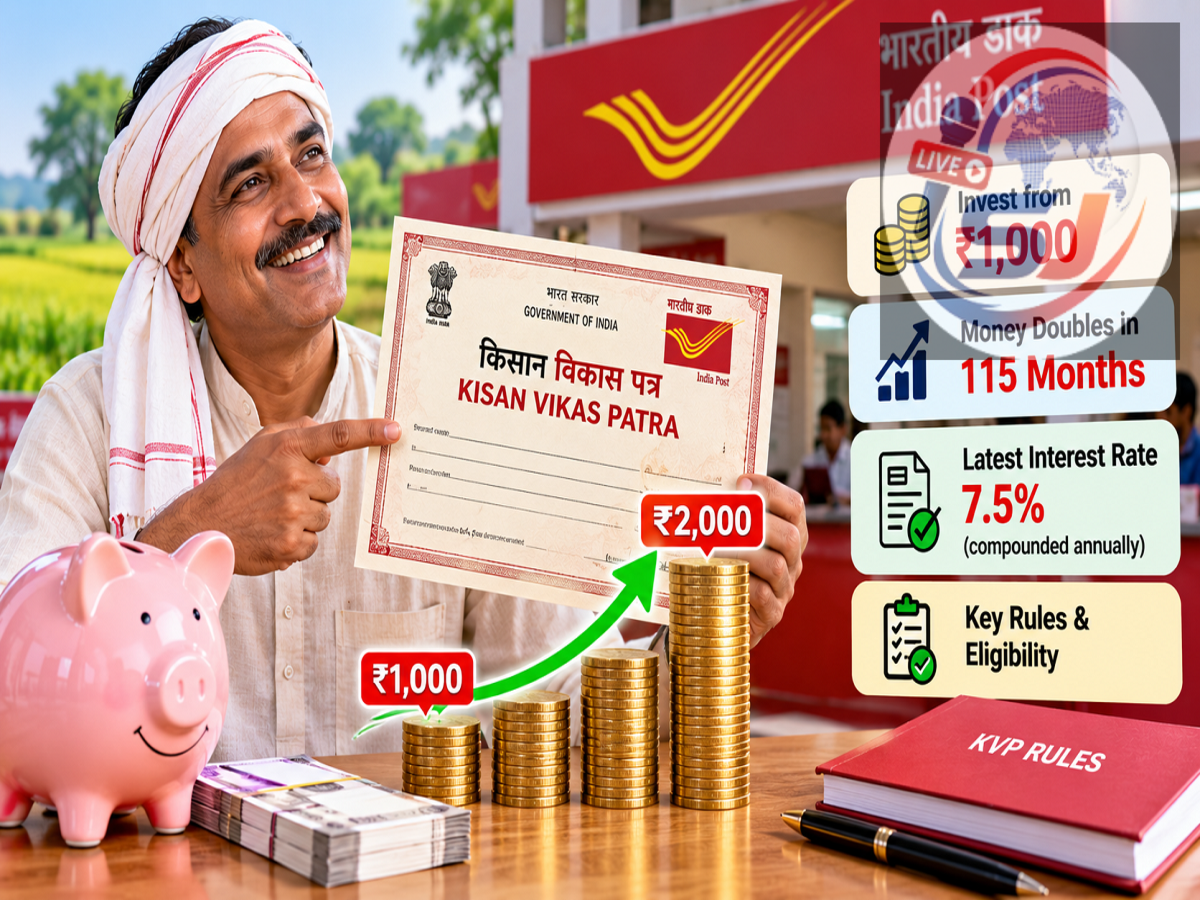
People looking for a government-backed savings option with predictable returns can consider Kisan Vikas Patra (KVP), a popular small savings scheme available through post offices. Despite having the word "Kisan" in its name, the scheme is not restricted only to farmers. Eligible individuals can invest in KVP according to the prescribed rules.
For the October-December 2026 quarter, the KVP interest rate has been kept at 7.5% per annum, according to the information provided. At this rate, the amount invested in the scheme doubles on maturity in 115 months, equivalent to 9 years and 7 months.
Another notable feature is its relatively low entry point. An investment can be started with ₹1,000, while there is no prescribed maximum investment ceiling. However, investors should also understand the lock-in, taxation and premature closure rules before putting money into the scheme.
What Is Kisan Vikas Patra?
Kisan Vikas Patra is part of the government's small savings schemes and is designed for people who want to invest a lump sum for the long term.
Unlike market-linked investments, KVP does not depend on daily movements in the stock market. Its maturity value is determined according to the interest rate and maturity period applicable to the investment.
At the stated 7.5% annual interest rate, an investment made under the current terms reaches twice its original value after 115 months.
This makes the scheme relatively straightforward for investors who want to know the maturity value in advance.
How Does Money Double in KVP?
The easiest way to understand KVP is through examples.
If an individual invests ₹1 lakh, the amount would grow to approximately ₹2 lakh at maturity under the applicable doubling period.
Similarly:
₹50,000 investment → approximately ₹1 lakh at maturity
₹1 lakh investment → approximately ₹2 lakh at maturity
₹2 lakh investment → approximately ₹4 lakh at maturity
₹5 lakh investment → approximately ₹10 lakh at maturity
These examples assume the applicable KVP terms under which the investment doubles in 115 months.
It is important to understand that the money does not double quickly. Investors need to remain invested for 9 years and 7 months to reach the stated maturity value.
KVP Interest Rate for October-December 2026
The government periodically reviews interest rates applicable to small savings schemes.
For the October-December 2026 quarter, KVP continues to offer an annual interest rate of 7.5%, according to the stated scheme information.
At this rate, the maturity period required to double an investment remains 115 months.
Investors opening a KVP account in the future should check the interest rate and maturity terms applicable at that time because the government can revise small savings rates for subsequent quarters.
Start Investing With Just ₹1,000
KVP does not require a very large initial investment.
An account can be opened with a minimum investment of ₹1,000, with additional investment permitted in the prescribed denominations.
There is no specified upper investment limit under the scheme. This means an investor can put in a larger amount depending on their financial capacity and long-term savings goals.
However, large investments may be subject to applicable documentation and regulatory requirements. Investors should therefore complete the necessary KYC and other formalities prescribed for the amount they intend to invest.
Is KVP Only for Farmers?
No. The name "Kisan Vikas Patra" sometimes creates the impression that only farmers are eligible to invest, but the scheme is not exclusively meant for people working in agriculture.
Eligible individuals can invest in KVP irrespective of whether they are farmers, salaried employees, self-employed individuals or engaged in another profession.
Therefore, KVP can be considered by a broader category of investors looking for a government-backed long-term savings instrument.
Can You Open a Joint KVP Account?
KVP provides different account-holding options under the applicable rules.
An eligible adult can open an account individually, while joint-account facilities are also available.
An account can also be opened on behalf of a minor by a parent or legal guardian, subject to the scheme's requirements.
Nomination facilities are available as well, helping account holders specify who should receive the proceeds in the event of their death.
Can You Withdraw KVP Money Before Maturity?
KVP is primarily designed as a long-term savings product, so investors should not treat it like an ordinary savings account where money can be withdrawn whenever required.
Under the normal premature-closure provisions, the investment generally becomes eligible for premature closure after 2 years and 6 months, subject to the applicable scheme rules.
Certain exceptional circumstances may have separate provisions.
Because liquidity is limited, investors should consider whether they might need the invested money for emergencies or short-term expenses before choosing KVP.
Can KVP Be Used as Security for a Loan?
Another feature of Kisan Vikas Patra is that it may be pledged or transferred as security under prescribed conditions.
This can allow the certificate to be used as collateral in eligible cases, subject to the rules and acceptance by the concerned institution.
Investors considering this facility should check the applicable Post Office and lender requirements before relying on KVP as loan security.
Does KVP Offer Section 80C Tax Benefits?
Taxation is an important consideration before investing.
Investment in Kisan Vikas Patra does not qualify for the commonly available deduction under Section 80C merely because money has been invested in the scheme.
The interest earned from KVP is also taxable according to the applicable income-tax rules and the investor's circumstances.
Therefore, investors should not choose KVP solely because it is a government small savings scheme and assume that it automatically provides tax-free returns.
Its post-tax return should be considered when comparing it with other investment choices.
Is Kisan Vikas Patra Right for You?
KVP can appeal to investors who prioritise a government-backed savings product, predictable maturity value and long-term wealth accumulation without direct stock-market exposure.
At the current stated rate of 7.5%, money doubles in 115 months, while the minimum investment starts at just ₹1,000.
However, the long maturity period, limited early liquidity and taxable interest should also be considered.
Before investing, compare KVP with alternatives such as Post Office Time Deposits, National Savings Certificates (NSC), Public Provident Fund (PPF), bank fixed deposits and other products based on your financial goals.
Most importantly, check the latest official interest rate, premature-closure rules, tax treatment and eligibility conditions before investing, as government small savings rules and rates can change over time.