
Indian Bank FD Rates Hiked: Check Returns on ₹10 Lakh Investment for 777 Days at 6.75% Interest
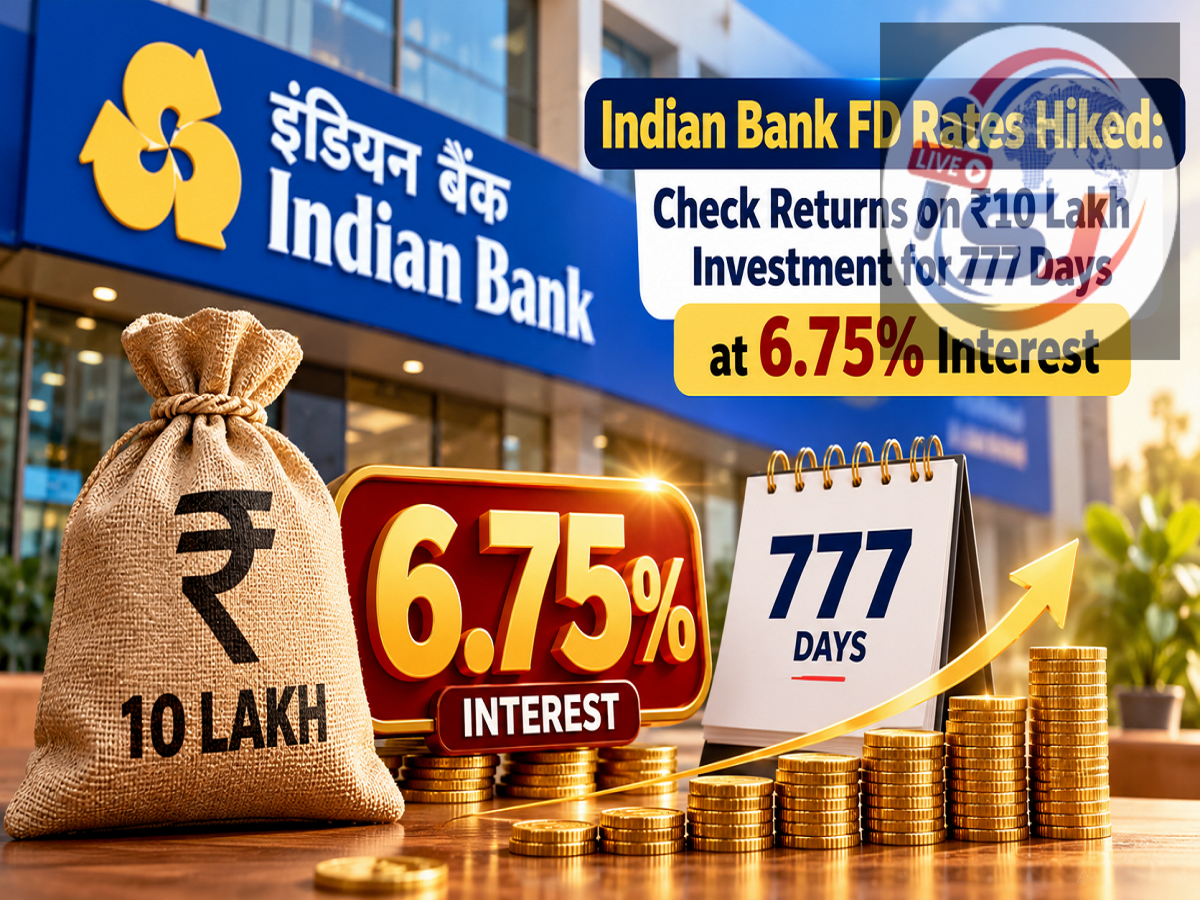
Indian Bank Fixed Deposit Update 2026: Fixed deposits continue to attract investors looking for predictable returns and relatively low-risk savings options. In a development for depositors, public sector lender Indian Bank has reportedly increased the interest rate on its special 777-day fixed deposit scheme, known as Ind Prosper.
According to the October 24, 2026 report, the bank has raised the interest rate on this deposit scheme by 15 basis points, taking it from 6.60% to 6.75% per annum for eligible general customers.
Senior citizens are reportedly eligible for an additional 0.50 percentage points, bringing their annual interest rate to 7.25%.
The revision comes amid changing interest rate conditions in India's banking sector. For individuals planning to invest ₹10 lakh in a fixed deposit, the revised rates could provide higher maturity proceeds than the previous interest structure.
However, the actual amount received at maturity depends on the interest calculation method, compounding frequency, deposit conditions and applicable taxes.
Indian Bank Ind Prosper FD: What Has Changed?
The Ind Prosper scheme is a special-tenure fixed deposit product with a maturity period of 777 days, equivalent to approximately two years and one month.
Unlike regular fixed deposits that offer several maturity options, this scheme focuses on a specific investment duration.
The reported rate revision provides an additional 0.15 percentage points of annual interest compared with the earlier rate.
Here is a comparison of the revised interest rates.
| Depositor Category |
Previous Rate |
Revised Rate |
Increase |
|---|---|---|---|
| General customers |
6.60% |
6.75% |
0.15 percentage points |
| Senior citizens |
7.10%* |
7.25% |
0.15 percentage points |
*The previous senior citizen rate assumes the same 0.50 percentage-point premium applied to the earlier general rate. Current eligibility and rates should be confirmed with Indian Bank.
A rise of 15 basis points may appear modest, but it can increase interest earnings, especially for customers investing larger amounts.
Indian Bank FD Calculator: How Much Will ₹10 Lakh Earn in 777 Days?
Suppose an investor deposits ₹10,00,000 in the 777-day scheme at the reported annual interest rate of 6.75%.
Under a simple-interest calculation, the estimated interest can be determined using the following formula:
\[ \text{Interest}=\frac{P\times R\times T}{100} \]
Here, P represents the principal, R is the annual interest rate, and T is the investment duration in years.
For a 777-day deposit, the investment period is approximately 2.13 years.
Using this calculation, a ₹10 lakh deposit would generate approximately ₹1.44 lakh in interest before taxes, bringing the estimated maturity value to around ₹11.44 lakh.
If the deposit earns interest through quarterly compounding, the maturity amount would be higher because interest is periodically added to the principal.
The exact proceeds should be verified using the bank's official deposit calculator.
Senior Citizens Can Earn Higher Interest on the Same Deposit
Senior citizens generally receive preferential fixed deposit interest rates from several Indian banks, subject to eligibility conditions.
Under the reported Ind Prosper rate structure, eligible senior citizens receive 7.25% annual interest, compared with 6.75% for general customers.
This additional return can be useful for retired individuals who depend on savings and interest income to meet regular financial needs.
For example, a senior citizen investing ₹10 lakh for 777 days at 7.25% would earn more interest than a general depositor investing the same amount for the same duration.
The difference becomes more noticeable when interest is compounded.
Nevertheless, investors should confirm the applicable senior citizen eligibility criteria, premature withdrawal provisions and maturity payment conditions before opening the deposit.
Estimated Returns on ₹10 Lakh: General vs Senior Citizen FD
The following comparison uses the reported interest rates and a 777-day deposit period. Figures are illustrative, before tax, and assume quarterly compounding for cumulative deposits.
| Details |
General Customer |
Senior Citizen |
|---|---|---|
| Investment amount |
₹10,00,000 |
₹10,00,000 |
| Annual interest rate |
6.75% |
7.25% |
| Deposit duration |
777 days |
777 days |
| Estimated interest earned |
₹1,53,145 |
₹1,65,271 |
| Estimated maturity value |
₹11,53,145 |
₹11,65,271 |
Calculation assumes a 365-day year and quarterly compounding. The bank's actual maturity calculation may differ depending on its day-count conventions, compounding rules and product terms.
Calculate Your Own FD Returns
Investment amount (₹)
Depositor category
General customer — 6.75%
Senior citizen — 7.25%
Estimated maturity after 777 days
₹11,53,145
Principal
₹10,00,000
Interest earned
₹1,53,145
Illustrative calculator based on reported rates and quarterly compounding, not an official Indian Bank quotation.
How Does the RBI Repo Rate Affect Fixed Deposit Returns?
Changes in the Reserve Bank of India's monetary policy can influence deposit and lending rates across the banking system.
When the RBI increases its benchmark repo rate, borrowing costs for banks may rise. Banks may respond by revising their lending and deposit rates, although the timing and extent of such changes vary.
A higher fixed deposit rate can benefit savers because it allows them to earn more interest on newly opened deposits.
However, an increase in the repo rate does not guarantee that every bank will immediately raise its FD rates.
Banks consider liquidity requirements, competition, deposit mobilisation targets and funding costs when deciding interest rates.
For investors, comparing available deposit products becomes especially important during periods of changing monetary policy.
Is Interest Earned From Indian Bank FD Taxable?
Interest income from fixed deposits is generally taxable under the Income Tax Act.
For most individual taxpayers, FD interest is included under the head "Income from Other Sources" and taxed according to the applicable income tax slab.
For example, someone falling into a higher tax bracket may have a larger tax liability on FD interest than an individual in a lower bracket.
Banks may also deduct tax at source (TDS) when interest payments or credits cross the applicable statutory threshold.
Eligible depositors may submit the prescribed declaration, such as Form 15G or Form 15H, where permitted, to request non-deduction of TDS.
However, avoiding TDS does not automatically mean the interest income is exempt from tax.
Senior citizens may qualify for certain deductions or benefits under applicable income tax provisions, depending on their chosen tax regime and eligibility.
Investors should calculate their expected post-tax returns before committing substantial amounts to fixed deposits.
Is Indian Bank's 777-Day FD a Suitable Savings Option?
A fixed deposit may appeal to investors who prefer a defined maturity period and predictable interest earnings instead of market-linked returns.
The 777-day tenure could be suitable for individuals who do not require immediate access to their savings and have a financial goal approximately two years away.
However, depositors should also consider liquidity requirements.
Withdrawing money before maturity may attract penalties or result in a lower applicable interest rate, depending on the bank's terms.
Bank deposits are also subject to deposit insurance limits. In India, eligible deposits are insured by the Deposit Insurance and Credit Guarantee Corporation (DICGC) up to ₹5 lakh per depositor per bank, including principal and interest, subject to applicable rules.
Therefore, investors placing ₹10 lakh or more in one bank should understand the insurance coverage and consider their overall financial risk.
How to Open an Indian Bank Fixed Deposit
Customers interested in the Ind Prosper scheme can check the bank's official website or visit a nearby Indian Bank branch.
Existing customers may also be able to open eligible term deposits through the bank's digital banking services.
Before investing, depositors should verify the current interest rate, deposit amount limits, maturity instructions, premature withdrawal conditions and whether the product offers cumulative or periodic interest payouts.
The official Indian Bank website is www.indianbank.in.
Final Takeaway
The reported increase in Indian Bank's 777-day Ind Prosper FD interest rate from 6.60% to 6.75% offers potentially higher returns for depositors looking for fixed-income savings options.
Eligible senior citizens could benefit further from the reported 7.25% annual rate.
Based on illustrative quarterly compounding, a ₹10 lakh investment could grow to approximately ₹11.53 lakh for general customers and ₹11.65 lakh for senior citizens over 777 days, before taxes.
Investors should confirm the revised rates and actual maturity values with Indian Bank before opening a deposit. They should also compare post-tax returns, withdrawal flexibility and deposit insurance coverage before making a decision.
Disclaimer: The interest rate revision is based on the supplied October 24, 2026 report and has not been independently confirmed through a current Indian Bank rate circular. Calculations are illustrative and do not constitute personalised financial advice.