
ICICI Bank New Charges 2026: Cash Deposit, Withdrawal and Auto-Debit Fees to Change From December 1
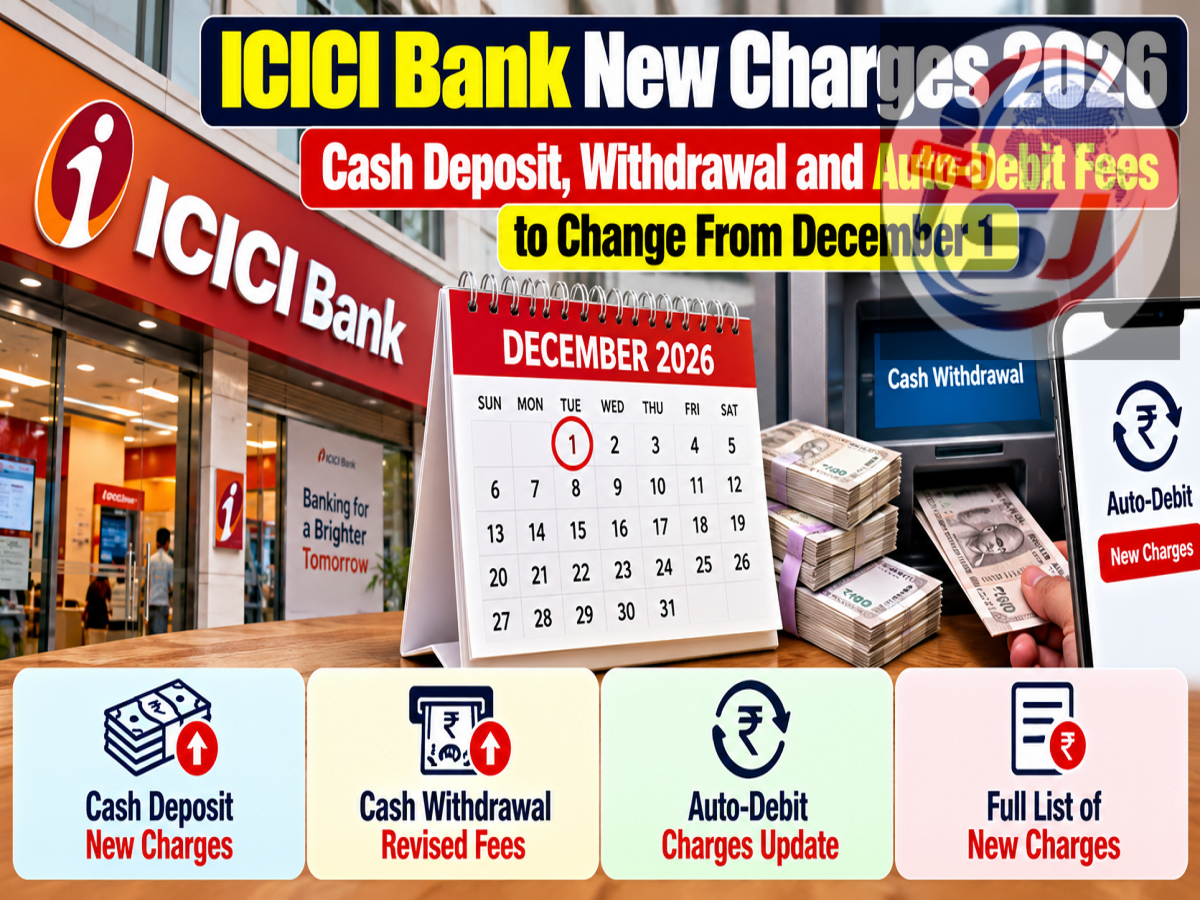
ICICI Bank Savings Account Charges 2026: ICICI Bank customers may need to review their banking habits as the private-sector lender is preparing to revise certain savings account service charges from December 1, 2026.
The changes reported on October 22 include higher charges for cash deposits and withdrawals beyond specified free limits, along with revised penalties for failed electronic debit transactions.
Customers who frequently visit bank branches to deposit or withdraw cash could face additional expenses if their transactions exceed the permitted monthly limits.
Similarly, account holders who use automatic payments for loan EMIs, insurance premiums or other recurring obligations should pay attention to the revised ECS and NACH debit return charges.
However, the changes do not mean that every savings account transaction will become chargeable.
Customers who remain within the applicable free transaction limits may continue to use the covered services without additional cash transaction charges.
Here is a detailed explanation of the proposed fee structure, its effective date and how customers can avoid unnecessary banking expenses.
ICICI Bank New Service Charges: When Will They Apply?
According to the reported revision, the updated service charges will become effective on December 1, 2026.
The changes primarily concern certain savings account categories and selected transaction types.
The revised charges include cash handling fees after the monthly free limits are exhausted and penalties for certain failed electronic debit instructions.
Customers should note that the precise fee structure may depend on their account variant and the bank's applicable schedule of charges.
Before December 1, account holders should review the official ICICI Bank service charges applicable to their savings account.
ICICI Bank Charges 2026: Key Changes at a Glance
| Service | Reported Revised Charge From December 1, 2026 |
|---|---|
| Effective Date | December 1, 2026 |
| Free Cash Transactions | Up to 3 Per Month for Covered Accounts |
| Monthly Free Cash Value Limit | Up to ₹1 Lakh |
| Cash Transactions Beyond Free Count | ₹150 Per Transaction |
| Cash Value-Based Charge Beyond Limit | ₹4 Per ₹1,000, Subject to Minimum ₹150 |
| Earlier Value-Based Charge | ₹3.50 Per ₹1,000 |
| First Financial ECS/NACH Debit Return | ₹500 |
| Second Financial Debit Return | ₹550 |
| Third Financial Debit Return | ₹550 |
The above charges are based on the reported changes for specified savings account categories. Customers should confirm account-specific conditions, applicable taxes and the method used to calculate excess transactions in the bank's official tariff.
Cash Deposit Charges to Increase From ₹3.50 to ₹4 Per ₹1,000
One of the important changes concerns cash deposits made through bank branches and supported cash recycler facilities.
For certain savings accounts, the value-based charge applicable after crossing the monthly cash transaction limit will reportedly increase from ₹3.50 to ₹4 for every ₹1,000.
The revised rate represents an increase of approximately 14.29% over the earlier per-₹1,000 charge.
However, the charge is not intended to apply automatically to every deposit.
The relevant free transaction and monthly value limits must first be considered.
Customers who regularly deposit substantial amounts of cash should pay particular attention to the revised tariff.
Cash Withdrawal Charges Will Also Change
The revised value-based charge will reportedly apply to eligible branch cash withdrawals after the applicable monthly limits are exceeded.
This means customers who frequently withdraw large amounts directly from a branch may face higher service fees.
For example, the revised rate of ₹4 per ₹1,000 would mathematically equal ₹400 on a chargeable amount of ₹1 lakh.
However, this does not mean every ₹1 lakh withdrawal will attract a ₹400 fee.
The actual charge depends on whether the transaction exceeds the relevant free limits, how the bank calculates chargeable value and whether any minimum or other conditions apply.
Customers should check the official tariff before estimating the fee on a particular transaction.
Three Free Cash Transactions Every Month
According to the report, covered savings accounts will continue to receive three free cash transactions per month.
The number-based charge becomes relevant when the customer exceeds the permitted monthly transaction count.
After the first three free transactions, a charge of ₹150 per additional transaction is reported.
For example, a customer making five chargeable-category cash transactions during a month could exceed the free count by two transactions.
At ₹150 per excess transaction, the count-based charges would amount to ₹300, assuming no additional value-based charge or other account-specific condition changes the calculation.
The bank's official schedule should be consulted to determine how count-based and value-based fees interact.
Monthly Cash Transaction Value Limit: ₹1 Lakh
The report also states that certain covered accounts will have a monthly free cash transaction value limit of ₹1 lakh.
Customers operating within both the permitted transaction count and value limits may avoid the additional charges covered by the revised tariff.
Once the applicable value threshold is exceeded, the revised charge of ₹4 per ₹1,000 may become relevant.
The reported minimum charge is ₹150.
This means the minimum fee can matter even when the calculated value-based charge is relatively small.
Illustrative Value-Based Fee Calculation
| Chargeable Cash Value | ₹4 Per ₹1,000 | Charge After ₹150 Minimum |
|---|---|---|
| ₹10,000 | ₹40 | ₹150 |
| ₹25,000 | ₹100 | ₹150 |
| ₹50,000 | ₹200 | ₹200 |
| ₹1,00,000 | ₹400 | ₹400 |
| ₹2,00,000 | ₹800 | ₹800 |
This table illustrates the reported value-based tariff only. It does not establish which portion of a particular customer's monthly transactions is chargeable. The bank's official terms determine the actual fee.
What Happens if Both Free Limits Are Exceeded?
Savings account holders should understand that banks may use more than one condition to determine cash transaction charges.
These conditions can include the number of monthly transactions and their total monetary value.
A customer may remain within the transaction count limit but exceed the value limit.
Another customer may conduct several smaller transactions and exceed the permitted count without crossing the total value threshold.
The applicable charge will depend on the bank's official rules for the relevant account type.
The reported revised tariff indicates a ₹150 transaction-based charge and a value-based charge of ₹4 per ₹1,000, subject to a minimum ₹150.
Customers should not assume that the two charges are always added together or that only one applies without reviewing the detailed schedule.
ECS and NACH Debit Return Charges Also Revised
Apart from cash transactions, ICICI Bank is reportedly changing penalties for certain unsuccessful electronic debit instructions.
The changes concern Electronic Clearing Service (ECS) and National Automated Clearing House (NACH) transactions.
These payment systems are commonly used for recurring payments, including loan EMIs, insurance premiums and other scheduled debits.
A debit return occurs when a scheduled payment instruction cannot be completed.
The report specifies that the revised penalties apply to returns caused by financial reasons.
One common example is insufficient funds in the account when the scheduled debit is attempted.
New ECS/NACH Debit Return Penalty From December 1
According to the reported tariff, the first financial debit return will attract a charge of ₹500.
The second and third financial debit returns will attract ₹550 each.
Revised Debit Return Charges
| Failed Debit Instance | Reported Charge |
|---|---|
| First Financial Return | ₹500 |
| Second Financial Return | ₹550 |
| Third Financial Return | ₹550 |
| Total for Three Returns | ₹1,600 |
The total of ₹1,600 is a mathematical illustration of three returns charged at the stated rates.
The report does not fully specify the period over which the first, second and third returns are counted or the treatment of further returns.
Customers should check the official tariff for those details.
Who Could Be Most Affected by the New Charges?
The revised fee structure may be particularly relevant to customers who rely heavily on physical banking services.
People who frequently deposit cash at branches, use cash recyclers or make repeated branch withdrawals should review their monthly transaction patterns.
Customers who use savings accounts for multiple automatic payments should also be cautious.
For example, someone with several loan EMIs and insurance premiums scheduled during the month may incur return charges if the account does not contain sufficient funds on the payment dates.
However, customers who stay within the free cash transaction limits and maintain adequate balances for recurring payments may avoid the reported additional charges.
Will Online Banking and UPI Transactions Become More Expensive?
The reported changes primarily concern specified cash transactions and certain failed electronic debit instructions.
They do not establish a general increase in charges for all UPI transfers, mobile banking payments or internet banking transactions.
Customers should avoid interpreting the revised cash handling tariff as a blanket fee on every digital payment.
Different banking services have separate terms and fee schedules.
For the latest charges, account holders should refer to ICICI Bank's official website.
How to Avoid Additional ICICI Bank Cash Transaction Charges
Customers can reduce the likelihood of unnecessary fees by reviewing how frequently they use cash banking services.
For instance, combining necessary cash deposits where practical may help reduce the number of transactions.
Keeping track of the monthly cash transaction value is also useful.
Customers who frequently exceed the limits should check whether their existing savings account variant remains appropriate for their banking requirements.
Digital banking options may be more convenient for eligible transactions, but customers should confirm their applicable charges and limits.
Importantly, transactions should never be structured to evade legal reporting or compliance requirements.
How to Avoid ECS and NACH Return Penalties
Failed automatic payments can result in bank charges and may also have consequences under the agreement with the lender or service provider.
Customers can take several precautions:
-
Maintain sufficient available funds before scheduled debit dates.
-
Keep a record of recurring EMI, insurance and subscription payments.
-
Review active auto-debit mandates periodically.
-
Set account balance and payment reminders.
-
Check whether a debit has been completed successfully.
-
Contact the bank or service provider promptly if a payment fails.
Customers should also remember that a bank's debit return charge may be separate from any late payment fee charged by a lender.
Repeated missed loan payments may affect the borrower's credit record, depending on the circumstances and reporting rules.
Are the New Charges Applicable to All ICICI Bank Savings Accounts?
Not necessarily.
The report refers to revisions affecting certain savings account categories.
Banks often maintain different schedules of charges for different products and customer segments.
Some accounts may offer different cash transaction allowances or other benefits.
Customers should therefore verify the tariff for their specific account variant rather than assuming that the same charges apply universally.
The relevant information may be available in the account's schedule of charges or through the bank's customer support channels.
Where to Check ICICI Bank's Official Service Charges
Customers can verify the latest account-related fees through ICICI Bank's official website.
Official Website: https://www.icicibank.com/
Look for the savings account schedule of charges, service charges or related account terms.
Before December 1, 2026, customers should check the revised tariff for their account category and confirm whether applicable GST or other charges are additional.
If any fee appears incorrect, they can request an explanation from the bank through its authorised grievance or customer service channels.
Final Word
ICICI Bank is reportedly preparing to revise certain savings account service charges from December 1, 2026.
The changes include an increase in the value-based cash transaction fee from ₹3.50 to ₹4 per ₹1,000 after applicable limits are crossed.
Covered accounts will reportedly continue to receive three free cash transactions and a monthly free cash value allowance of ₹1 lakh, subject to account-specific terms.
The bank is also expected to apply revised financial ECS/NACH debit return penalties of ₹500 for the first return and ₹550 for the second and third returns.
Customers who frequently use branch cash services or automatic payments should review their account terms before December 1 to understand the potential impact.
Disclaimer: This article is based on reported service charge revisions dated October 22, 2026. The detailed official tariff has not been independently verified here. Actual fees, limits, counting rules and applicable taxes may vary by account category. Customers should consult ICICI Bank's official schedule of charges for binding information.