
How to Open an NPS Account Online in 2026: Step-by-Step Guide, Tier 1 vs Tier 2 and Tax Benefits
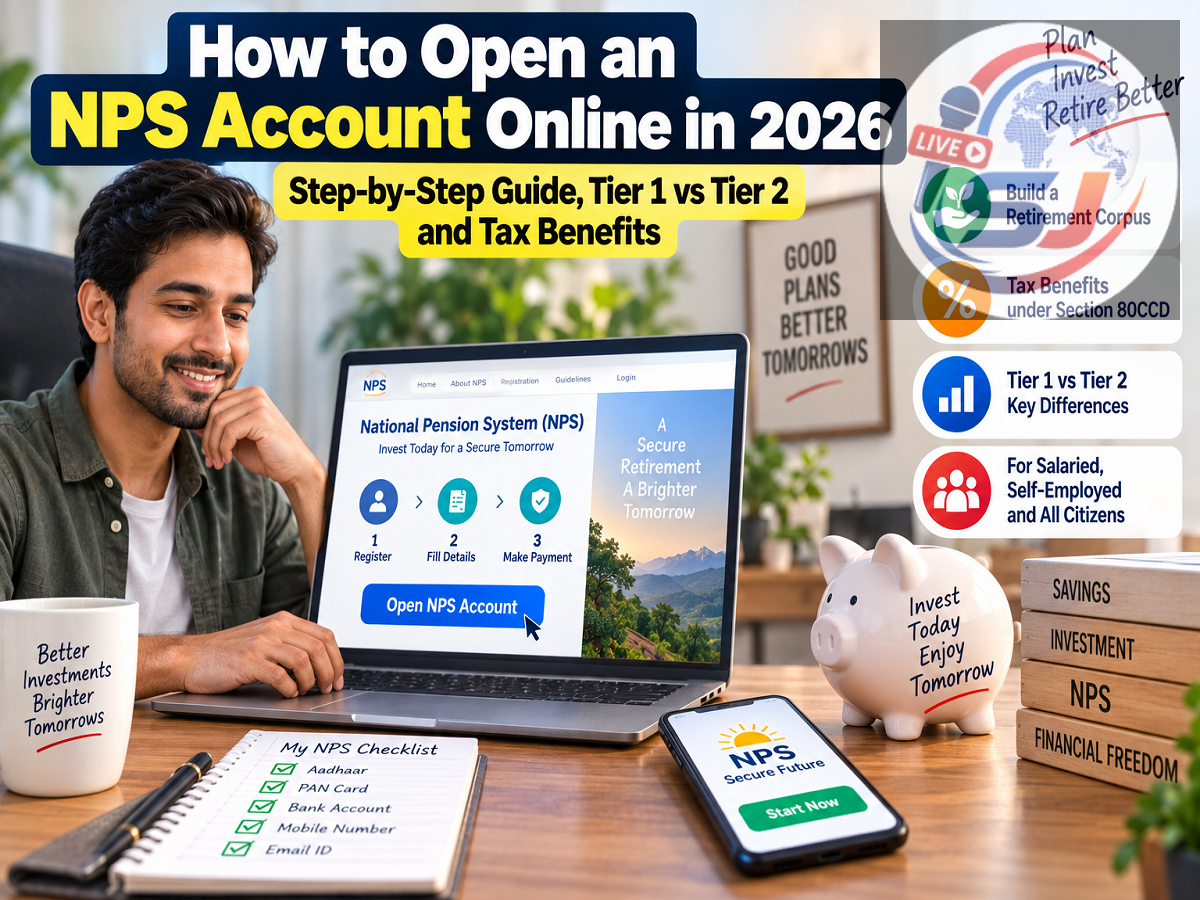
Planning for retirement becomes increasingly important when regular salary income stops. The National Pension System (NPS) is a regulated, market-linked retirement savings system that allows subscribers to build a retirement corpus through regular contributions over the long term.
Opening an NPS account has also become easier with digital registration facilities. Eligible applicants can complete much of the process online through authorised NPS platforms without necessarily visiting a bank branch.
However, NPS should not be confused with a guaranteed-return savings scheme. The money is invested in market-linked assets according to the investment option selected by the subscriber, which means the eventual corpus depends on contributions, investment performance, charges and the period for which the money remains invested.
Here is a detailed look at how an individual can open an NPS account online, the difference between Tier I and Tier II accounts, documents required and important tax considerations.
What Is the National Pension System?
NPS is a retirement-focused pension system regulated by the Pension Fund Regulatory and Development Authority (PFRDA).
Subscribers contribute money to their NPS account and select from the available investment choices. The contributions are invested through registered pension fund managers across permitted asset classes.
Over time, these investments can build a retirement corpus.
Because NPS investments are market-linked, returns are not fixed or guaranteed. The value of the retirement corpus can vary depending on market performance and the asset allocation selected.
NPS Tier I vs Tier II: What's the Difference?
NPS broadly provides two account types—Tier I and Tier II.
Tier I is the primary retirement account. It is designed for long-term pension accumulation and therefore has restrictions on withdrawals before exit, although partial withdrawals are permitted in specified circumstances under the applicable NPS rules.
It would therefore be inaccurate to say that all money in a Tier I account is completely inaccessible until the age of 60.
Tier II, on the other hand, is a voluntary investment account with considerably greater withdrawal flexibility. Eligibility and availability are subject to the applicable NPS rules.
| Feature | NPS Tier I | NPS Tier II |
|---|---|---|
| Primary purpose | Retirement planning | Voluntary investment |
| Withdrawal | Restricted; permitted under prescribed rules | More flexible |
| Pension-focused | Yes | No, primarily an investment account |
| Tax treatment | Benefits available subject to tax rules | Depends on applicable provisions/category |
| Returns | Market-linked | Market-linked |
Investors should understand these differences before deciding where to contribute.
What Do You Need to Open an NPS Account Online?
Applicants using a digital registration facility should keep their identification and financial details ready.
Depending on the onboarding route, this can include PAN, Aadhaar, mobile number, email address and bank-account information.
Aadhaar-based registration may use OTP or another approved authentication mechanism for electronic KYC.
Depending on the platform and registration method, applicants may also be asked for a photograph, signature or other supporting information.
Bank details are important not only for making contributions but also for verification and future transactions.
Since onboarding methods can change, applicants should follow the document requirements shown on the authorised NPS registration platform they are using.
How to Open an NPS Account Online
The online registration process can generally be completed through an authorised NPS digital platform.
Start by opening the official NPS registration facility and choosing the option for new subscriber registration.
You will then need to complete the required KYC process using the available identification method.
After successful identity verification, enter the requested personal details, contact information and bank details.
You will also need to provide information about your nominee according to the applicable NPS nomination rules.
The next important decision concerns your investment strategy.
Choose Your Pension Fund Manager
NPS subscribers can choose from registered pension fund managers available under the system, subject to the applicable sector and rules.
The pension fund manager is responsible for investing your NPS contributions according to the asset allocation selected.
Investors should not select a pension fund manager solely on the basis of short-term past returns. Historical performance does not guarantee future returns.
Factors such as investment approach, long-term performance, consistency and your own retirement objectives can be considered before making a choice.
Active Choice vs Auto Choice
NPS also allows subscribers to select how their money is allocated across permitted asset classes.
Under Active Choice, subscribers can decide the allocation among the available asset categories within the prescribed limits.
Under Auto Choice, asset allocation is determined according to the selected lifecycle approach, with the allocation changing with age under the applicable structure.
Auto Choice can be useful for investors who do not want to determine and manage asset allocation themselves, while Active Choice provides more control to those who understand their investment preferences and risk tolerance.
Neither option guarantees a particular return.
PRAN Is Generated After Registration
After completing the required registration process and making the applicable initial contribution, the subscriber receives a Permanent Retirement Account Number (PRAN).
PRAN is the unique identification number associated with the subscriber's NPS account.
It should be kept safely because it is used for accessing and managing the account, making contributions and carrying out other NPS-related transactions.
The time needed to complete registration can vary depending on KYC verification, payment processing and the platform being used. Therefore, claims that every NPS account can be opened in exactly 10 minutes should be treated as an estimate rather than a guaranteed processing time.
How Does NPS Help Build a Retirement Corpus?
The basic principle behind NPS is long-term accumulation.
A subscriber can make regular contributions throughout their working years. Those contributions are invested according to the selected asset allocation.
Over a long period, investment growth can potentially increase the value of the corpus.
For example, someone who begins contributing in their 20s may have several decades for investments to accumulate before retirement.
But unlike a fixed-return pension product, NPS does not promise a predetermined corpus. Market movements can affect investment value.
NPS Tax Benefits Need Careful Understanding
NPS has traditionally provided tax deductions under specific sections of the Income Tax Act, but investors should be careful when interpreting these benefits.
Under the applicable tax provisions, eligible individual contributions have been associated with Section 80CCD(1) within the overall limit under Section 80CCE, while an additional deduction of up to ₹50,000 has traditionally been available under Section 80CCD(1B).
Employer contributions can have separate tax treatment under Section 80CCD(2), subject to the applicable rules and limits.
However, the availability of deductions depends on factors including whether the taxpayer is using the old or new tax regime and the tax provisions applicable for the relevant financial year.
Therefore, it would be misleading to say that every NPS investor automatically receives ₹2 lakh of tax deductions.
Subscribers should check the latest income-tax rules applicable to their tax regime before making an investment primarily for tax-saving purposes.
Can You Withdraw Money Before Retirement?
Tier I is designed for retirement, so withdrawals are restricted compared with an ordinary bank or investment account.
However, NPS provides for partial withdrawals in specified circumstances, subject to eligibility requirements and limits prescribed under the rules.
Exit and withdrawal rules also determine how the accumulated corpus is treated at retirement or on premature exit.
Depending on the applicable rules at the time of exit, a portion of the corpus may be available for lump-sum withdrawal while another portion may need to be used according to the pension or annuity requirements then in force.
Subscribers should check the current PFRDA withdrawal rules when approaching retirement rather than relying on older percentages or outdated information.
Is NPS Right for Everyone?
NPS can be useful for people looking for a disciplined, long-term retirement investment structure, but it should not automatically be considered the best option for every investor.
The appropriate choice depends on age, income, retirement target, existing investments, risk tolerance and need for liquidity.
Someone who may need frequent access to their money should understand Tier I withdrawal restrictions before making large contributions.
Similarly, investors seeking guaranteed returns should remember that NPS returns are linked to investment performance.
Key Things to Remember Before Opening an NPS Account
Opening an NPS account online has made retirement investing considerably more convenient. Applicants can complete KYC, provide bank and nominee information, select a pension fund manager and choose an investment strategy through authorised digital channels.
But convenience should not replace careful planning.
Understand the difference between Tier I and Tier II, evaluate Active Choice and Auto Choice, check withdrawal restrictions and verify which tax benefits actually apply to you.
Most importantly, remember that NPS can help build a retirement corpus, but it does not guarantee a particular investment return, retirement corpus or monthly pension amount.
Starting early and contributing regularly can provide more time for retirement savings to accumulate, but the final outcome will depend on actual contributions and market performance.
Disclaimer: NPS investments are market-linked and subject to applicable PFRDA regulations. Returns and retirement corpus are not guaranteed. Tax benefits depend on prevailing income-tax rules and the taxpayer's circumstances. Investors should verify the latest NPS and tax provisions before investing.