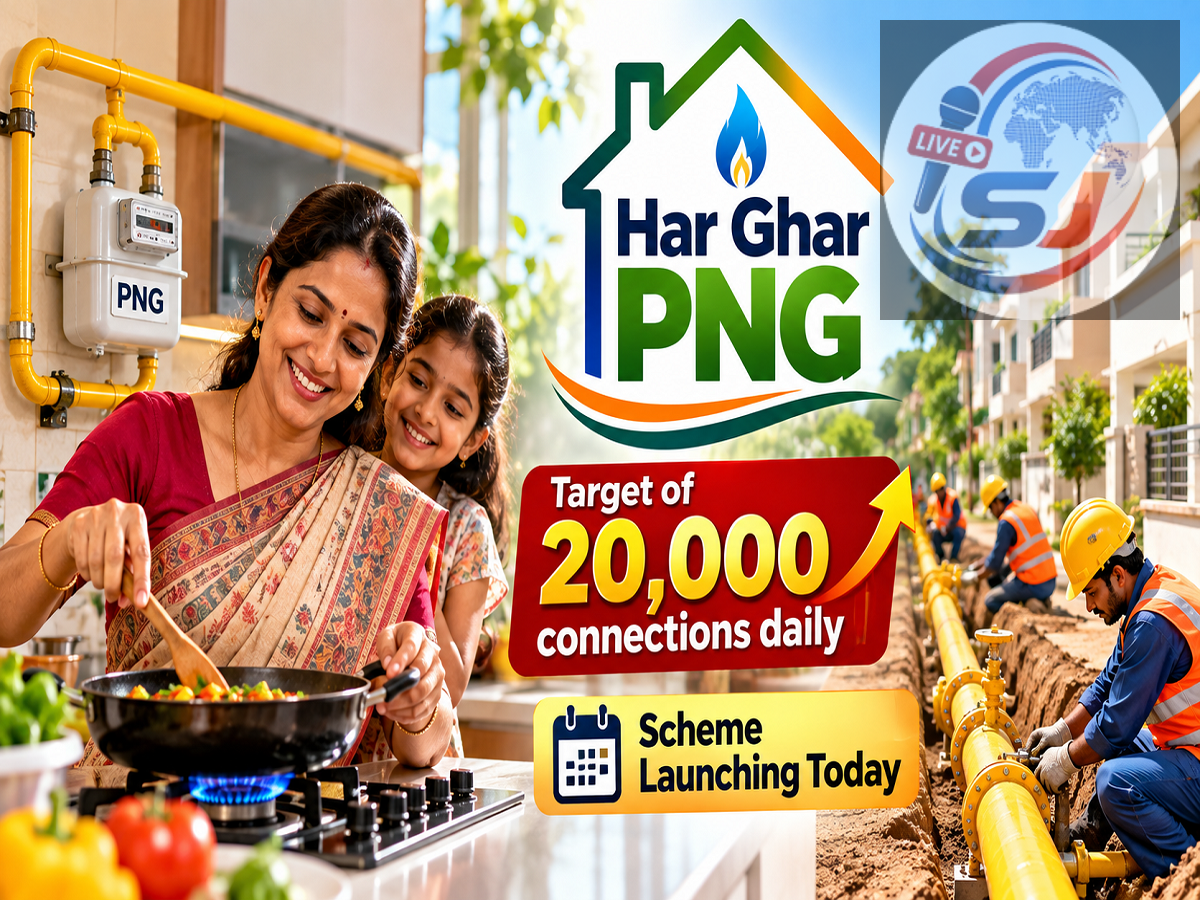
'Har Ghar PNG'... Target of 20,000 connections daily; scheme launching today
PNG Drive 3.0 Launch: Government Targets 20,000 New Piped Gas Connections Every Day
The government is stepping up efforts to expand Piped Natural Gas (PNG) connections across India, with PNG Drive 3.0 set to be launched on October 1, 2026. The initiative is aimed at accelerating household access to piped cooking gas and significantly increasing the pace at which new connections are provided.
According to the information cited in the source, more than 10,000 PNG connections are currently being added per day, and the new campaign aims to roughly double this pace.
The target under the latest drive is to reach approximately 20,000 new PNG connections every day.
If achieved consistently, the faster rollout could substantially expand India's piped-gas network and give more households an alternative to conventional LPG cylinders.
What Is PNG Drive 3.0?
PNG Drive 3.0 is an initiative focused on increasing the adoption of piped natural gas among households.
Unlike LPG, which is supplied to homes through cylinders, PNG is delivered directly through a pipeline network to eligible households.
The new campaign is intended to encourage more consumers in areas already covered by City Gas Distribution networks to opt for piped cooking gas.
The emphasis is not simply on expanding pipelines but also on converting available network coverage into active household connections.
Target of 20,000 PNG Connections Per Day
One of the most important features of the latest initiative is its ambitious daily connection target.
According to the supplied information, the current pace has crossed around 10,000 connections per day, particularly amid changes in the energy market following the Middle East crisis.
Under PNG Drive 3.0, the aim is to increase the pace to approximately:
20,000 new connections per day
That would be roughly double the current daily rate cited in the source.
However, consumers should note that 20,000 connections per day is a target, not a claim that this level has already been achieved.
Actual additions may vary depending on pipeline availability, local infrastructure, consumer demand and the ability of City Gas Distribution companies to complete installations.
How Many Connections Could Be Added at This Pace?
If the target of 20,000 connections per day were maintained continuously, the scale of expansion could be significant.
At that pace:
20,000 × 30 days = 6 lakh connections in approximately one month
And theoretically:
20,000 × 365 days = 73 lakh connections in one year
These figures are simple mathematical illustrations of the daily target rather than an official annual commitment.
Actual annual additions could be higher or lower depending on the duration of the campaign and the pace of implementation.
How Is PNG Different From an LPG Cylinder?
The most visible difference between PNG and LPG is how the fuel reaches the consumer.
With LPG, cooking gas is stored in a cylinder that needs to be replaced or refilled after the gas is consumed.
PNG, in contrast, is supplied through a pipeline directly to the household where infrastructure is available.
This means a PNG customer generally does not need to book a conventional cooking-gas cylinder each time the existing supply runs out.
The consumer instead uses gas supplied through the network and is billed according to the applicable system and consumption.
Why Is the Government Promoting PNG?
The push for PNG is part of the broader expansion of India's gas-based energy infrastructure.
As City Gas Distribution networks expand, more residential areas can potentially gain access to piped cooking gas.
Increasing household connections can help improve the utilisation of gas infrastructure that has already been developed.
The latest drive is therefore expected to focus particularly on areas where pipeline networks are available but a large number of households have not yet taken a PNG connection.
Who Can Get a PNG Connection?
A household cannot obtain a PNG connection simply because the consumer wants one. The service depends on whether a City Gas Distribution network is available in the locality.
Consumers interested in PNG should first check whether their home or residential society falls within an area covered by an authorised gas-distribution company.
If pipelines have reached the locality, the consumer may be able to apply for a connection, subject to the distributor's eligibility requirements, technical feasibility and installation conditions.
Areas without the necessary pipeline infrastructure will need network expansion before households can receive PNG.
What Are the Potential Benefits of PNG?
One of the main conveniences associated with piped gas is continuous supply through a fixed network, subject to the distributor's service conditions.
Consumers do not have to manage a heavy cylinder or repeatedly arrange cylinder replacement in the same way as conventional LPG users.
A household can use gas through its installed pipeline connection and pay according to the applicable billing mechanism.
PNG can therefore be particularly convenient in densely populated urban areas and residential societies where city gas infrastructure is already available.
Will PNG Be Available in Every House Immediately?
No. The phrase "PNG for every home" represents the broader expansion objective, but it should not be interpreted as meaning that every household in India will immediately receive a piped-gas connection after the launch of PNG Drive 3.0.
PNG availability depends heavily on local infrastructure.
Even if the government and gas-distribution companies accelerate new connections, households in areas without pipelines cannot be connected until the required network reaches them.
The rollout will therefore differ from city to city and even between neighbourhoods within the same city.
Why the Daily Connection Target Matters
Increasing the pace from more than 10,000 connections per day toward 20,000 would represent a significant acceleration in household PNG adoption.
The initiative could also help City Gas Distribution companies bring more customers onto existing networks.
A higher number of active users can improve the utilisation of pipeline infrastructure and broaden consumer access to piped cooking gas.
The pace of actual expansion, however, will depend on execution on the ground.
What Should Consumers Do?
Households interested in switching to PNG should first identify the authorised City Gas Distribution company operating in their area.
They should then check whether their address is covered by the pipeline network and ask about connection charges, security deposits, installation requirements, billing arrangements and other applicable terms.
Consumers should rely on the official channels of the authorised distributor when applying and avoid sharing banking information or OTPs with unknown agents.
PNG Drive 3.0: What to Watch Next
The launch of PNG Drive 3.0 on October 1, 2026 puts the focus on accelerating India's household piped-gas connections.
The headline objective is to raise the pace from more than 10,000 connections per day to a target of around 20,000 per day.
For households, however, the most important question will be whether PNG infrastructure is available in their locality.
Consumers living in areas already covered by City Gas Distribution networks may have a greater opportunity to obtain connections as the new campaign gathers pace, while locations without pipeline infrastructure will have to wait for network expansion.
Disclaimer: The 20,000-connections-per-day figure is a target cited for PNG Drive 3.0 and should not be interpreted as a guaranteed daily achievement. PNG availability, installation charges and connection conditions can vary by location and authorised gas distributor.