
GST Rules 2026: New Registration, Refund and Tax Notice Changes for Online Sellers From November 1
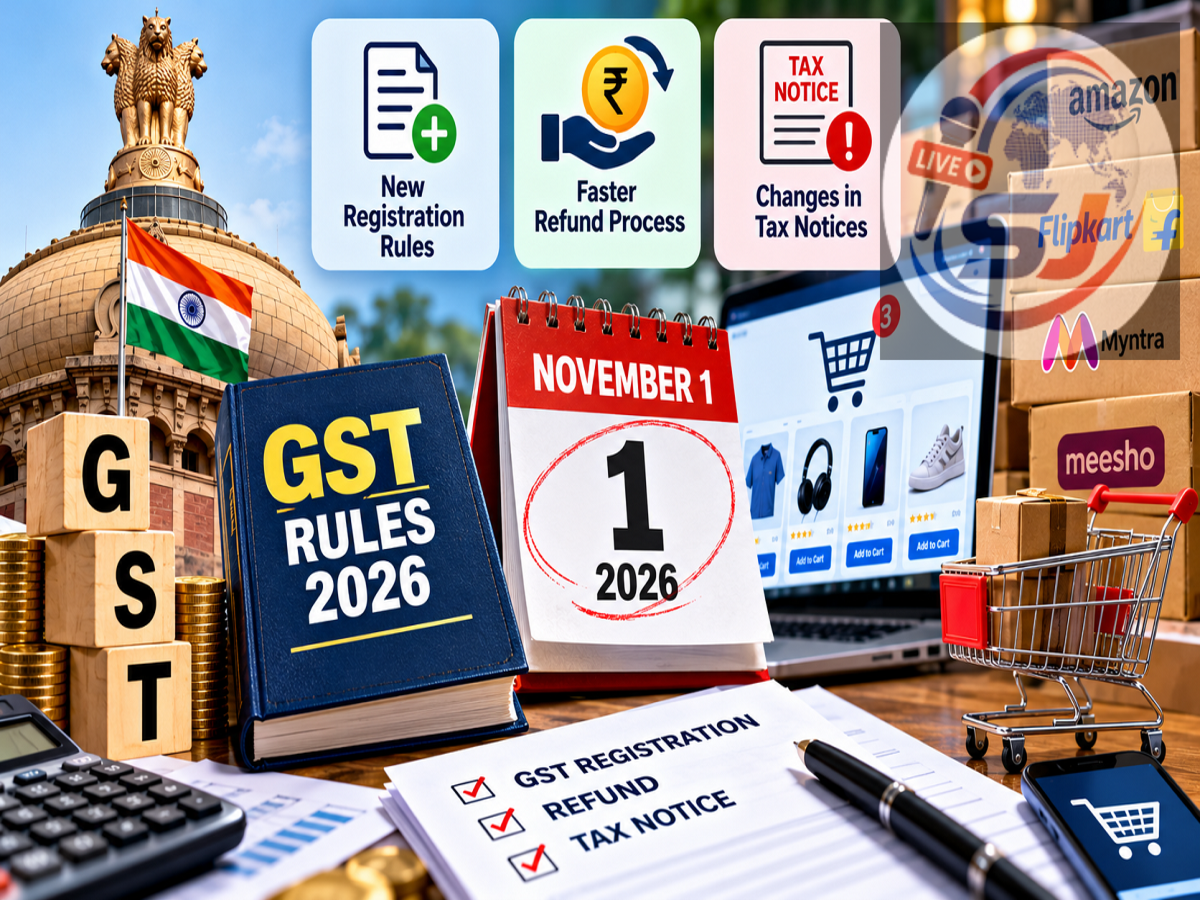
GST New Rules 2026: Small businesses and online sellers in India could benefit from proposed changes to Goods and Services Tax (GST) procedures aimed at simplifying registration, accelerating refunds and reducing unnecessary compliance disputes.
According to a report dated October 23, 2026, several administrative reforms discussed at the 57th GST Council meeting are expected to be introduced in phases beginning November 1, 2026. Certain measures requiring legislative amendments may take effect from April 1, 2027, subject to the necessary legal notifications.
The proposed changes are particularly relevant to sellers operating through e-commerce marketplaces, small traders managing GST registrations across multiple states and businesses experiencing delays in tax refunds.
However, businesses should distinguish between proposals, draft procedures and rules that have been formally notified. A GST Council recommendation does not automatically become enforceable law.
GST Changes From November 1, 2026: What Is Being Proposed?
The reported reforms focus on improving administrative efficiency and reducing compliance difficulties for small businesses.
One of the major objectives is to make GST registration easier for eligible e-commerce sellers who supply goods across state boundaries.
Other proposed measures include more predictable registration documentation, greater automation of refund processing and revisions to GST return forms.
The government is also reportedly considering a minimum monetary threshold for issuing certain show-cause notices.
Here is an overview of the changes described in the report.
| Proposed Change |
Expected Benefit |
|---|---|
| Simplified registration for eligible online sellers |
Easier compliance for businesses operating across states |
| Clearer registration documentation requirements |
Fewer applications rejected over avoidable deficiencies |
| Automated excess cash ledger refunds |
Reduced manual processing |
| Shorter refund-related processing timeline |
Faster handling of eligible refund applications |
| Revised GST return forms |
Fewer reporting inconsistencies |
| Proposed ₹10,000 notice threshold |
Reduced compliance burden for certain small-value disputes |
The precise applicability of each measure will depend on the final rules, notifications and implementation instructions.
Small E-Commerce Sellers May Get Easier GST Registration
Businesses selling products through online marketplaces often face additional compliance requirements when supplying goods to customers in different states.
Under the reported proposal, eligible small e-commerce sellers may be permitted to declare a principal place of business and use a simplified process for obtaining registration in other states.
The arrangement is expected to involve physical verification and coordination with the relevant e-commerce platform.
If implemented as described, the change could make compliance more manageable for sellers who currently find multi-state registration procedures complicated.
The report estimates that approximately 9.5 lakh small e-commerce sellers could potentially benefit.
However, this number should be treated as a reported estimate rather than a confirmed count of businesses that will qualify.
What Is the Principal Place of Business?
Under GST, the principal place of business is generally the primary business location specified in a taxpayer's registration.
It is an important part of the registration framework because it identifies the main location from which the business operates or maintains its records.
For online sellers, registration requirements can become more complex when goods are stored, dispatched or supplied from multiple states.
A simplified framework could reduce some of this administrative burden, but sellers would still need to comply with applicable registration, invoicing and return-filing requirements.
GST Registration Applications Could Face Fewer Rejections
Another important proposal involves clearer guidance on the documents and information required for GST registration.
Businesses sometimes experience delays when applications are flagged for missing details, inconsistent information or additional verification.
The government reportedly plans to issue more detailed instructions outlining the documents that registration authorities may require.
This could help applicants submit complete information at the beginning of the process.
Clearer documentation requirements may also reduce avoidable clarification requests and application rejections.
However, the proposed simplification does not mean that identity verification, business address checks or other statutory registration requirements will disappear.
Authorities would continue to have powers to examine applications in accordance with applicable GST provisions.
GST Refund Process May Become More Automated
Delayed refunds can create cash-flow difficulties, particularly for small businesses with limited working capital.
The reported reforms include a proposal to automate the refund of eligible excess balances held in the electronic cash ledger.
Under GST, the electronic cash ledger records amounts deposited by taxpayers for payment of tax and other applicable liabilities.
If a taxpayer has an eligible excess balance, they may be able to claim a refund under the relevant provisions.
Greater automation could reduce manual intervention and make the refund process more predictable.
However, automated processing would still be subject to eligibility checks and the conditions specified in the final rules.
Refund-Related Timeline Could Be Reduced to 10 Days
The report also indicates that a refund-related communication or memorandum timeline may be reduced from 15 days to 10 days.
This change is intended to speed up the handling of eligible refund applications.
For small businesses, faster processing of refund documentation can be important because money held up in tax procedures may otherwise be unavailable for inventory purchases, employee payments or routine operations.
Nevertheless, businesses should not interpret the proposed 10-day period as a guarantee that every GST refund will be credited to a bank account within 10 days.
Different refund categories have separate procedural requirements and statutory timelines.
The exact event covered by the proposed shorter deadline must be confirmed from the final notification.
GSTR-1, GSTR-1A and IFF Forms May Be Revised
The government is also reportedly preparing changes to GST return forms.
According to the source report, draft revisions involving GSTR-1, GSTR-1A and the Invoice Furnishing Facility (IFF) are expected to be released for public consultation.
The stated objective is to improve reporting accuracy and reduce mismatches between declared tax liabilities and input tax credit records.
Such mismatches can lead to additional compliance work, clarification requests and tax notices.
Understanding the Three Forms
| GST Form |
Main Purpose |
|---|---|
| GSTR-1 |
Reporting details of outward supplies |
| GSTR-1A |
Amending or adding eligible outward supply details within the permitted framework |
| IFF |
Optional invoice reporting facility for eligible quarterly return filers |
Better alignment between these reporting mechanisms could make reconciliation easier for businesses and their accountants.
However, the actual impact will depend on the design of the revised forms and how they interact with other GST returns and statements.
GST Return Draft May Be Released on MyGov on November 1
According to the report, the government plans to publish draft changes to the relevant GST return forms on the MyGov portal on November 1, 2026.
Stakeholders may be invited to submit feedback until November 30, 2026.
The consultation process could allow businesses, tax professionals, industry associations and other interested parties to identify practical difficulties before the revised forms are finalised.
If the consultation proceeds as reported, businesses can monitor the official MyGov portal for the draft and submission instructions.
Importantly, publication of a draft form for feedback does not mean the revised form becomes mandatory immediately.
A separate implementation process may be required.
GST Show-Cause Notice Threshold: What Does ₹10,000 Mean?
One of the reported proposals concerns a minimum monetary threshold of ₹10,000 for issuing certain show-cause notices to registered taxpayers.
The measure is intended to reduce administrative disputes involving relatively small amounts.
If introduced, it could help businesses avoid some compliance proceedings where the disputed amount falls below the specified threshold.
However, the exact legal scope of this proposal is important.
A minimum notice threshold would not necessarily cancel the underlying tax liability or exempt businesses from paying amounts legally due.
It also should not be assumed to apply to every category of GST notice, penalty, fraud investigation or recovery proceeding.
Taxpayers should wait for the relevant statutory amendment or official notification to understand which proceedings are covered.
When Will the New GST Rules Take Effect?
The report describes two broad implementation periods.
November 1, 2026 — Expected administrative rollout
Some procedural measures may begin in phases. Draft GST return forms are also reportedly scheduled for public consultation.
April 1, 2027 — Possible legislative implementation
Measures requiring changes to GST legislation may become applicable after the necessary legal process and notifications.
These dates reflect the supplied report's expectations and should not be treated as confirmed effective dates for every measure.
What Should Online Sellers Do Before November 1?
Businesses do not need to change their GST compliance practices solely because reforms have been announced or proposed.
However, online sellers can use the period before implementation to review their existing registration details and tax records.
They should ensure that their principal place of business, business address and contact information are accurate.
Sellers operating in multiple states should also review their current registration obligations with a qualified GST professional.
Businesses expecting refunds may benefit from reconciling their electronic cash ledger and checking whether outstanding applications contain complete supporting information.
Similarly, regular reconciliation of sales invoices, GSTR-1 details and input tax credit records can help identify discrepancies before they develop into larger compliance problems.
How Could the Reforms Benefit Small Businesses?
The potential benefits of the proposed changes extend beyond reduced paperwork.
A simpler registration process could help eligible sellers expand operations across state boundaries.
Faster handling of refunds may improve working capital availability.
Clearer documentation requirements could reduce uncertainty for first-time GST applicants.
Revised return forms may help businesses identify reporting errors earlier, while a properly defined monetary threshold for certain notices could reduce disputes over small amounts.
Nevertheless, these benefits will depend on the final design and practical implementation of the reforms.
Where Can Businesses Check Official GST Updates?
Businesses should rely on official government sources when determining whether a new GST rule has become applicable.
Relevant sources include the GST Portal, the GST Council website and the Central Board of Indirect Taxes and Customs.
Official notifications, circulars and amendments provide the legal details necessary to determine eligibility, effective dates and compliance obligations.
Final Takeaway
The GST reforms reported for November 2026 could make tax administration easier for small businesses and e-commerce sellers.
Proposals covering simplified registration, automated refunds, revised return forms and smaller-value tax disputes are aimed at reducing procedural difficulties.
However, not every announced measure will necessarily become effective on November 1.
Businesses should monitor official notifications, maintain accurate tax records and avoid changing their filing or registration practices until the applicable requirements are confirmed.
Disclaimer: This article is based on the supplied October 23, 2026, report. The proposals, meeting details and implementation dates have not been independently verified against official GST Council minutes or government notifications. The information is intended for general awareness and should not be treated as legal or tax advice.