
GST Rules 2026: 7 Major Reforms Proposed, Faster Refunds, Lower Penalties and Relief for Small Businesses
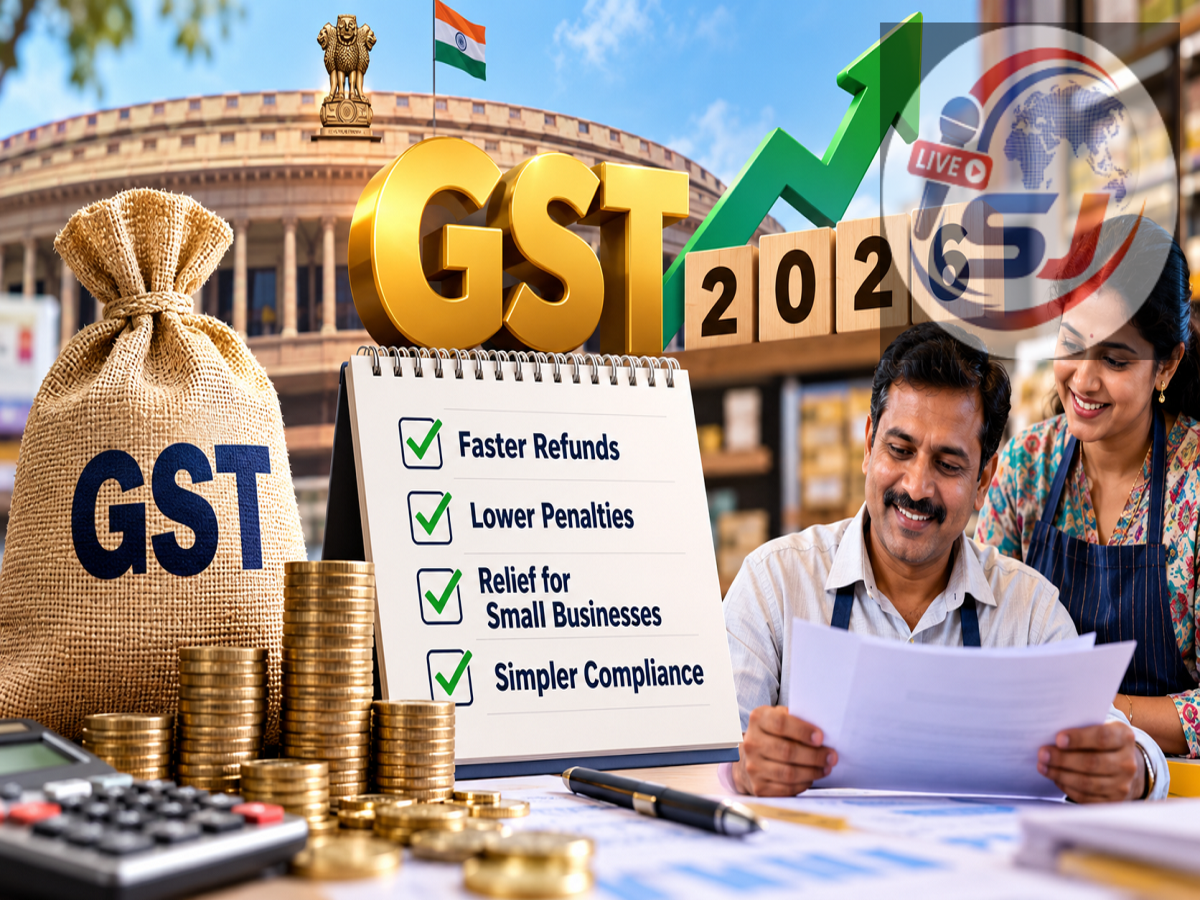
GST Council Meeting 2026: Significant changes to India's Goods and Services Tax (GST) framework have been reported following the 57th GST Council meeting chaired by Union Finance Minister Nirmala Sitharaman. The proposed reforms aim to simplify tax compliance, reduce unnecessary legal proceedings, accelerate refunds, and make GST procedures more convenient for businesses.
According to the reported decisions, the government is considering major changes involving arrest powers, prosecution thresholds, penalties, GST registration, Input Tax Credit (ITC), and tax assessments. One of the most notable proposals would allow eligible businesses to receive GST refund approvals within three working days.
The changes are reportedly scheduled to take effect from April 1, 2027, although their implementation will depend on the necessary legal amendments and official notifications.
Here is a detailed explanation of the seven proposed GST reforms and how they could affect taxpayers, traders, startups, and established businesses.
1. GST Arrest Powers Could Be Removed Under Proposed Changes
One of the most significant developments mentioned in the report concerns the powers currently available to GST authorities.
According to the proposed framework, GST officers would no longer have the existing authority to arrest taxpayers under the relevant provisions.
The report also states that the monetary threshold for initiating prosecution would increase from ₹1 crore to ₹5 crore.
If implemented as described, these changes could reduce the risk of criminal proceedings in certain tax-related disputes and provide greater legal certainty to businesses.
However, taxpayers should understand that the reported removal of arrest powers is not yet an established legal change. Existing enforcement provisions continue to apply unless they are formally amended.
2. Lower GST Penalties and Relief in Small Tax Disputes
Another proposed reform focuses on reducing the financial and administrative burden associated with smaller tax disputes.
The report states that the general penalty amount could be reduced from ₹25,000 to ₹10,000.
Additionally, tax authorities would reportedly avoid issuing notices when the tax demand is below ₹10,000, subject to the final legal provisions.
Such a change could help businesses avoid lengthy proceedings over relatively small amounts.
For example, a small trader facing a minor tax discrepancy might benefit from a simplified resolution process rather than becoming involved in a formal notice and adjudication procedure.
The exact circumstances in which the proposed threshold would apply will need clarification through official rules.
3. GST Registration May Become Easier for Small Online Sellers
Small businesses selling products through e-commerce platforms could benefit from simplified GST registration requirements.
The reported proposal aims to make it easier for eligible sellers to complete registration and comply with tax regulations.
Currently, GST obligations for e-commerce sellers can depend on factors such as the nature of supplies, turnover, place of supply, and applicable statutory exemptions.
Simplifying registration procedures could encourage small manufacturers, local traders, home-based entrepreneurs, and online sellers to expand their operations.
It may also reduce paperwork and the time required to complete certain registration formalities.
However, simplified registration does not automatically mean that every online seller will be exempt from GST requirements.
4. GST Refund Approval Could Take Just Three Working Days
The proposed refund reforms could be particularly important for businesses that regularly claim GST refunds.
According to the report, the time allowed for acknowledging refund applications would be reduced from 15 days to 10 days.
More importantly, eligible refund claims could receive approval within three working days through a risk-based assessment mechanism.
This would mean that claims meeting prescribed conditions could move through the approval process much faster.
For exporters and businesses with significant working capital requirements, quicker refunds could improve cash flow and reduce the amount of money tied up in pending tax claims.
However, a three-day approval timeline should not be confused with a guarantee that every applicant will receive money in their bank account within three days.
Actual processing and payment would depend on eligibility, verification, and the final rules.
5. Input Tax Credit Rules Could Be Reviewed
Input Tax Credit remains one of the most important elements of the GST system because it allows eligible businesses to offset GST paid on purchases against their output tax liability.
However, disputes can arise when suppliers fail to deposit tax or comply with their reporting obligations.
According to the reported proposal, a committee of officials would examine issues involving ITC claims where the supplier has not paid the corresponding tax.
The committee is expected to submit its findings within three months.
The report also mentions proposed refund facilities relating to accumulated ITC on plant and machinery and input services.
If implemented, these measures could help address certain longstanding compliance difficulties.
Businesses should nevertheless continue following the existing eligibility requirements, documentation standards, and reconciliation procedures until any amendments are officially notified.
6. New Checks on Vehicle Inspections and Easier Registration Amendments
The reported GST reforms also address the movement of goods and changes to business registration details.
Under the proposal, GST officials would require approval from a senior officer before stopping vehicles carrying goods for inspection.
This measure is intended to introduce additional oversight into enforcement procedures and reduce unnecessary disruption to commercial transportation.
The proposal also seeks to simplify amendments to GST registration details, including changes to a business's principal place of operation.
Such improvements could be useful for companies relocating offices, opening new facilities, or updating their registered business information.
The precise scope of the proposed vehicle-inspection restrictions will depend on the final legal framework.
7. Annual GST Rate Changes and Faceless Assessment From 2027–28
Another reported decision involves the frequency of GST rate revisions.
The proposal suggests establishing a system in which GST rates would ordinarily be revised once a year, potentially making tax planning more predictable for businesses.
Frequent rate changes can create additional compliance work, particularly for companies managing large inventories, billing systems, and multiple product categories.
A more structured revision schedule could give businesses additional time to prepare.
The report also states that faceless assessment would be introduced from the financial year 2027–28 for certain Central GST taxpayers registered across multiple jurisdictions.
Under a faceless assessment system, eligible cases could be examined through digital procedures with reduced direct interaction between taxpayers and officials.
The objective would be to improve transparency, standardization, and administrative efficiency.
GST Changes 2026: Summary of the Seven Reported Proposals
| Proposed Reform |
Reported Change |
|---|---|
| Arrest and prosecution |
Removal of GST arrest powers; prosecution threshold raised from ₹1 crore to ₹5 crore |
| Penalties and small disputes |
General penalty reduced to ₹10,000; relief proposed for tax demands below ₹10,000 |
| E-commerce registration |
Simpler GST registration procedures for eligible small sellers |
| GST refunds |
Acknowledgement period reduced to 10 days; eligible approvals within three working days |
| Input Tax Credit |
Committee to examine supplier-payment disputes; additional ITC refund measures proposed |
| Goods transportation |
Senior-officer approval proposed before certain vehicle inspections |
| GST rates and assessments |
Annual rate-revision framework and faceless CGST assessments proposed |
Note: These are proposals described in the supplied report, not independently verified amendments to GST law.
When Will the New GST Rules Come Into Effect?
The report identifies April 1, 2027, as the proposed implementation date for the GST reforms.
It also mentions financial year 2027–28 as the expected starting period for the faceless assessment initiative.
However, decisions or recommendations attributed to the GST Council do not necessarily become enforceable immediately.
Depending on the nature of each reform, implementation may require amendments to the Central Goods and Services Tax Act, changes to the GST Rules, or notifications issued by the relevant authorities.
Businesses should therefore avoid changing their tax compliance practices solely on the basis of media reports.
What Should Businesses and GST Taxpayers Do Now?
Businesses can begin reviewing how the proposed changes might affect their operations, particularly in relation to refund applications, registration details, tax disputes, and ITC reconciliation.
Small traders may want to assess whether simplified registration procedures could apply to them in the future.
Exporters and other businesses claiming refunds should continue maintaining accurate records so that their applications satisfy existing verification requirements.
Taxpayers should also monitor official announcements through the GST Council website and the GST portal.
Conclusion
The seven GST reforms described in the report could represent meaningful changes for Indian businesses if they are formally approved and implemented.
Faster refund approvals, simplified registration, lower penalties, and a revised approach to enforcement could reduce compliance difficulties and improve the overall taxpayer experience.
However, the most important distinction is between reported GST Council proposals and legally effective GST rules. Businesses must continue following the existing law until the government publishes the necessary amendments and notifications.
Editorial note: The specific claims attributed to the 57th GST Council meeting—including the proposed removal of arrest powers, revised prosecution thresholds, and three-day refund approvals—have not been independently verified for this rewrite. Official confirmation is necessary before presenting them as finalized government decisions.