
Government Scheme Rules 2026: Voter ID and Biometric Verification May Replace Aadhaar for Benefit Payments
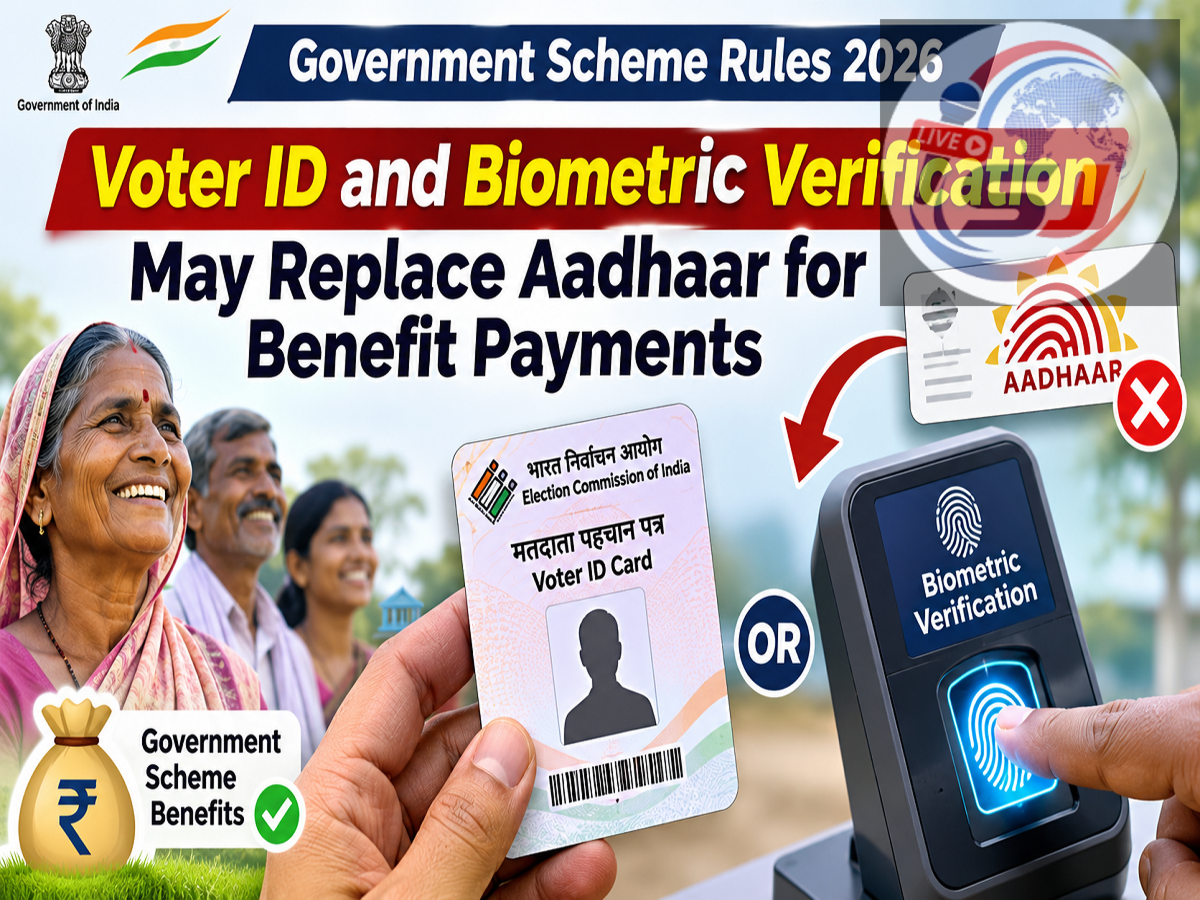
Government Scheme Update 2026: Millions of Indians who receive financial assistance through government welfare programmes may see changes in the way their identities are verified. The Centre could introduce a new verification system involving Voter ID numbers and biometric authentication instead of relying primarily on Aadhaar for beneficiary payments.
Union Minister Rajiv Ranjan Singh, popularly known as Lalan Singh, has indicated that the government may adopt a different identification mechanism for distributing financial benefits under welfare schemes. However, no implementation date or final list of affected schemes has been announced.
Government May Introduce New Verification Rules for Welfare Beneficiaries
Aadhaar has played an important role in identifying beneficiaries and facilitating financial assistance under several central government programmes. From agricultural support to rural housing assistance and social security pensions, Aadhaar-linked verification has become a familiar part of the welfare delivery system.
However, the government may reconsider how beneficiaries are identified before receiving payments.
During a national workshop organised by the Ministry of Panchayati Raj on October 30, 2026, Union Minister Rajiv Ranjan Singh discussed the possibility of replacing Aadhaar-based identification with a system involving biometric details and Electors Photo Identity Card (EPIC) numbers.
The workshop was associated with the People's Plan Campaign 2026–27, which focuses on strengthening local governance and development planning.
The minister's remarks have attracted attention because any change in identification requirements could affect people who depend on government financial assistance.
Why Is the Government Considering an Alternative to Aadhaar?
While addressing the workshop, Singh raised concerns about the reliability of Aadhaar as the primary document for identifying welfare beneficiaries.
He referred to the widespread availability of Aadhaar enrolment facilities and questioned whether the existing identification mechanism should remain the sole basis for beneficiary payments.
According to his remarks, biometric identification and the EPIC number printed on a person's Voter ID card could become important elements in verifying eligibility for financial assistance.
The proposed approach would connect beneficiary identification with electoral identity information and biometric verification.
However, the minister did not provide detailed operational guidelines explaining how the new system would function or whether Aadhaar would continue to be accepted alongside other documents.
Which Government Schemes Currently Use Aadhaar Verification?
Several major welfare programmes currently rely on Aadhaar information, Aadhaar authentication or Aadhaar-linked banking arrangements for beneficiary identification and payments.
These include:
-
PM-Kisan Samman Nidhi: Provides financial assistance to eligible farming families through direct benefit transfers.
-
Pradhan Mantri Awas Yojana–Gramin (PMAY-G): Supports eligible rural households in obtaining housing assistance.
-
Rural Employment Guarantee Programme: Uses Aadhaar-linked payment arrangements for eligible workers under the applicable system.
-
National Social Assistance Programme (NSAP): Provides social security support, including old-age, widow and disability pensions.
-
National Livestock Mission: Certain components require beneficiaries to provide Aadhaar details or complete Aadhaar authentication.
These programmes serve different categories of beneficiaries, including farmers, rural workers, elderly citizens, persons with disabilities and financially vulnerable households.
Importantly, there has been no confirmation that all these schemes will shift to Voter ID-based verification.
Will Aadhaar Become Invalid for PM-Kisan, Pension and Housing Schemes?
One of the biggest questions among beneficiaries is whether Aadhaar will stop being accepted for popular government schemes.
At present, there is no official confirmation of such a nationwide change.
The minister's remarks suggest a possible shift in beneficiary identification, but the government has not specified which departments or welfare programmes would be covered.
It is also worth noting that the Ministry of Panchayati Raj does not currently operate a scheme that directly transfers money into individual beneficiaries' bank accounts. However, certain programmes administered by the Ministry of Fisheries, Animal Husbandry and Dairying, also headed by Singh, have Aadhaar-related requirements.
Therefore, beneficiaries should not assume that their existing Aadhaar-linked registrations or payment arrangements have become invalid.
What Is an EPIC Number and Why Could It Become Important?
The EPIC number is a unique identification number associated with a registered voter's Electors Photo Identity Card, commonly known as a Voter ID.
It is used to identify individuals registered on electoral rolls.
If the proposed verification arrangement is introduced, eligible beneficiaries may be asked to provide their EPIC numbers along with biometric information.
Biometric authentication generally involves verifying identity through physical characteristics such as fingerprints or iris patterns.
However, the government has not yet explained which biometric technology would be used, how records would be linked, or what alternative verification arrangements would be available to people who do not possess Voter ID cards.
These details will be important because access to welfare benefits must account for different categories of eligible beneficiaries.
Proposed Changes Trigger Political Debate
The minister's announcement has also generated political discussion.
Congress leader Rahul Gandhi criticised the possibility of linking welfare payments with Voter ID information, raising concerns that people excluded from electoral rolls could face difficulties accessing government assistance.
He questioned whether such requirements might eventually affect pensions, food assistance, employment benefits and other welfare programmes.
Singh responded to the criticism and clarified that Aadhaar alone would not be the basis for beneficiary payments.
The exchange has brought attention to the need for transparent eligibility rules and accessible verification procedures.
What Should Government Scheme Beneficiaries Do Now?
Until detailed government instructions are released, beneficiaries should continue following the existing requirements of their respective schemes.
People receiving PM-Kisan payments, pensions, housing assistance or other benefits should ensure that their registered information remains accurate.
They should also complete any officially required e-KYC or document verification within the applicable deadlines.
There is currently no reason to replace Aadhaar details with Voter ID information solely because of the minister's statement.
Beneficiaries should rely on official government portals and authorised departments for updates rather than unverified messages circulating on social media.
When Will the New Government Scheme Verification Rules Take Effect?
As of November 6, 2026, no official implementation date has been announced for the proposed EPIC and biometric-based payment verification arrangement.
The government has also not released a comprehensive list of affected schemes or detailed instructions explaining how beneficiaries would complete the new verification process.
Further clarification will be necessary before the proposed arrangement can be treated as an operational requirement.
For now, Aadhaar continues to remain relevant wherever existing government scheme rules require it. Any future transition to Voter ID and biometric verification will depend on official notifications and scheme-specific guidelines.