
Gold-Silver Price Update: Silver Rallies in 5 Days but Remains ₹1.83 Lakh Below Its Peak
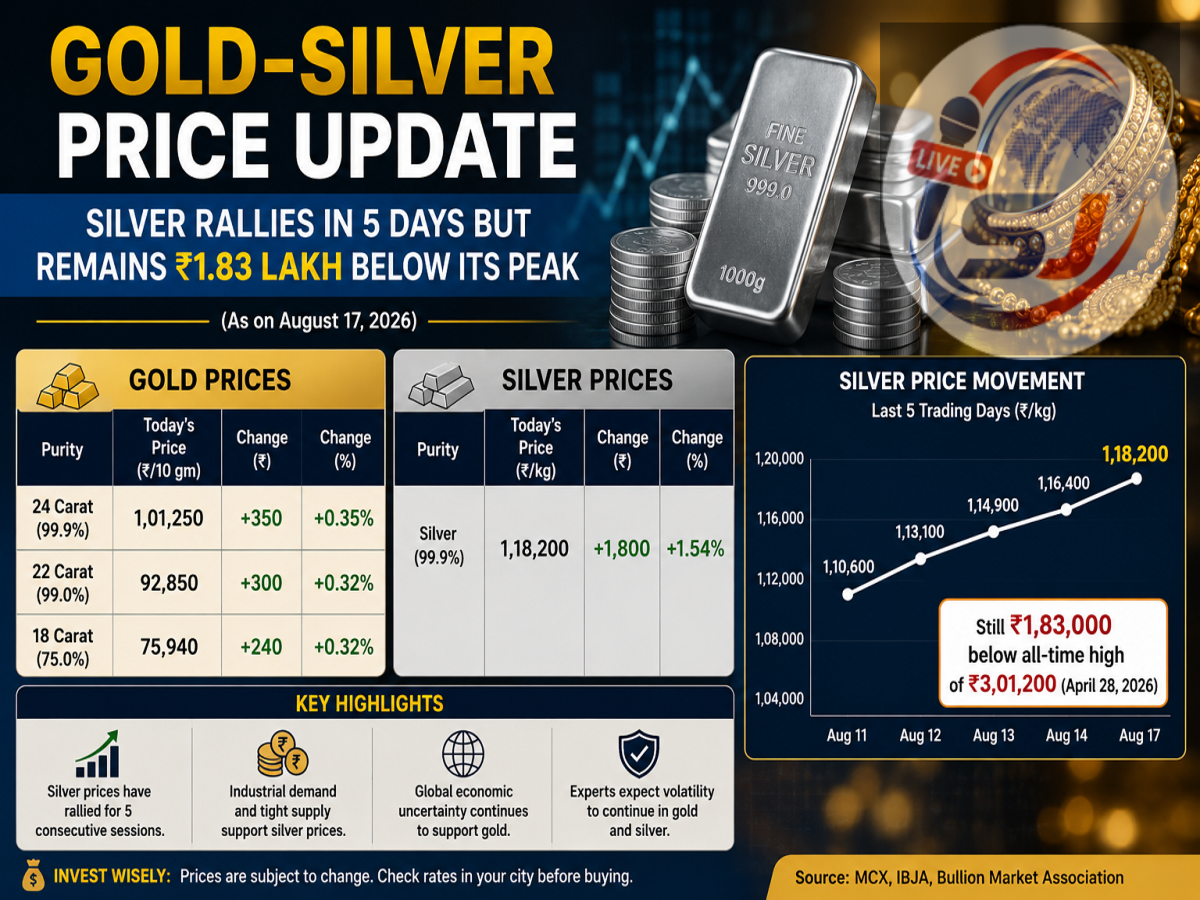
Gold-Silver Price Today: Gold and silver prices have witnessed strong movement over the past few trading sessions, bringing precious metals back into focus for investors and jewellery buyers. Despite the recent rally, silver remains substantially cheaper than its previous record high, while 24-karat gold is trading above the ₹1.54 lakh per 10 gram level.
The sharp price movements are particularly interesting in the silver market. Even after gaining ground over the past five trading sessions, silver is still around ₹1.83 lakh per kilogram below its earlier peak, according to the figures cited in the latest market report.
Current bullion-market data on August 16 also show 24-karat gold around ₹1.54 lakh per 10 grams and silver above ₹2.37 lakh per kilogram, although actual rates can vary by market and source.
Gold and Silver Prices Rise in Recent Sessions
Precious-metal prices have remained volatile, with both gold and silver recording noticeable changes over a short period.
Gold has once again moved above ₹1.54 lakh per 10 grams, while silver has recovered to above ₹2.3 lakh per kilogram.
Data available for August 16 showed 24-karat gold at around ₹1,54,850 per 10 grams, while 999-fineness silver was quoted at approximately ₹2,37,250 per kilogram. The same data showed gold up around 1.77% compared with a week earlier, while silver was approximately 1.97% higher over the same comparison period.
This indicates that both metals have regained momentum, although silver remains much more volatile than gold.
Silver Still Far Below Its Record High
The biggest talking point is not simply silver's latest price increase but how far the metal remains from its previous peak.
According to the reported price comparison, silver is still approximately ₹1.83 lakh per kilogram cheaper than its record-high level, despite the recent rally.
That gap highlights the extraordinary volatility seen in silver prices.
Unlike gold, silver has significant industrial demand in addition to its role as a precious metal and investment asset. Changes in global industrial activity, solar-energy demand, electronics manufacturing, currency movements and investment flows can therefore have a substantial impact on its price.
As a result, silver can sometimes rise or fall much more sharply than gold.
Gold Crosses ₹1.54 Lakh Per 10 Grams
Gold prices have also strengthened.
Latest market data available on August 16 placed 24-karat gold at approximately ₹1,54,850 per 10 grams. The corresponding price for 22-karat gold was around ₹1,41,946 per 10 grams.
These prices are indicative bullion rates. Consumers buying jewellery will generally pay a different final amount because retail jewellery prices can include GST, making charges and other costs.
Rates can also vary between cities and jewellers.
For buyers planning a major jewellery purchase, comparing the per-gram gold price along with making charges can therefore be more useful than looking only at the headline bullion rate.
How Much Has Gold Changed in a Week?
The recent movement becomes clearer when prices are compared over a slightly longer period.
Market data showed 24-karat gold at around ₹1,52,160 per 10 grams on August 9, compared with approximately ₹1,54,850 on August 16.
That represents an increase of roughly 1.77% within a week.
The increase is significant considering the already elevated price of the yellow metal.
Gold was also substantially more expensive compared with the same period a year earlier. This illustrates why investors who entered the market much earlier have seen sizeable gains, while new buyers now face a much higher entry price.
Silver Also Moves Higher
Silver has followed a similar direction recently.
The quoted rate for 999-fineness silver was around ₹2,32,660 per kilogram on August 9, compared with approximately ₹2,37,250 on August 16.
That works out to a weekly rise of around 1.97%.
Although this increase is notable, it needs to be viewed against silver's much wider historical price swings.
This is why a metal can record a strong short-term recovery and still remain significantly below a previous high.
Why Do Gold and Silver Prices Change So Quickly?
Precious-metal prices are influenced by a combination of domestic and international factors.
International gold and silver prices play an important role because both commodities are traded globally. Movements in the US dollar can also influence prices, while changes in the rupee-dollar exchange rate affect the cost of precious metals in India.
Interest-rate expectations are another important factor. Gold does not generate regular interest income, so changes in bond yields and expectations surrounding central-bank policy can alter investor demand for the metal.
Geopolitical uncertainty can also push investors toward gold, which is traditionally viewed as a safe-haven asset during periods of economic or political stress.
Silver has an additional dimension because of its industrial usage. Demand from sectors such as solar energy, electronics and manufacturing can influence prices alongside investment demand.
MCX and Physical-Market Rates Can Be Different
Consumers may sometimes notice that the gold or silver price shown on a commodity exchange is different from the rate quoted by a jeweller.
This is normal.
MCX prices represent exchange-traded commodity contracts, whereas physical bullion rates can reflect local taxes, transportation costs, demand and other market factors.
Market data on August 16 showed MCX gold around ₹1,54,590 per 10 grams and MCX silver near ₹2,36,272 per kilogram at the reported time.
Retail jewellery prices can differ further after GST and making charges are included.
Check Purity Before Buying Gold
Price should not be the only consideration when purchasing physical gold.
Consumers should also check purity and hallmarking. A 24-karat bullion price should not be directly compared with the price of 22-karat jewellery because their gold content differs.
24-karat gold is generally considered close to pure gold, while 22-karat gold contains a lower proportion of gold and is commonly used for jewellery because of its greater durability.
The India Bullion and Jewellers Association publishes daily benchmark gold rates used across the bullion ecosystem.
Buyers should verify the applicable purity and other charges before completing a high-value purchase.
Is This the Right Time to Buy Gold or Silver?
Recent gains may tempt some investors to enter the market expecting prices to continue rising. However, short-term movements in precious metals can be difficult to predict.
Silver, in particular, can experience large price swings. The fact that it remains significantly below its previous high does not automatically mean it will return to that level quickly.
Similarly, gold trading above ₹1.54 lakh per 10 grams does not guarantee further gains.
Investors considering precious metals should evaluate their investment horizon, portfolio allocation and ability to tolerate price fluctuations rather than making decisions solely on recent price movements.
Gold-Silver Price Update: What Buyers Should Know
The past several trading sessions have once again highlighted the volatility of India's precious-metal market.
Gold is currently trading above ₹1.54 lakh per 10 grams, while silver has climbed above ₹2.37 lakh per kilogram based on indicative market data available on August 16. Both metals have recorded gains compared with the previous week.
Yet silver remains far below the record level referenced in the latest market report, with the gap estimated at around ₹1.83 lakh per kilogram.
For jewellery buyers, investors and bullion traders, the key lesson is to look beyond a single day's price. Comparing current rates with weekly, monthly and previous-peak levels can provide a much clearer picture of how sharply gold and silver markets are moving.