
Gold and Silver Price Crash 2026: Gold Falls ₹51,000, Silver Drops Over ₹2.33 Lakh From Record Highs
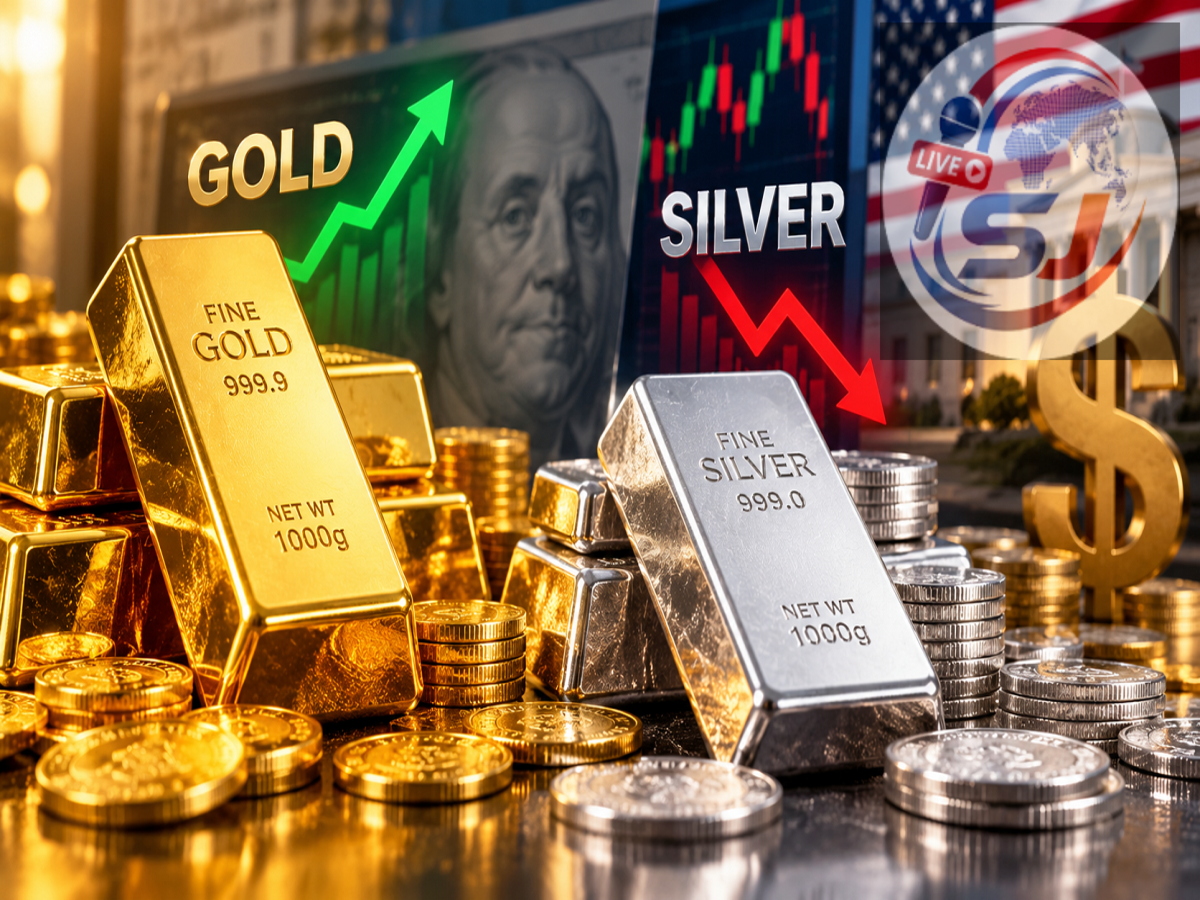
Gold and Silver Price Today, October 30, 2026: Gold and silver prices have witnessed sharp fluctuations after reaching historic highs earlier this year. The recent decline has attracted the attention of jewellery buyers and investors, raising an important question: will precious metals become cheaper, or could the correction offer a long-term investment opportunity?
According to a Live Hindustan report published on October 30, 2026, gold futures on the Multi Commodity Exchange (MCX) have fallen by more than ₹51,000 per 10 grams from their reported record high of ₹1,93,096.
Silver has experienced an even steeper correction. From its reported peak of ₹4,20,048 per kilogram, the metal has declined by more than ₹2.33 lakh at the levels discussed in the report.
Market experts attribute the weakness to profit-booking, a stronger US dollar, concerns over interest rates, rising crude oil prices and uncertainty surrounding global industrial demand.
However, analysts remain divided over the future direction of precious metals.
Gold and Silver Prices: How Much Have They Fallen?
The report highlights the significant difference between the record highs and the prices seen during the recent correction.
| Precious metal |
Reported record high |
Recent level discussed |
Approximate decline |
|---|---|---|---|
| Gold (MCX, per 10 grams) |
₹1,93,096 |
Around ₹1.42 lakh |
Over ₹51,000 |
| Silver (MCX, per kg) |
₹4,20,048 |
₹1,92,800 |
₹2,27,248 |
The silver calculation in the table uses the specifically quoted price of ₹1,92,800. At that level, the decline is approximately ₹2.27 lakh, or 54.1%. A fall exceeding ₹2.33 lakh would require a price below approximately ₹1.87 lakh.
These are historical reference levels cited in the report, not independently verified live market quotations. MCX prices also depend on the relevant futures contract.
Why Are Gold Prices Falling?
Gold is generally viewed as a safe-haven investment during periods of economic or geopolitical uncertainty.
However, even safe-haven assets can experience sharp corrections after a prolonged rally.
According to Rajiv Sharan, Head of Research at Brickwork Ratings, several factors have contributed to the recent weakness.
1. Profit-Booking After Record Highs
Gold prices had risen sharply before the recent decline.
When prices reach record levels, some investors sell their holdings to lock in profits.
Large-scale profit-booking can create additional selling pressure, particularly in futures markets.
This does not necessarily mean that the long-term investment outlook has permanently changed.
2. Stronger US Dollar
Gold is internationally priced in US dollars.
When the dollar strengthens, gold can become more expensive for buyers using other currencies.
This may reduce demand and put pressure on international prices.
However, the relationship is not always straightforward because geopolitical events and investment flows can influence both assets.
3. Higher US Bond Yields
Gold does not provide regular interest income.
When US government bond yields rise, interest-bearing investments may become relatively more attractive.
As a result, some investors may reduce their exposure to gold.
4. Uncertainty Over Federal Reserve Interest Rates
The US Federal Reserve's monetary policy remains an important factor for precious metal prices.
Expectations of lower interest rates can support gold because they reduce the opportunity cost of holding a non-interest-bearing asset.
Conversely, expectations that interest rates will remain elevated can weigh on prices.
5. Changing Geopolitical Risks
Gold often benefits from safe-haven demand during periods of heightened uncertainty.
If geopolitical tensions ease, some of that demand may decline.
However, renewed conflicts or financial instability can quickly change market sentiment.
Gold Price Outlook: Could MCX Gold Fall to ₹1.42 Lakh?
Anindya Banerjee, Head of Currency and Commodity Research at Kotak Neo, has warned that gold may remain under pressure in the near term.
According to the report, Banerjee identified $4,120 per ounce in the international market and ₹1,46,000 per 10 grams on MCX as important levels.
He suggested that investors should remain cautious about expecting a sustained recovery while prices stay below these levels.
His analysis also indicated that MCX gold could approach ₹1.42 lakh per 10 grams under certain market conditions.
This is a possible downside scenario rather than a guaranteed price target.
The outlook may change depending on movements in the dollar, crude oil prices, US bond yields and Federal Reserve policy expectations.
Can Gold Fall Below ₹1.40 Lakh?
The ₹1.40 lakh region has emerged as an area of interest in the analysis.
However, no technical level can guarantee that a price decline will stop.
If selling pressure intensifies, gold could move below an anticipated support area.
Similarly, a reversal in the dollar or bond yields could improve sentiment and support a recovery.
Investors should avoid treating a single price target as a certain buying opportunity.
Those purchasing gold for weddings or other fixed requirements may need to consider their purchase deadline rather than waiting indefinitely for a lower price.
Silver Price Crash: Why Has Silver Fallen More Than Gold?
Silver has experienced substantially greater volatility than gold.
According to Ajay Kedia, President of Kedia Commodities, MCX silver declined from a reported high of ₹4,20,048 per kilogram to around ₹1,92,800.
That represents a fall of approximately 54.1%.
The report also cites a decline in international silver prices from $121.64 to $53.47 per ounce, equivalent to roughly 56%.
Silver prices are influenced by both investment demand and industrial consumption.
This makes the metal particularly sensitive to changes in economic growth expectations.
Four Major Reasons Behind the Silver Price Decline
Industrial demand concerns: Silver is used in electronics, solar-related applications and several manufacturing processes. A slowdown in industrial activity can weaken demand expectations.
Higher interest rates: If inflation remains elevated, central banks may be less willing to reduce interest rates. This can affect investor interest in precious metals.
Liquidity pressures: During periods of market stress, investors sometimes sell profitable or liquid assets to raise cash or cover losses elsewhere.
Crude oil and geopolitical developments: Rising energy prices can increase inflation concerns, influencing bond yields, monetary policy expectations and investment flows.
These factors can operate simultaneously, creating sharp and sometimes unpredictable price movements.
Silver Price Outlook: Could MCX Silver Reach ₹1.75 Lakh?
Anindya Banerjee has identified several important levels for silver.
In the international market, $50 per ounce was highlighted as a key support area.
If silver remains below that level, the next downside levels discussed in the report are $48 and $46 per ounce.
For MCX silver, ₹2.10 lakh per kilogram was identified as an important upper resistance area.
Under unfavourable market conditions, the analyst suggested that silver could decline toward ₹1.75 lakh–₹1.80 lakh per kilogram.
Important Gold and Silver Price Levels
| Metal |
Market level |
Expert interpretation |
|---|---|---|
| Gold |
$4,120/oz |
International reference level for recovery |
| Gold |
₹1,46,000/10g |
MCX reference level |
| Gold |
₹1,42,000/10g |
Possible downside scenario |
| Silver |
$50/oz |
International support area |
| Silver |
$48–$46/oz |
Lower levels if support breaks |
| Silver |
₹2.10 lakh/kg |
MCX resistance area |
| Silver |
₹1.75–₹1.80 lakh/kg |
Possible downside range |
These levels reflect analyst commentary reported on October 30, 2026. They are not assured future prices.
Can Silver Recover to $90–$100 by Next Dhanteras?
Despite the recent decline, Ajay Kedia has expressed optimism about silver's longer-term prospects.
According to the report, Kedia believes that industrial demand and supply constraints could eventually support a recovery.
He estimated that approximately half of silver demand is linked to industrial uses.
If industrial consumption strengthens while supply remains constrained, prices could receive support.
Based on these factors, Kedia suggested that international silver prices might approach $90–$100 per ounce by the next Dhanteras.
However, this is a longer-term forecast and should not be confused with the near-term downside risks highlighted by other analysts.
The recovery scenario depends on several uncertain factors, including economic growth, industrial demand, interest rates and supply conditions.
There is no guarantee that silver will reach the projected range.
Is the Gold Price Fall a Correction or a Trend Reversal?
Rajiv Sharan of Brickwork Ratings has described the recent weakness as a possible correction rather than definitive evidence that gold's longer-term upward trend has ended.
According to his analysis, the decline from a more recent October high was around 5%.
This differs from the much larger decline calculated against the January record high.
Both figures can be meaningful, but they refer to different starting points.
Investors should therefore examine the period being compared before interpreting claims about how much gold has fallen.
A short-term correction can occur within a broader upward trend.
However, a prolonged period of selling pressure could also signal a more substantial change in market conditions.
Should You Buy Gold and Silver After the Crash?
The recent decline may appear attractive to investors who were waiting for lower prices.
However, buying solely because an asset has fallen sharply can be risky.
A price that is substantially below its record high can still decline further.
The analysts cited in the report suggest considering a disciplined approach rather than investing a large amount at a single price.
Important Points Before Investing
-
Consider staggered purchases: Buying in stages can reduce dependence on a single entry price, although it cannot eliminate losses.
-
Understand the difference between gold and silver: Gold is commonly used for portfolio diversification, while silver can be more volatile because of industrial demand.
-
Monitor global indicators: The US dollar, bond yields, crude oil and central bank decisions can influence precious metal prices.
-
Match purchases to your financial goals: Jewellery purchases, long-term investments and short-term trading involve different considerations.
-
Avoid relying entirely on price targets: Analyst forecasts are scenarios, not guarantees.
Investors should also consider their financial position, investment horizon and tolerance for losses.
MCX Gold Price vs Jewellery Price: What Is the Difference?
The price quoted on MCX is not necessarily the amount a customer will pay at a jewellery shop.
MCX futures prices relate to exchange-traded contracts with specified terms.
Retail jewellery prices depend on additional factors such as purity, local market premiums, taxes and making charges.
For example, the price of a 24-carat gold futures contract cannot be directly compared with the final bill for a 22-carat gold necklace.
Consumers should check the metal's purity, applicable GST, making charges and hallmarking details before purchasing jewellery.
The same principle applies to silver coins, bars and ornaments.
What Could Decide Gold and Silver Prices Next?
The next major price movements may depend on developments in international financial markets.
If the US dollar strengthens further and bond yields remain elevated, precious metals could face additional pressure.
Higher crude oil prices could also complicate the inflation outlook and affect expectations for interest rate reductions.
On the other hand, a weaker dollar, declining yields or renewed safe-haven demand could support gold.
For silver, industrial demand will remain particularly important.
A recovery in manufacturing and continued demand from technology-related sectors could improve its outlook.
However, weaker global growth could delay any sustained recovery.
Gold and Silver Price Outlook 2026: Final Update
Gold and silver have experienced significant declines from the record levels cited in the report.
Gold has fallen by more than ₹51,000 per 10 grams from its reported January high, while silver has lost more than half its value when measured against the stated MCX peak and recent reference price.
Experts remain cautious about the near-term outlook, particularly for silver.
At the same time, some analysts believe that long-term industrial demand and supply constraints could eventually support a recovery.
The key takeaway: Gold and silver prices remain sensitive to the US dollar, interest rates, crude oil and global economic conditions. Analysts have identified possible downside levels for both metals, but these are forecasts rather than guaranteed targets. Buyers and investors should consider their needs, time horizon and financial risk before making decisions.
Disclaimer: This article is based on market commentary and analyst estimates cited in the supplied report. The prices refer to reported market levels, not independently verified live quotations. Precious metal prices can fluctuate sharply, and the forecasts discussed are not guaranteed. This content is for information only and does not constitute personalised investment advice.