
Gold and Silver Holding Rules 2026: How Much Jewellery Can You Keep at Home Without Income Tax Trouble?
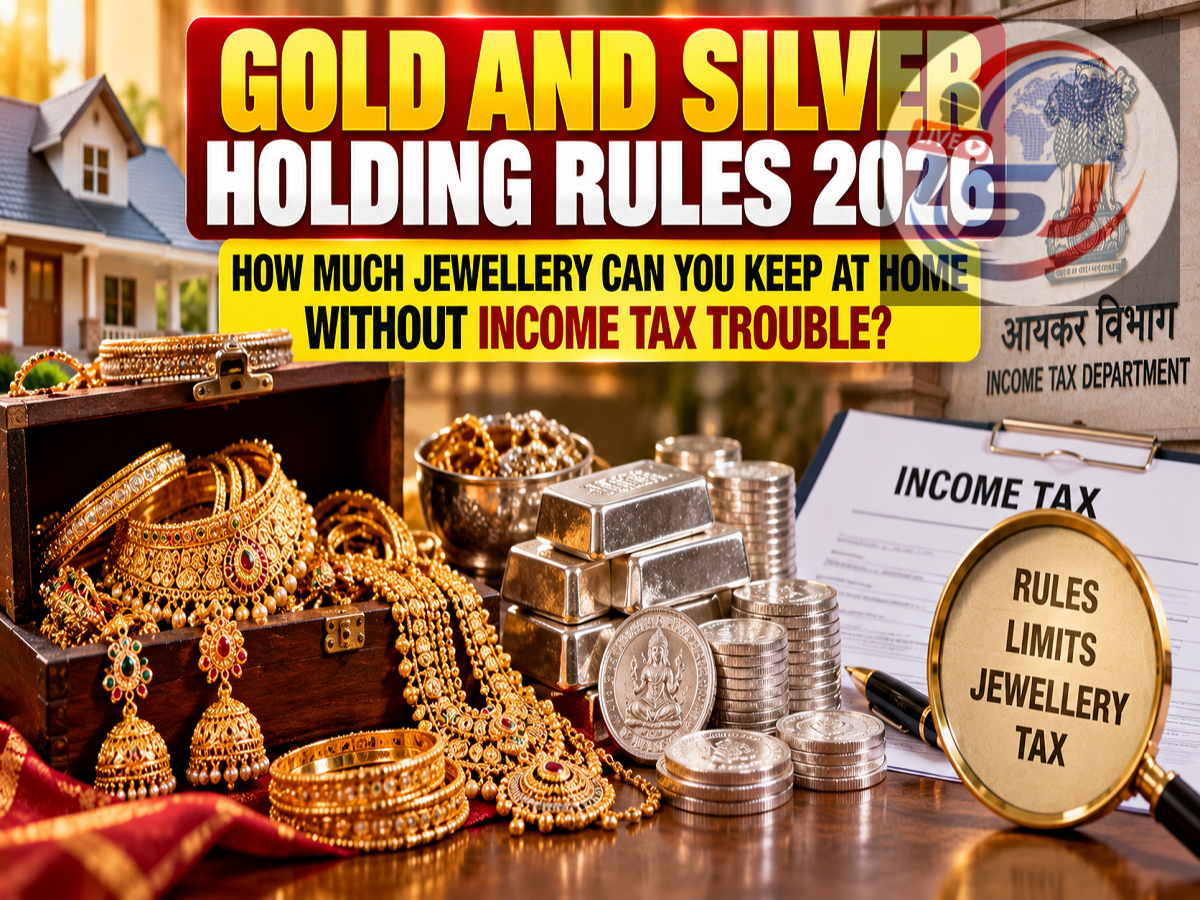
Gold and Silver Rules in India 2026: Gold and silver are an important part of Indian households, particularly during weddings, festivals and family celebrations. Many families own jewellery received as wedding gifts, inherited from previous generations or purchased gradually over several years.
However, one question often concerns taxpayers: How much gold and silver can legally be kept at home or in a bank locker without attracting action from the Income Tax Department?
The Central Board of Direct Taxes (CBDT) has issued guidelines regarding the seizure of gold jewellery and ornaments during income tax searches. These guidelines specify quantities for married women, unmarried women and male family members.
Under CBDT Instruction No. 1916, the commonly cited thresholds are 500 grams for a married woman, 250 grams for an unmarried woman and 100 grams for a male family member.
However, these figures are frequently misunderstood. They are guidelines concerning the seizure of jewellery during income tax searches, not maximum legal ownership limits or automatic tax exemptions.
Here is a detailed explanation of the gold and silver holding rules, documentation requirements and precautions taxpayers should understand in 2026.
How Much Gold Can You Legally Keep at Home in India?
Indian income tax law does not prescribe a general maximum quantity of legitimately acquired gold jewellery that an individual may keep at home.
A person may own more than 500 grams, 1 kilogram or another quantity of gold, provided its acquisition can be satisfactorily explained where required.
Gold may be acquired through several legitimate sources, including purchases from disclosed income, inheritance, family gifts and wedding presents.
The important consideration is not merely the weight of the jewellery but whether the person can establish a credible source of acquisition.
CBDT Instruction No. 1916 provides specific guidance concerning the seizure of jewellery and ornaments found during income tax searches.
CBDT Gold Jewellery Limits: 500 Grams, 250 Grams and 100 Grams
The following quantities are commonly referenced under CBDT Instruction No. 1916.
| Family Member |
Gold Jewellery Seizure Guideline |
|---|---|
| Married woman |
500 grams |
| Unmarried woman |
250 grams |
| Male family member |
100 grams |
These figures relate to jewellery and ornaments in the context of income tax search proceedings.
They should not be interpreted as a blanket permission to hold unexplained assets or as a guarantee that the Income Tax Department cannot ask questions.
Importantly, the instruction also recognises that larger quantities of jewellery may be reasonable in certain circumstances, depending on family customs, traditions and other relevant facts.
Is Gold Above 500 Grams Illegal?
No. Owning more than 500 grams of gold jewellery is not automatically illegal.
For example, a married woman may possess jewellery exceeding 500 grams because of inheritance, wedding gifts or purchases made from legitimate income.
Similarly, a family may collectively own several kilograms of gold accumulated across generations.
There is no general rule stating that all jewellery exceeding the CBDT thresholds must be confiscated or taxed.
However, if tax authorities investigate the source of the jewellery, the owner may need to provide a satisfactory explanation.
The applicable tax consequences depend on the facts, supporting evidence and relevant provisions of income tax law.
Does Keeping Extra Gold Automatically Attract Income Tax?
Simply possessing gold jewellery above the CBDT guideline does not automatically create a new income tax liability.
Tax may become relevant when jewellery is purchased using undisclosed income, when unexplained assets are identified or when a taxable transaction occurs.
For example, if an individual purchases expensive gold jewellery using properly disclosed savings, the quantity alone does not make the purchase unlawful.
On the other hand, if a person cannot satisfactorily explain how valuable assets were acquired, tax authorities may examine the matter under the applicable provisions.
The distinction between legitimately acquired assets and unexplained investments is important.
What Is the Silver Holding Limit in India?
Unlike gold jewellery, CBDT Instruction No. 1916 does not specify equivalent fixed weight thresholds for silver.
There is no general maximum quantity of legitimately acquired silver that an individual may keep at home solely under these income tax guidelines.
A family may possess silver utensils, coins, jewellery, religious articles or inherited silver items.
However, the absence of a fixed silver limit does not mean that the source of a large silver holding can never be questioned.
Tax authorities may seek an explanation for valuable silver assets during an investigation.
Purchase records, inheritance details and other supporting evidence may be useful in such circumstances.
Gold vs Silver Holding Rules in India
| Particulars |
Gold |
Silver |
|---|---|---|
| General maximum legal holding limit |
No fixed maximum for legitimately acquired holdings |
No fixed maximum for legitimately acquired holdings |
| CBDT Instruction No. 1916 weight guidelines |
Yes, for gold jewellery and ornaments |
No equivalent fixed weight guideline |
| Can authorities ask about the source? |
Yes |
Yes |
| Are purchase documents useful? |
Yes |
Yes |
| Can inherited assets be legally held? |
Yes |
Yes |
| Does exceeding a particular weight automatically trigger tax? |
No |
No |
What Happens to Gold Jewellery During an Income Tax Raid?
During an authorised income tax search, officials may examine jewellery, cash, documents and other assets found at the premises.
CBDT Instruction No. 1916 provides guidance on jewellery and ornaments that ordinarily should not be seized up to the specified quantities in the circumstances covered by the instruction.
However, the treatment of jewellery can depend on the person's status, the nature of the asset and the facts of the case.
Jewellery found during a search may still be inventoried or examined even when it is not seized.
The authorities may also ask questions about ownership and acquisition.
Therefore, the CBDT guideline should not be confused with complete immunity from investigation.
Are Gold Coins and Gold Bars Covered by the Same Limits?
An important distinction exists between gold jewellery and other forms of gold.
CBDT Instruction No. 1916 specifically concerns jewellery and ornaments.
Its weight-based seizure guidelines should not automatically be applied to gold bars, bullion or investment-grade gold coins.
This does not mean that holding gold bars or coins is inherently illegal.
Instead, their treatment depends on the applicable law and the circumstances in which they were acquired.
Individuals holding substantial quantities of investment gold should maintain suitable records supporting the source and ownership of those assets.
What Documents Should You Keep for Gold and Silver?
Maintaining proper records can make it easier to explain the acquisition of jewellery and precious metals.
Useful supporting documents may include:
-
Purchase invoices from jewellers.
-
Bank statements showing payments.
-
Gift deeds or other records relating to substantial gifts.
-
Inheritance documents or family settlement records.
-
Insurance valuations and jewellery inventories.
-
Relevant income tax records and evidence of disclosed income.
Not every inherited ornament will necessarily have an original purchase invoice, particularly when jewellery has remained in a family for decades.
In such cases, other credible evidence and the surrounding circumstances may be relevant.
A missing invoice does not automatically prove that jewellery is an undisclosed asset.
Are Wedding Gifts and Inherited Jewellery Tax-Free?
Jewellery received at the time of marriage or through inheritance may receive favourable treatment under certain income tax provisions.
However, the tax treatment of gifts depends on factors such as the relationship between the giver and recipient, the occasion and the applicable statutory conditions.
Gifts received by an individual on the occasion of their marriage are generally covered by a specific exemption under the income tax provisions governing gifts.
Assets received through inheritance or under a will are also generally covered by relevant exclusions from gift taxation.
However, later sale of such jewellery may give rise to capital gains tax, depending on the circumstances.
Therefore, exemption at the time of receiving jewellery should not be confused with exemption from every future tax consequence.
Mumbai ITAT Case: What Happened With Gold and Silver Jewellery?
A case discussed before the Mumbai bench of the Income Tax Appellate Tribunal (ITAT) highlights the importance of examining the facts behind precious metal holdings.
According to the reported case, authorities found several categories of assets at a woman's residence and bank locker.
These included:
| Asset Category |
Reported Quantity |
|---|---|
| Gold jewellery |
427.71 grams |
| Pure gold |
258 grams |
| Gold contained in diamond-studded jewellery |
161.33 grams |
| Silver |
11.2 kilograms |
The woman reportedly explained that the assets were connected with wedding gifts, stridhan, inheritance and jewellery accumulated by the family over several decades.
The tribunal considered the circumstances surrounding the assets and did not accept an approach that treated pure gold as unexplained solely because of its physical form.
The case illustrates that the source, family background and supporting facts may be important in determining the tax treatment of precious metals.
However, individual tribunal decisions depend on their specific facts and should not be interpreted as creating a universal exemption for all gold bars or silver holdings.
Can You Keep Gold and Silver in a Bank Locker?
Yes. Individuals may keep legitimately owned jewellery and precious metals in bank lockers, subject to the bank's terms and applicable rules.
However, keeping an asset in a bank locker does not automatically establish that it was acquired from disclosed income.
The same underlying questions about ownership and source may arise if authorities investigate the assets.
Maintaining an inventory of valuable jewellery and preserving available purchase or inheritance records can be useful.
Individuals should also understand the bank's locker agreement and any applicable insurance arrangements.
How Can Families Avoid Tax Disputes Over Jewellery?
Families holding substantial quantities of gold and silver can reduce potential difficulties by maintaining clear records.
When purchasing expensive jewellery, obtain proper invoices showing the transaction details.
For inherited jewellery, preserve available family documents or other evidence establishing how the assets were received.
If substantial jewellery is gifted, appropriate documentation may help clarify ownership and the nature of the transfer.
It is also sensible to keep records of jewellery stored in different locations, including bank lockers.
These measures do not guarantee that an investigation will never occur, but they can make it easier to provide a credible explanation if questions arise.
Gold and Silver Rules 2026: Final Takeaway
Indian taxpayers are not subject to a general maximum legal holding limit for gold or silver that has been legitimately acquired.
CBDT Instruction No. 1916 provides guidelines concerning the non-seizure of gold jewellery during income tax searches: 500 grams for a married woman, 250 grams for an unmarried woman and 100 grams for a male family member.
These quantities are not ownership limits and do not mean that gold exceeding them automatically becomes taxable or illegal.
Similarly, there is no equivalent fixed silver weight threshold under the instruction.
The most important consideration is whether the ownership and source of valuable assets can be satisfactorily explained when required.
Families with substantial inherited jewellery, wedding gifts or precious metal investments should preserve available records and seek professional tax advice where necessary.
Disclaimer: This article provides general information based on CBDT Instruction No. 1916 and the reported legal developments discussed as of October 14, 2026. Actual treatment during tax proceedings depends on the facts, applicable law and judicial interpretation.