
Free Ration Scheme 2026: Who Gets 5 Kg or 35 Kg Free Foodgrains Every Month?
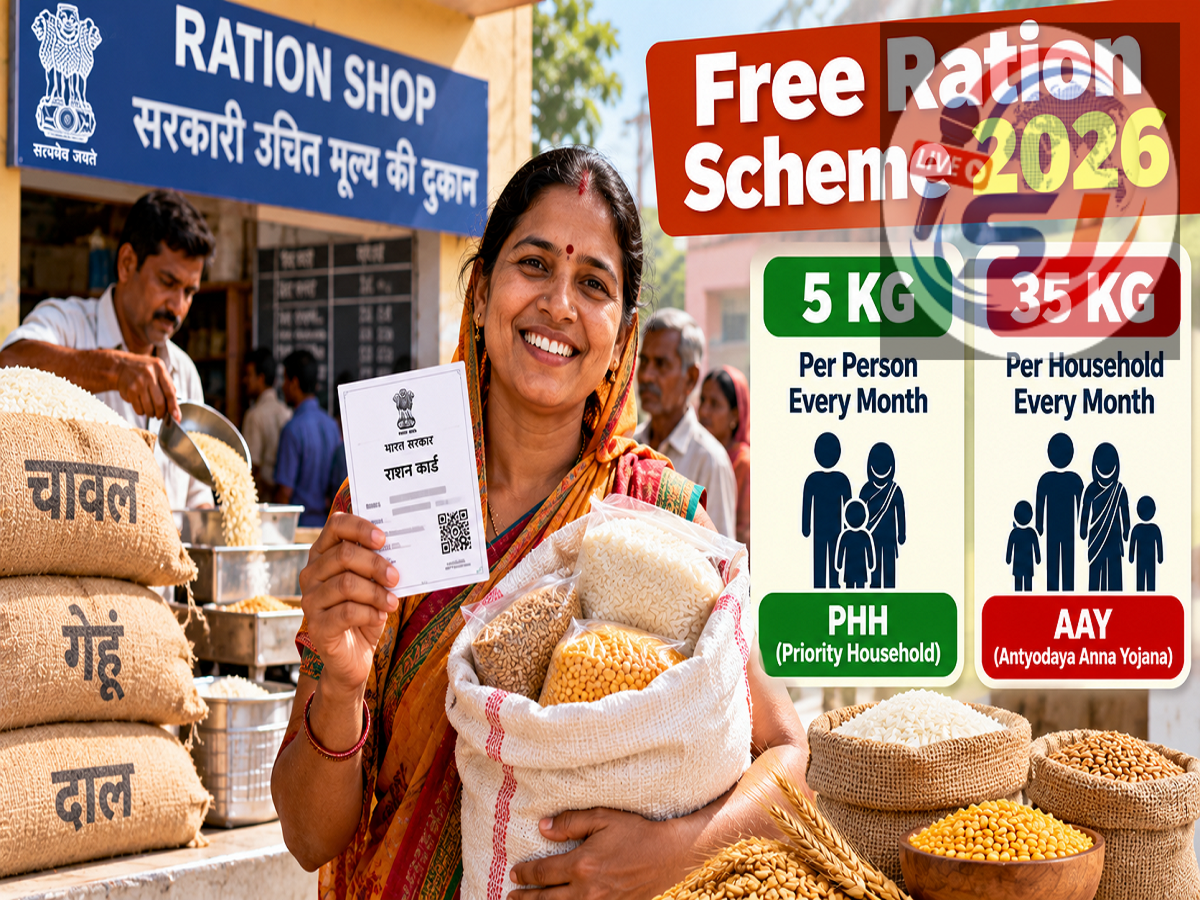
Free Ration Scheme Latest Update, October 24, 2026: Millions of low-income families across India continue to receive free wheat and rice under the central government's food security programme. The initiative helps eligible households reduce their monthly food expenses and ensures access to essential foodgrains.
Under the Pradhan Mantri Garib Kalyan Anna Yojana (PMGKAY), eligible beneficiaries covered by the National Food Security Act (NFSA), 2013, receive foodgrains without paying the usual issue price.
The government approved the continuation of free foodgrain distribution for five years beginning January 1, 2024, extending the arrangement through December 2028.
However, there is an important distinction in the quantity distributed to different categories of beneficiaries. While Priority Household (PHH) members receive 5 kg per person every month, Antyodaya Anna Yojana (AAY) households receive 35 kg per family per month, regardless of the number of family members.
Here is a detailed explanation of the eligibility requirements, monthly entitlements, ration card categories and complaint procedures.
What Is the Free Ration Scheme?
The Pradhan Mantri Garib Kalyan Anna Yojana is a major food security initiative designed to support economically vulnerable households.
The programme was originally introduced during the COVID-19 pandemic to provide additional foodgrain assistance to eligible beneficiaries.
Subsequently, the government continued free distribution of NFSA foodgrain entitlements under the PMGKAY arrangement.
The objective is to ensure that households covered by the food security system can obtain essential foodgrains without the burden of paying the prescribed central issue price.
प्रधानमंत्री गरीब कल्याण अन्न योजना के तहत पात्र लाभार्थियों को हर महीने निःशुल्क खाद्यान्न उपलब्ध कराया जाता है, जिससे परिवारों को खाद्य जरूरतें पूरी करने में सहायता मिलती है और अन्य आवश्यक खर्चों के लिए आर्थिक राहत मिलती है। #PMGKAY #DFPD #FoodSecurity https://t.co/OTrjGHntMU
— Department of Food & Public Distribution (@fooddeptgoi) October 23, 2026
The programme operates through the Public Distribution System (PDS), which supplies foodgrains to eligible families through fair price shops.
Beneficiaries generally receive wheat, rice or other notified foodgrains according to the allocation and distribution arrangements applicable in their state or Union Territory.
Free Ration Scheme Extended Until December 2028
The central government approved a five-year continuation of free foodgrain distribution beginning January 1, 2024.
This means eligible NFSA beneficiaries are covered by the arrangement through December 31, 2028, subject to applicable rules and government decisions.
The continuation provides longer-term support to households that depend on subsidised food distribution.
It also helps beneficiaries plan their household budgets because their basic NFSA foodgrain entitlements are supplied free of charge.
Importantly, the five-year extension does not mean that every Indian resident automatically qualifies for free ration.
Eligibility remains linked to inclusion under the National Food Security Act and the applicable beneficiary lists maintained by state and Union Territory authorities.
How Much Free Ration Does Each Person Receive?
The quantity of foodgrains depends on the category under which a household is covered.
There are two major NFSA beneficiary categories: Priority Households and Antyodaya Anna Yojana households.
PHH beneficiaries are entitled to 5 kg of foodgrains per eligible person every month.
For example, a family with four eligible PHH members receives a total monthly entitlement of 20 kg.
A five-member PHH family receives 25 kg.
AAY households, however, receive a fixed entitlement of 35 kg per household each month.
This distinction is important because the 5 kg per person formula does not apply to AAY families.
Free Ration Quantity for Different Family Sizes
The following table explains how monthly foodgrain entitlements are calculated.
| Eligible Family Members |
PHH Monthly Entitlement |
AAY Monthly Entitlement |
|---|---|---|
| 1 member |
5 kg |
35 kg |
| 2 members |
10 kg |
35 kg |
| 3 members |
15 kg |
35 kg |
| 4 members |
20 kg |
35 kg |
| 5 members |
25 kg |
35 kg |
| 6 members |
30 kg |
35 kg |
| 7 members |
35 kg |
35 kg |
| 8 members |
40 kg |
35 kg |
The table illustrates the standard NFSA entitlements.
The actual combination of rice, wheat or other notified foodgrains may differ depending on state allocations and distribution policies.
Who Is Eligible for Free Ration in 2026?
Free foodgrain benefits are available to eligible households identified under the National Food Security Act.
The two main beneficiary categories are:
Priority Households (PHH): These households are identified according to eligibility criteria applied by the relevant state or Union Territory government. Each eligible member receives 5 kg of foodgrains per month.
Antyodaya Anna Yojana (AAY): This category is intended for the poorest and most vulnerable households identified under the applicable criteria. Each eligible household receives 35 kg of foodgrains per month.
A person's eligibility cannot be determined solely by the fact that they possess a ration card.
The ration card must fall under an eligible NFSA category, and the beneficiary details must be correctly recorded in the relevant database.
State governments and Union Territory administrations are responsible for identifying eligible households under the applicable framework.
Is Every Ration Cardholder Eligible for 5 Kg Free Ration?
No. This is one of the most important points beneficiaries should understand.
Not every ration cardholder automatically receives 5 kg of free foodgrains per person.
The benefit depends on the ration card's category and its coverage under NFSA.
Some states issue different types of ration cards for various purposes.
Certain cards may be used for identification or state-specific benefits without carrying the standard central NFSA entitlement.
Therefore, households should verify whether their ration card is classified under PHH or AAY.
The quantity printed or recorded against the household's entitlement should also be checked.
What Foodgrains Are Distributed Under PMGKAY?
The scheme primarily covers essential foodgrains supplied through the Public Distribution System.
These commonly include rice and wheat.
The specific allocation can vary according to government decisions and regional distribution arrangements.
In some areas, other notified foodgrains may also form part of the allocation.
The standard central NFSA entitlement should not be confused with additional items that some state governments may distribute under separate welfare programmes.
For example, pulses, cooking oil, sugar or other products may be provided through state-specific initiatives where applicable.
Such items are not automatically guaranteed to every PMGKAY beneficiary across India.
How to Check Your Name on the Ration Card Beneficiary List
Eligible households can verify their ration card details through the National Food Security Portal or the relevant state food department website.
The general process involves visiting the official portal, selecting the state or Union Territory and accessing the available ration card or beneficiary information services.
Depending on the state, users may need to select their district, block, village or fair price shop.
Some state portals also provide a ration card number search facility.
The exact steps differ because beneficiary databases are maintained by the respective state and Union Territory administrations.
Beneficiaries can begin by visiting the National Food Security Portal.
Can You Apply for a New Free Ration Card?
People who believe they qualify for NFSA benefits but are not currently covered may contact their state food and civil supplies department.
The application procedure and eligibility criteria differ across states.
Applicants may be asked to provide household details, identity documents, address information and other supporting records.
Approval depends on the applicable identification criteria and available coverage under the food security system.
Submitting an application does not automatically guarantee inclusion in the beneficiary list.
Applicants should use official state government services rather than paying unauthorised agents who promise immediate approval.
What Is the One Nation One Ration Card Facility?
The One Nation One Ration Card (ONORC) initiative allows eligible NFSA beneficiaries to access their foodgrain entitlements through portability arrangements.
This is particularly useful for migrant workers and families who live or work away from their home state.
For example, an eligible beneficiary registered in one state may be able to collect the applicable ration entitlement from a participating fair price shop in another state.
The system relies on the relevant ration card records and prescribed authentication procedures.
Portability is intended to reduce difficulties faced by families who move between locations for employment or other reasons.
Beneficiaries should check the applicable authentication requirements and local distribution arrangements before collecting ration outside their home area.
What if a Ration Dealer Demands Money?
Foodgrains covered by the free NFSA distribution arrangement should be supplied without charging beneficiaries the prescribed issue price.
If an eligible beneficiary is asked to pay for their free entitlement, receives less than the prescribed quantity or faces another distribution-related problem, they can raise a complaint.
The complaint may be submitted through the relevant state food department, district supply office or designated grievance mechanism.
Beneficiaries should keep their ration card details and any available transaction records ready.
If possible, they should record the date of the incident, the fair price shop details and the nature of the problem.
The Department of Food and Public Distribution and the NFSA portal provide official information about food security programmes and relevant services.
Important Things Beneficiaries Should Remember
Households should regularly verify that their ration card details and family member information are accurate.
If an eligible family member is missing from the record, the household should contact the appropriate authority to understand the correction procedure.
Beneficiaries should also complete any applicable verification or e-KYC requirements according to official instructions.
They should avoid sharing Aadhaar OTPs, banking credentials or other confidential information with unknown callers claiming to represent the ration department.
Any changes to eligibility, distribution schedules or authentication requirements should be confirmed through government sources.
Final Takeaway
The central government's free foodgrain arrangement continues to provide important support to eligible households across India.
Under the five-year extension beginning January 1, 2024, NFSA beneficiaries are covered by the free distribution programme through December 2028.
Priority Household beneficiaries receive 5 kg of free foodgrains per eligible person each month, while Antyodaya Anna Yojana households receive 35 kg per family every month.
Families should verify their ration card category and entitlement through official government portals or their local food department.
Disclaimer: This article explains the standard NFSA and PMGKAY foodgrain entitlements. Eligibility, authentication procedures and distribution arrangements may vary by state. Beneficiaries should consult official government sources for their current household records and applicable requirements.