Free Ration Rules 2026: AAY and PHH Cardholders Get Different Foodgrain Benefits, Check Your Entitlement
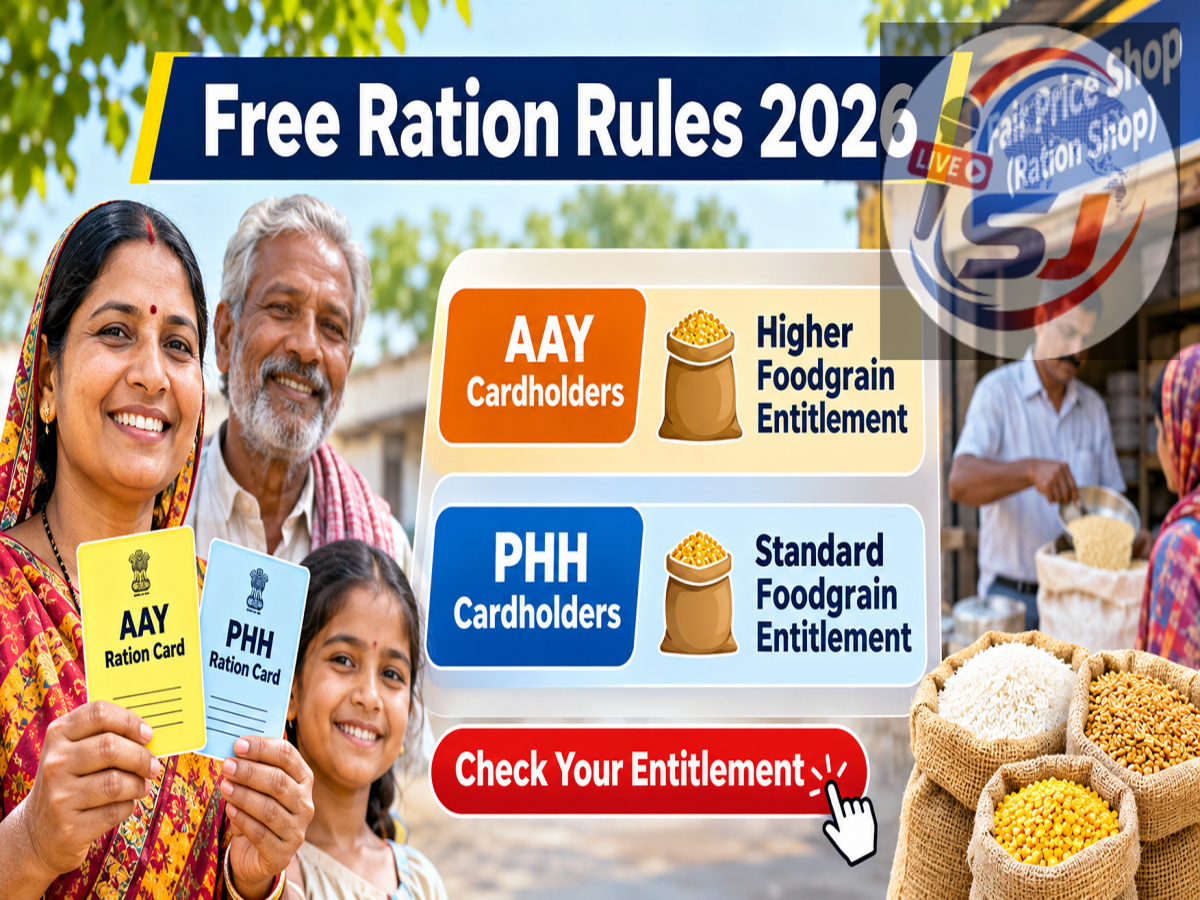
Free Ration Scheme 2026: Millions of eligible households across India receive free foodgrains through the Public Distribution System (PDS). However, the quantity of foodgrains provided to a family depends on the category of its ration card. Understanding the difference between Antyodaya Anna Yojana (AAY) and Priority Household (PHH) ration cards is important for ensuring that beneficiaries receive their correct monthly entitlement.
The Department of Food and Public Distribution (DFPD) has highlighted the importance of identifying the category of ration card held by a beneficiary. Under the National Food Security Act (NFSA), AAY and PHH households are entitled to different quantities of foodgrains.
While AAY families receive a fixed quantity every month, PHH beneficiaries receive foodgrains based on the number of eligible members in their household.
Knowing these rules can help ration cardholders verify their entitlements and avoid confusion when collecting foodgrains from fair price shops.
AAY vs PHH Ration Cards: What Is the Difference?
The National Food Security Act, 2013, provides a legal framework for distributing subsidised foodgrains to eligible households. Under the current free-foodgrain arrangement, eligible NFSA beneficiaries receive their prescribed foodgrain entitlement without paying for it.
There are two major beneficiary categories under the NFSA: Antyodaya Anna Yojana (AAY) and Priority Households (PHH).
Antyodaya Anna Yojana (AAY) is intended to provide food security support to the poorest and most vulnerable households identified under applicable eligibility rules.
Priority Household (PHH) coverage extends to eligible families identified by state governments and Union Territory administrations according to their prescribed criteria.
The most important distinction between these categories is the method used to calculate monthly foodgrain entitlements.
How Much Free Ration Do AAY and PHH Cardholders Receive?
The quantity of free foodgrains available under the NFSA depends on the beneficiary category.
| Ration Card Category |
Monthly Free Foodgrain Entitlement |
|---|---|
| Antyodaya Anna Yojana (AAY) |
35 kg per household |
| Priority Household (PHH) |
5 kg per eligible person |
| PHH family with 2 members |
10 kg |
| PHH family with 3 members |
15 kg |
| PHH family with 4 members |
20 kg |
| PHH family with 5 members |
25 kg |
| PHH family with 6 members |
30 kg |
| PHH family with 7 members |
35 kg |
These quantities represent the standard NFSA foodgrain entitlements. The exact combination of rice, wheat, or other eligible foodgrains may depend on applicable government allocations.
Additional food items or benefits provided under separate state government schemes may differ.
AAY Ration Card: 35 Kg Free Foodgrains Every Month
Antyodaya Anna Yojana is an important component of India's food security framework.
Under this category, an eligible household is entitled to receive 35 kilograms of foodgrains every month, regardless of the number of family members.
For example, an AAY household consisting of three members receives a total entitlement of 35 kg per month. Similarly, an AAY household with six members is also entitled to 35 kg.
This fixed household-based allocation is one of the defining features of the AAY category.
The programme is intended to support particularly vulnerable families by providing a predictable monthly foodgrain allocation.
However, possession of an AAY ration card is subject to identification and eligibility rules administered by the relevant state or Union Territory.
PHH Ration Card: Free Ration Based on Family Size
Priority Household beneficiaries follow a different entitlement structure.
Under the PHH category, each eligible person is entitled to receive 5 kilograms of foodgrains every month.
This means that the total quantity increases according to the number of eligible family members recorded on the ration card.
For instance, a family with four eligible members can receive 20 kg of foodgrains monthly. If the household has six eligible members, its monthly entitlement increases to 30 kg.
Therefore, PHH cardholders should ensure that their family details are correctly recorded in the ration card database.
Any change in household composition should be updated through the appropriate state food and civil supplies department, subject to applicable procedures.
Are AAY and PHH Foodgrains Free in 2026?
Yes. Under the government's free-foodgrain arrangement, eligible NFSA beneficiaries continue to receive their prescribed foodgrain entitlements free of cost in 2026.
The Union Government approved the continuation of free foodgrain distribution under the Pradhan Mantri Garib Kalyan Anna Yojana (PMGKAY) for five years beginning January 1, 2024.
This arrangement covers eligible AAY and PHH beneficiaries under the NFSA.
It is important to understand that free distribution applies to the prescribed foodgrain entitlement. Other commodities, if distributed through state-specific schemes, may be governed by separate eligibility conditions and pricing rules.
Beneficiaries should verify the details applicable in their state before assuming that every item supplied through a ration shop is free.
How to Check Whether Your Ration Card Is AAY or PHH
Ration cardholders can check their beneficiary category through the official food distribution systems maintained by the government.
The following steps can help:
-
Visit the official National Food Security Portal at **https://nfsa.gov.in/**.
-
Navigate to the ration card information or state-specific ration card details section.
-
Select your state or Union Territory and follow the link to its official food department portal.
-
Search for your ration card information using the details required by that state portal.
-
Check whether your household is classified under AAY or PHH.
-
Verify the number of eligible members and the corresponding monthly foodgrain entitlement.
The exact online verification procedure may vary between states.
Beneficiaries can also seek assistance from their local fair price shop or the relevant food and civil supplies office.
What Should You Do If You Receive Less Ration Than Your Entitlement?
Beneficiaries should remain aware of the quantity of foodgrains they are eligible to receive each month.
If a ration cardholder receives less than the prescribed entitlement, the first step is to verify the quantity recorded against the ration card and the distribution transaction.
Any discrepancy can be raised with the fair price shop dealer or the appropriate food distribution authority.
Beneficiaries may also use the grievance redressal facilities provided by their state government.
Keeping transaction receipts or electronic distribution records, where available, can help support complaints regarding incorrect quantities.
One Nation One Ration Card: Access Foodgrains Away From Home
The One Nation One Ration Card (ONORC) system provides portability benefits to eligible NFSA beneficiaries.
This facility allows beneficiaries to access their entitled foodgrains from participating fair price shops outside their home location, subject to applicable authentication and distribution procedures.
The system is particularly useful for migrant workers and families who temporarily live away from their registered place of residence.
Beneficiaries can also use official government services, including the Mera Ration application where supported, to access relevant ration card and distribution information.
Why Checking Your Ration Card Category Is Important
Many beneficiaries may not be fully aware of how their monthly foodgrain allocation is calculated.
An AAY household receives a fixed 35 kg entitlement, while a PHH household receives 5 kg for each eligible member.
Understanding this distinction helps families calculate their expected monthly ration and identify possible errors in distribution.
It also encourages beneficiaries to keep their ration card records updated and use official grievance channels whenever necessary.
Conclusion
India's free ration distribution system provides essential food security support to eligible households under the National Food Security Act.
However, the quantity of foodgrains available is not identical for every ration cardholder.
AAY households are entitled to 35 kg of free foodgrains per month, whereas PHH households receive 5 kg per eligible person per month.
Beneficiaries should check their ration card category, verify the number of eligible family members, and understand the applicable entitlement before collecting their monthly ration.
Staying informed about these rules can help households receive the foodgrain benefits available to them under government schemes.
Source Credit: Department of Food and Public Distribution (DFPD), Government of India; National Food Security Act, 2013; National Food Security Portal (https://nfsa.gov.in/). Based on the DFPD public awareness communication regarding AAY and PHH ration card entitlements.