FD vs SCSS: How Much Can Senior Citizens Earn Annually on a ₹10 Lakh Investment?
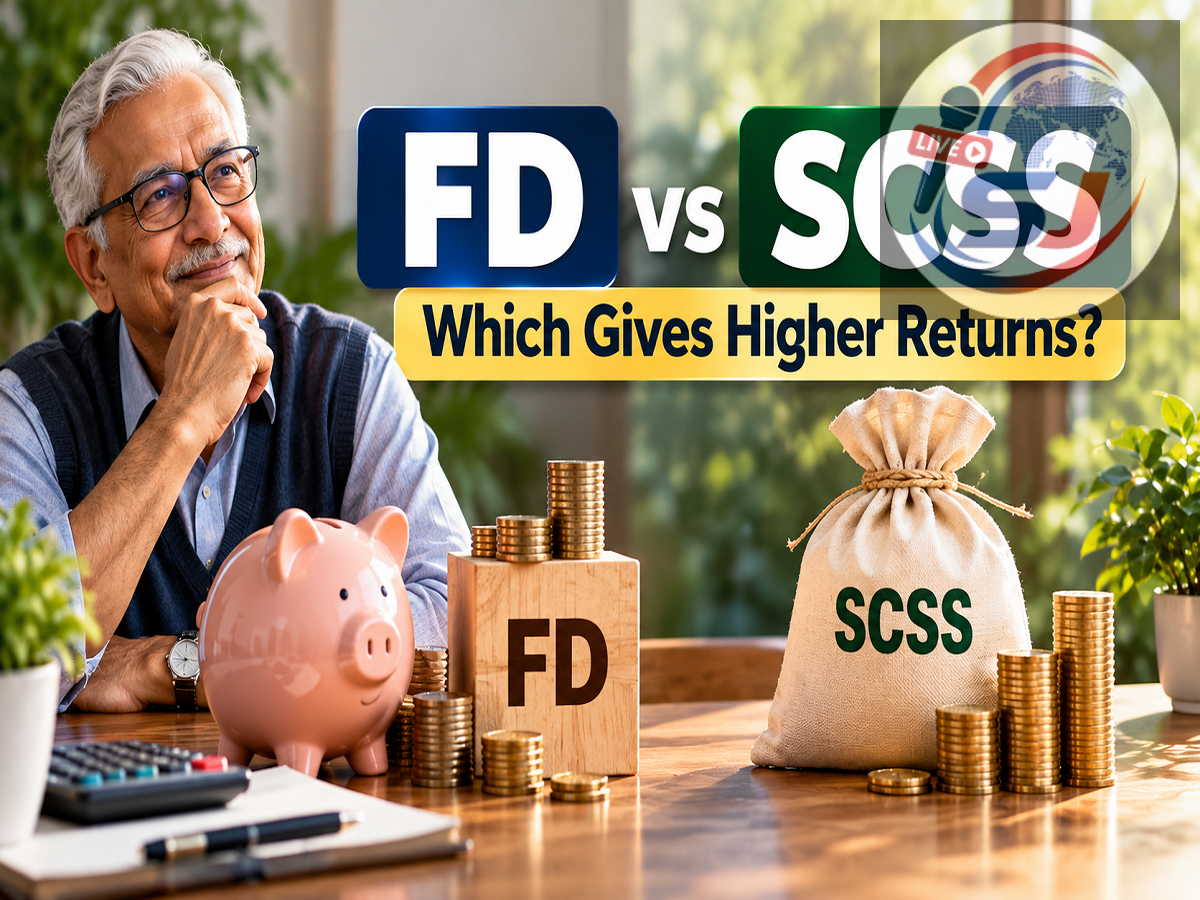
Senior citizens seeking a regular income after retirement often consider fixed deposits and the Senior Citizens’ Savings Scheme. Both options offer predictable returns without direct exposure to stock-market volatility, but they differ in interest rates, payment frequency, liquidity and tax treatment.
Based on the rates considered in this comparison, a ₹10 lakh investment in SCSS can generate ₹82,000 in annual interest, while an SBI senior-citizen fixed deposit at 7.05% can provide approximately ₹70,500 a year. The difference works out to ₹11,500 annually before tax.
The 7.05% SBI rate applies to senior citizens for deposits with a tenure of five years and up to 10 years, subject to the bank’s applicable terms. SBI’s published rate information should be checked before booking a deposit because bank rates can change.
How Much Will ₹10 Lakh Earn Under SCSS?
The Senior Citizens’ Savings Scheme currently offers an annual interest rate of 8.2%. This government-backed scheme pays interest every quarter, making it suitable for eligible retirees who need a predictable cash flow.
Here is the calculation:
₹10,00,000 × 8.2% = ₹82,000 per year
Since the interest is paid quarterly, the investor would receive:
₹82,000 ÷ 4 = ₹20,500 every quarter
The principal amount of ₹10 lakh remains invested during the scheme’s five-year tenure, subject to its rules. The account may also be extended after maturity in accordance with the prevailing provisions.
The government reviews small-savings rates every quarter. The rates for the July–September 2026 period were kept unchanged, including the SCSS rate. The government’s quarterly decision was reported here.
A later rate revision generally affects newly opened accounts. The rate applicable when an SCSS account is opened ordinarily remains fixed for that account’s original tenure.
SBI Senior-Citizen FD Return on ₹10 Lakh
For this comparison, an annual rate of 7.05% has been used for an SBI senior-citizen term deposit in the five-year to 10-year tenure category.
The indicative annual interest calculation is:
₹10,00,000 × 7.05% = ₹70,500 per year
If the depositor selects a periodic-interest option, the actual payout schedule will depend on the option offered by the bank. Depositors may generally be able to choose monthly, quarterly or another available payout frequency.
A cumulative FD works differently. Instead of paying interest regularly, the bank reinvests it, allowing compounding to increase the maturity amount. Therefore, ₹70,500 should be treated as a straightforward annual-interest illustration rather than the final maturity calculation for a cumulative deposit.
SCSS and SBI FD Return Comparison
| Investment Option | Annual Interest Rate | Annual Interest on ₹10 Lakh | Payment Pattern |
|---|---|---|---|
| Senior Citizens’ Savings Scheme | 8.20% | ₹82,000 | Paid quarterly |
| SBI Senior-Citizen FD | 7.05% | ₹70,500 | Depends on the selected option |
| Difference | 1.15 percentage points | ₹11,500 more under SCSS | Before tax |
At these rates, SCSS provides approximately ₹2,875 more per quarter than the annualised equivalent of the SBI FD.
How Much Could Remain After Tax?
Interest earned from both SCSS and bank fixed deposits is taxable according to the investor’s applicable income-tax slab. The scheme’s headline interest rate is not a tax-free return.
Suppose the entire interest income is taxable at 20%, and a 4% health and education cess is also applied. The effective rate for this simplified illustration becomes 20.8%.
Estimated tax on SCSS interest
- Annual interest: ₹82,000
- Illustrative tax at 20.8%: ₹17,056
- Estimated post-tax interest: ₹64,944
Estimated tax on FD interest
- Annual interest: ₹70,500
- Illustrative tax at 20.8%: ₹14,664
- Estimated post-tax interest: ₹55,836
| Option | Gross Annual Interest | Illustrative Tax | Estimated Post-Tax Interest |
|---|---|---|---|
| SCSS | ₹82,000 | ₹17,056 | ₹64,944 |
| SBI Senior-Citizen FD | ₹70,500 | ₹14,664 | ₹55,836 |
| Post-tax difference | — | — | ₹9,108 |
These figures represent an estimated income-tax liability, not necessarily the amount that will be deducted at source. Actual tax depends on the investor’s total taxable income, deductions, exemptions, rebate eligibility and interest earned from all deposits. TDS and final income-tax liability are also separate concepts.
Which Option May Be More Suitable?
SCSS produces a higher return in this example and guarantees quarterly interest payments. It may suit eligible investors who want regular income and are comfortable keeping their money invested for a five-year term.
An FD may provide greater flexibility because customers can choose from different tenures, banks and payout options. Premature withdrawal is also possible, although the bank may impose a penalty or reduce the effective interest rate.
Senior citizens should compare the following points before deciding:
- Current interest rate
- Required payout frequency
- Lock-in period and premature-closure rules
- Tax liability
- Need for emergency liquidity
- Deposit safety and applicable protection
- Nomination and account-operation facilities
At the rates used here, SCSS offers ₹11,500 more gross annual interest on ₹10 lakh than the SBI senior-citizen FD. However, the higher rate should not be the only consideration. Investors should evaluate income needs, access to funds and tax implications before choosing either option.
Disclaimer: This article is intended for general information only and does not constitute investment or tax advice. Interest rates and rules may change. Verify the latest terms with the bank, post office or relevant authority and consult a qualified adviser before investing.