
FD Laddering Strategy 2026: Earn Up to 8.60% Interest and Learn How to Invest ₹10 Lakh in Four Fixed Deposits
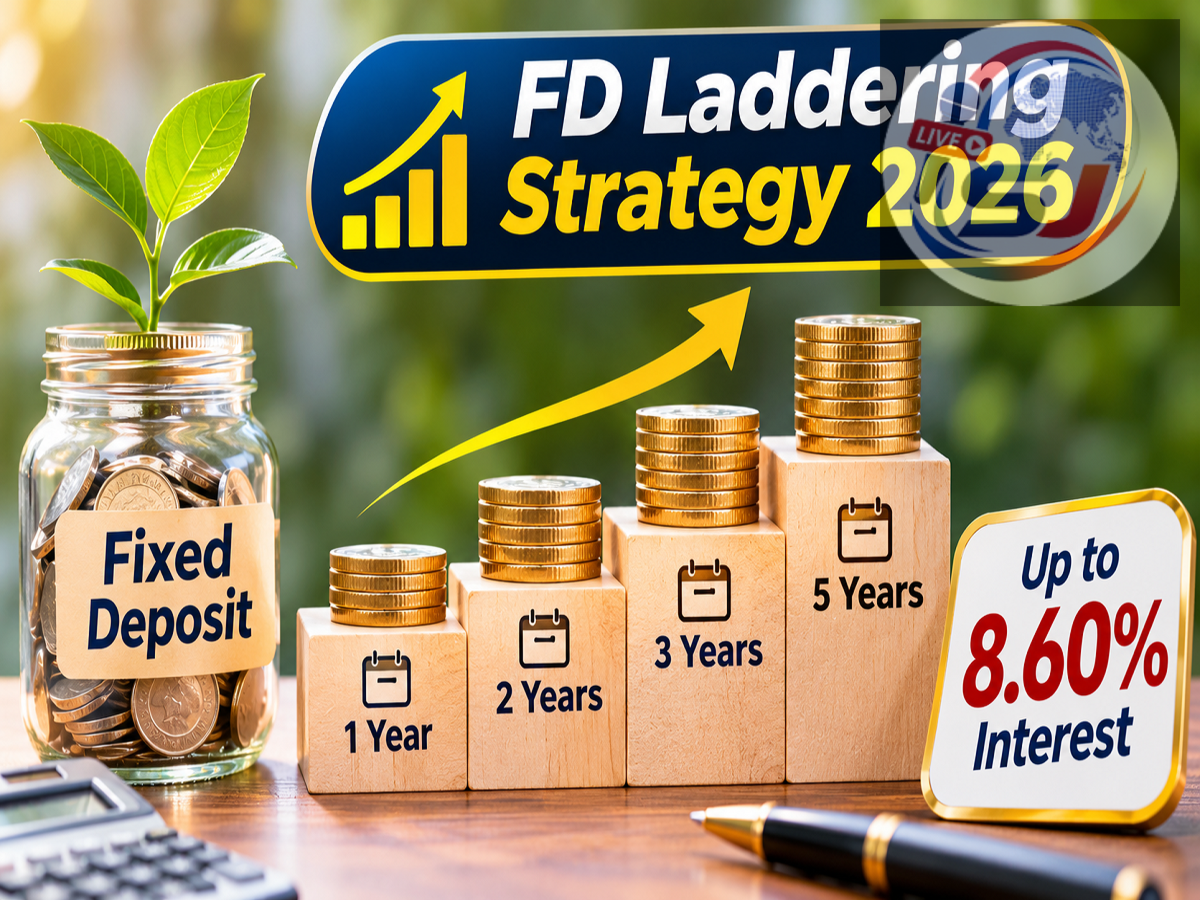
FD Interest Rates November 2026: Fixed deposits remain a popular savings option for Indian investors looking for predictable returns and relatively low market exposure. Several banks, particularly small finance banks, are offering attractive interest rates, with some senior citizen FD schemes providing returns of up to 8.60% annually. However, investing an entire ₹10 lakh corpus in a single fixed deposit may not always be the most practical approach, especially when unexpected financial needs arise.
A strategy known as FD laddering allows investors to divide their savings among multiple fixed deposits with different maturity dates. This approach can improve access to funds, reduce dependence on a single maturity date and provide opportunities to reinvest money as interest rates change.
According to a fixed deposit rate comparison by Stable Money dated November 12, 2026, Suryoday Small Finance Bank and Ujjivan Small Finance Bank are among the institutions offering competitive rates to senior citizens.
FD Interest Rates November 2026: Which Banks Offer the Highest Returns?
Small finance banks continue to offer some of the highest reported fixed deposit interest rates in India.
Suryoday Small Finance Bank is offering up to 8.25% annual interest to regular depositors on a five-year FD, while eligible senior citizens can receive up to 8.60%.
Ujjivan Small Finance Bank is also offering competitive returns on selected deposit tenures, with interest rates reaching 8.10% for general customers and 8.60% for senior citizens.
Meanwhile, Bank of Baroda has reportedly increased its highest interest rate for regular depositors from 6.75% to 6.85% on its 555-day fixed deposit scheme. Senior citizens can earn up to 7.35% on the same tenure.
Indian Overseas Bank is offering 6.75% to regular customers and 7.25% to senior citizens on its 444-day FD.
Latest Bank FD Interest Rates: November 2026 Comparison
| Bank |
FD Tenure |
General Customers |
Senior Citizens |
|---|---|---|---|
| Suryoday Small Finance Bank |
5 years |
8.25% |
8.60% |
| Ujjivan Small Finance Bank |
Selected tenures |
Up to 8.10% |
Up to 8.60% |
| Bank of Baroda |
555 days |
6.85% |
7.35% |
| Indian Overseas Bank |
444 days |
6.75% |
7.25% |
Note: The rates are based on the Stable Money comparison dated November 12, 2026, as quoted in the original article. Interest rates may vary by deposit amount, customer category and tenure. Verify current rates directly with the bank before investing.
What Is FD Laddering and How Does It Work?
FD laddering is a savings strategy in which an investor divides a large amount of money into several fixed deposits with different maturity periods.
Instead of placing ₹10 lakh in one five-year FD, for example, an investor could create four separate deposits of ₹2.50 lakh each.
Each deposit would mature at a different time, allowing the investor to access a portion of the money without necessarily disturbing the remaining deposits.
The approach resembles a ladder, where each fixed deposit represents a separate step with its own maturity date.
The main objective is not necessarily to maximise interest income. Rather, it is to balance returns, liquidity and reinvestment opportunities.
Why Can Investing ₹10 Lakh in One FD Be Risky?
A single large fixed deposit may appear convenient because it involves one interest rate, one investment certificate and one maturity date.
However, this structure can create practical difficulties.
Suppose an investor deposits ₹10 lakh in a five-year FD. After two years, an unexpected medical expense or family requirement creates a need for ₹2 lakh.
If the bank does not permit partial withdrawals, the investor may have to prematurely close the entire deposit.
Premature closure can result in a lower applicable interest rate and additional penalties, depending on the bank's rules.
Another concern is reinvestment risk.
When the entire ₹10 lakh matures on one date, the investor must decide whether to reinvest the full amount at the interest rates available at that time.
If market rates have declined, the investor may receive lower returns on the renewed deposit.
FD laddering helps spread these maturity dates, although it cannot eliminate interest rate risk entirely.
FD Laddering Example: How to Divide ₹10 Lakh Into Four Deposits
An investor with ₹10 lakh can consider splitting the money equally into four fixed deposits.
Each deposit can have a different tenure, depending on the investor's financial goals and expected cash requirements.
Illustrative ₹10 lakh FD ladder
Total investment
₹10,00,000
4 equal deposits
₹2.50 lakh each
444 days
Shorter-term liquidity
₹2,50,000
555 days
Medium-term expenses
₹2,50,000
3 years
Longer-term savings
₹2,50,000
5 years
Long-term deposit
₹2,50,000
This is an example of how to structure deposits, not a recommendation of particular banks or guaranteed returns.
Under this arrangement, the first FD matures after approximately 444 days, followed by the second after 555 days.
The third deposit becomes available after three years, while the final FD matures after five years.
This structure gives investors multiple opportunities to review their financial requirements and decide whether to withdraw or reinvest the proceeds.
Calculate Your Own FD Ladder Allocation
Investors can adjust the total amount and the number of fixed deposits to understand how their savings could be distributed.
Investment amount (₹)
Number of fixed deposits
2 FDs
4 FDs
5 FDs
Amount per fixed deposit
₹2,50,000
Equal allocation before interest
Calculate estimated maturity returns
What Happens When Each Fixed Deposit Matures?
When an FD reaches maturity, investors generally have two main choices.
They can withdraw the money to meet a planned expense or reinvest the proceeds in another fixed deposit.
For example, if the 444-day deposit matures and the investor does not immediately need the money, the proceeds can be reinvested at the prevailing interest rate.
If interest rates have increased, the new deposit may offer a better return. If rates have declined, the investor may have to accept a lower rate.
This flexibility is one of the principal advantages of FD laddering.
However, reinvestment decisions should be based on future financial requirements rather than interest rates alone.
Are Small Finance Bank FDs Safe?
Small finance banks are regulated by the Reserve Bank of India, but depositors should understand the applicable deposit insurance rules.
The Deposit Insurance and Credit Guarantee Corporation (DICGC) provides insurance coverage of up to ₹5 lakh per depositor per insured bank, including eligible principal and interest.
Importantly, this limit applies to the combined eligible deposits held by a depositor in the same bank and in the same capacity and right.
Opening several fixed deposits at the same bank does not create separate ₹5 lakh insurance limits for each deposit.
For example, if an investor places four FDs of ₹2.50 lakh each in the same bank, the combined principal would be ₹10 lakh. The standard insurance limit would still be ₹5 lakh, including eligible interest.
Investors seeking to spread bank-specific exposure may consider deposits across different DICGC-insured banks, while checking the applicable ownership and insurance rules.
FD laddering improves maturity flexibility, but it does not automatically protect the entire investment from bank failure.
FD Laddering vs Single Fixed Deposit: Which Is Better?
| Feature |
Single Large FD |
FD Laddering |
|---|---|---|
| Number of deposits |
One |
Multiple |
| Maturity dates |
One |
Different dates |
| Access to money |
Depends on withdrawal rules |
Greater flexibility |
| Premature withdrawal |
May affect a larger deposit |
May require closing only one FD |
| Reinvestment timing |
Concentrated on one date |
Spread across dates |
| Interest rates |
One contracted rate |
May vary by tenure |
| Management |
Simpler |
Requires tracking multiple FDs |
A single FD may suit investors who have a specific financial goal and know exactly when they will need their money.
FD laddering may be more appropriate for those who prefer periodic access to funds or want to avoid having all their savings mature simultaneously.
Important Factors to Check Before Opening an FD
Investors should compare more than the headline interest rate when choosing a fixed deposit.
The maturity period, interest payout option, premature withdrawal penalty and compounding frequency can influence actual returns.
Senior citizens should also verify whether the advertised higher interest rate applies to their selected deposit tenure.
Taxation is another important consideration. FD interest is generally taxable according to the investor's applicable income tax rules, and tax deducted at source may apply when prescribed conditions are met.
Additionally, the highest advertised FD rate may be available only for a particular tenure rather than all deposit periods.
Final Takeaway: Can FD Laddering Make ₹10 Lakh Savings More Flexible?
With certain banks reportedly offering FD interest rates of up to 8.60% for senior citizens, fixed deposits remain worth evaluating for investors seeking predictable interest income.
However, selecting the highest interest rate should not be the only consideration.
Dividing ₹10 lakh into four deposits of ₹2.50 lakh each, with maturities of 444 days, 555 days, three years and five years, can provide greater flexibility than placing the entire amount in one long-term FD.
Investors should also evaluate deposit insurance limits, bank-specific risks, taxation and premature withdrawal conditions before making a decision.
The appropriate strategy ultimately depends on individual liquidity needs, financial objectives and risk tolerance.
Disclaimer: This article is for educational and informational purposes only and does not constitute personalised investment advice. Bank FD rates and terms are subject to change. The calculator illustrates equal principal allocation, not interest earnings or guaranteed maturity proceeds. Verify the latest rates and conditions with the respective bank before investing.