
EPFO ₹25,000 Wage Limit: Check How Much PF May Be Deducted From Your Salary Under the New Ceiling
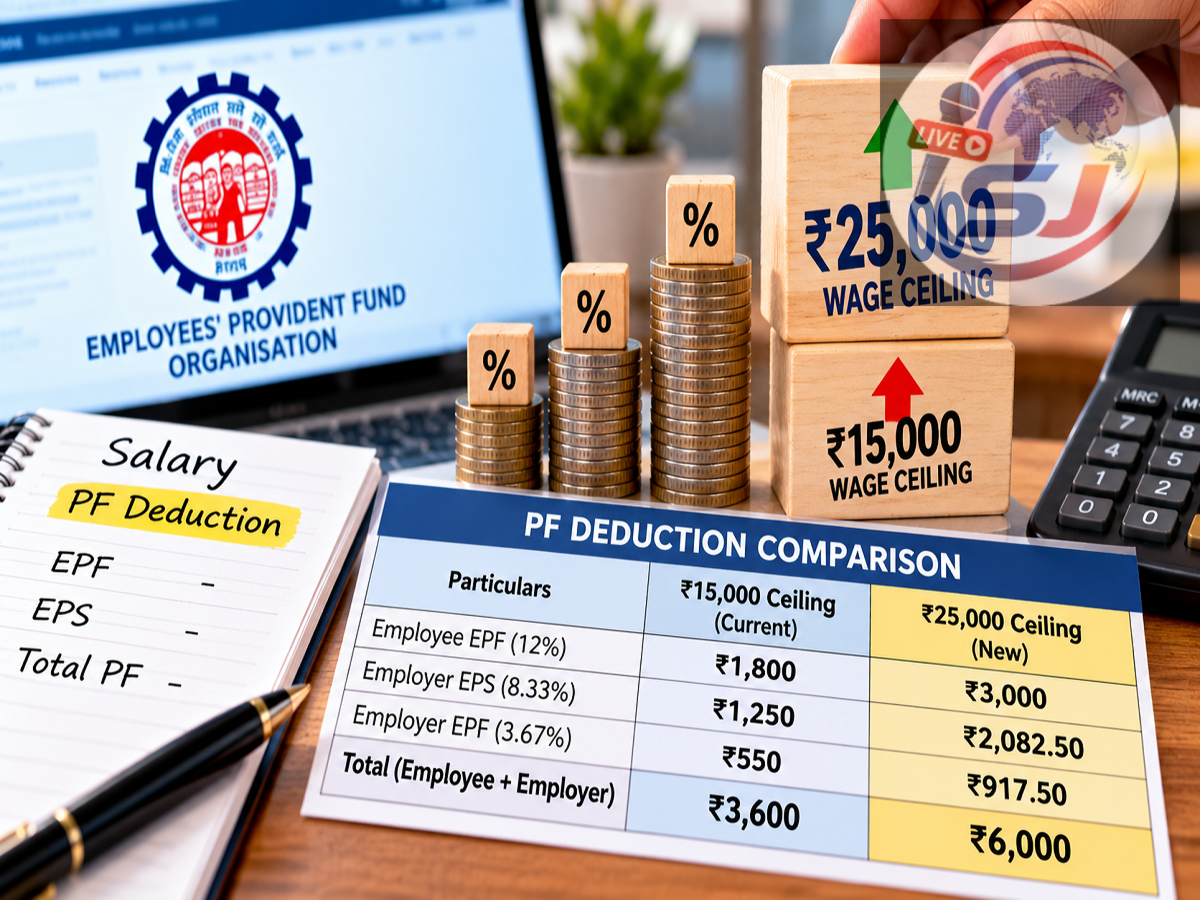
EPFO Wage Limit Change 2026: Employees covered under the Employees' Provident Fund Organisation should understand how a higher wage ceiling can affect their monthly PF contribution and take-home salary. Under the reported change, the wage ceiling used for statutory EPF coverage has moved from ₹15,000 to ₹25,000 per month, potentially bringing more workers within the mandatory social-security framework and increasing contributions for some existing members.
In simple terms, if an affected employee's PF contribution was previously restricted to the ₹15,000 statutory wage ceiling, a higher ceiling of ₹25,000 can increase the amount going into the provident fund.
That can mean a lower monthly take-home salary, but it also means a larger amount is being directed towards the employee's retirement savings and related social-security benefits.
Here's how the calculation works.
How Much PF Was Deducted Under the ₹15,000 Ceiling?
Under the standard EPF contribution structure, the employee contributes 12% of eligible PF wages.
If the contribution was restricted to the earlier ₹15,000 ceiling, the monthly employee contribution worked out to:
12% of ₹15,000 = ₹1,800
Therefore, an employee whose PF was calculated on ₹15,000 contributed ₹1,800 per month from salary towards EPF.
The employer also made the prescribed contribution, although the employer's share is allocated between EPF and the Employees' Pension Scheme according to the applicable rules.
What Happens If PF Is Calculated on ₹25,000?
If an employee's eligible PF wages are ₹25,000 and the full ₹25,000 is used for the contribution calculation, the employee's 12% share becomes:
12% of ₹25,000 = ₹3,000
That means the employee contribution can rise from ₹1,800 to ₹3,000 per month in this illustration.
| PF Calculation | ₹15,000 Wage Base | ₹25,000 Wage Base |
|---|---|---|
| Employee Contribution at 12% | ₹1,800 | ₹3,000 |
| Monthly Increase | — | ₹1,200 |
| Annual Employee Contribution | ₹21,600 | ₹36,000 |
| Annual Increase | — | ₹14,400 |
For an affected employee moving from a ₹15,000 contribution base to ₹25,000, the difference would therefore be ₹1,200 per month, or ₹14,400 over 12 months.
What If Your PF Wage Is ₹20,000?
The new ceiling does not mean every employee will automatically contribute PF on exactly ₹25,000.
Suppose an employee's eligible PF wage is ₹20,000.
At a 12% employee contribution rate:
12% of ₹20,000 = ₹2,400 per month
Similarly, if the eligible PF wage is ₹18,000:
12% of ₹18,000 = ₹2,160 per month
Here is a simple comparison:
| Eligible PF Wage | Employee PF at 12% |
|---|---|
| ₹15,000 | ₹1,800 |
| ₹18,000 | ₹2,160 |
| ₹20,000 | ₹2,400 |
| ₹22,000 | ₹2,640 |
| ₹25,000 | ₹3,000 |
The actual deduction therefore depends on the employee's eligible PF wages and the contribution arrangement applicable to that employment.
Will Take-Home Salary Decrease?
For employees whose PF deduction increases because of the higher contribution base, monthly take-home pay can decline.
Consider an employee whose contribution rises from ₹1,800 to ₹3,000.
The difference is ₹1,200 per month.
All else being equal, that additional ₹1,200 being directed towards PF could reduce the amount available as monthly take-home salary.
However, this money is not simply an additional fee paid to EPFO. The employee's contribution goes into the provident fund account and forms part of long-term retirement savings.
Therefore, the immediate effect may be lower disposable income, while the longer-term effect is higher retirement accumulation.
How Does the Employer Contribution Work?
The employer also contributes towards the employee's EPF-related benefits.
Under the standard structure, the employer contribution is also linked to eligible wages, but its allocation differs from the employee's share.
A portion of the employer contribution goes towards the Employees' Pension Scheme, or EPS, while the remaining applicable amount goes towards EPF, subject to the prevailing statutory rules.
For illustration, if EPS were calculated at 8.33% on a ₹25,000 wage base, the amount would be approximately ₹2,082.50, with the remaining applicable employer contribution going towards EPF.
However, employees should not assume that every employer-side contribution will automatically follow this exact split in every case. EPS eligibility, wage ceilings and implementation provisions must be applied according to the final EPFO rules governing the employee.
Why Does Raising the Wage Ceiling Matter?
A statutory wage ceiling plays an important role in determining which employees fall within mandatory EPF coverage.
When the ceiling rises, workers earning above the previous threshold but within the new limit can potentially come within the mandatory coverage framework, subject to the applicable rules.
For employees, this can provide access to a broader package of social-security benefits rather than simply creating another salary deduction.
EPFO-related coverage can involve provident fund savings, pension-related benefits and insurance protection under applicable schemes.
Higher PF Can Build a Bigger Retirement Corpus
An increase in monthly PF contributions can have a substantial long-term effect.
If an employee contributes an additional ₹1,200 every month, that represents an additional ₹14,400 of employee contributions in a year.
Over several years, these additional contributions can accumulate further interest at the rate declared for EPF for the relevant financial year.
The eventual difference in the retirement corpus can therefore be considerably larger than the sum of the additional monthly deductions alone.
The actual corpus will depend on future contribution levels, salary changes, EPF interest rates and the length of service.
Does Everyone With a ₹25,000 Salary Lose ₹3,000 to PF?
Not necessarily.
A ₹25,000 wage ceiling should not automatically be interpreted as meaning that every person whose gross monthly salary is ₹25,000 will see exactly ₹3,000 deducted.
PF contributions are based on the components of salary treated as eligible wages under EPFO rules and the contribution arrangement applicable to the employee.
Gross salary, CTC, basic salary and PF wages are not always identical figures.
Employees should therefore check their salary slip and speak with their employer's payroll or HR department to determine the actual PF wage being used for their contribution.
Existing Higher-Wage Contributors May See a Different Impact
Some employees already contribute PF on wages above the statutory minimum or ceiling under arrangements with their employer.
For such workers, the effect of a statutory ceiling increase may not be the same as it is for someone whose contribution was previously restricted to ₹15,000.
This is why headlines suggesting that every employee's PF will immediately jump from ₹1,800 to ₹3,000 can be misleading.
The impact depends on the employee's existing contribution base, eligible PF wages and the implementation rules applicable to the establishment.
What Employees Should Check on Their Salary Slip
Once the revised ceiling is reflected in payroll, employees should examine their payslip carefully.
Check the amount shown as the employee EPF contribution and compare it with previous months.
Also check the PF wage or basic wage being used for the calculation.
For example, if your PF wage is ₹20,000 and the applicable employee contribution is 12%, the deduction would ordinarily work out to ₹2,400 under that calculation—not ₹3,000 simply because the statutory ceiling is ₹25,000.
Any unexplained difference should be clarified with the employer or payroll department.
₹25,000 Ceiling Could Mean More Savings but Lower In-Hand Pay
The key impact of the reported EPFO wage-ceiling increase is the possibility of higher social-security contributions for affected employees.
If an employee's PF contribution base rises from ₹15,000 to the full ₹25,000, the employee contribution at 12% increases from ₹1,800 to ₹3,000 per month.
That is an additional ₹1,200 going towards PF each month.
For someone with eligible PF wages of ₹20,000, the corresponding 12% employee contribution would be ₹2,400, while at ₹18,000 it would be ₹2,160.
The change can therefore reduce monthly take-home pay for affected employees, but it can simultaneously increase long-term provident fund accumulation.
Employees should focus on the PF wage shown in their salary structure rather than assuming that the ₹25,000 ceiling automatically results in a ₹3,000 deduction for everyone.
Disclaimer: This article is for informational purposes only. PF and EPS contributions depend on eligible wages, membership status, employer arrangements and the EPFO rules applicable to the employee. Illustrations above use a 12% employee contribution rate. Employees should verify the implementation of the revised wage ceiling and their individual contribution with their employer and official EPFO communications.