
EPFO Withdrawal Rules: Members Can Access Up to 75% of PF for Emergencies, Education, Marriage and Housing
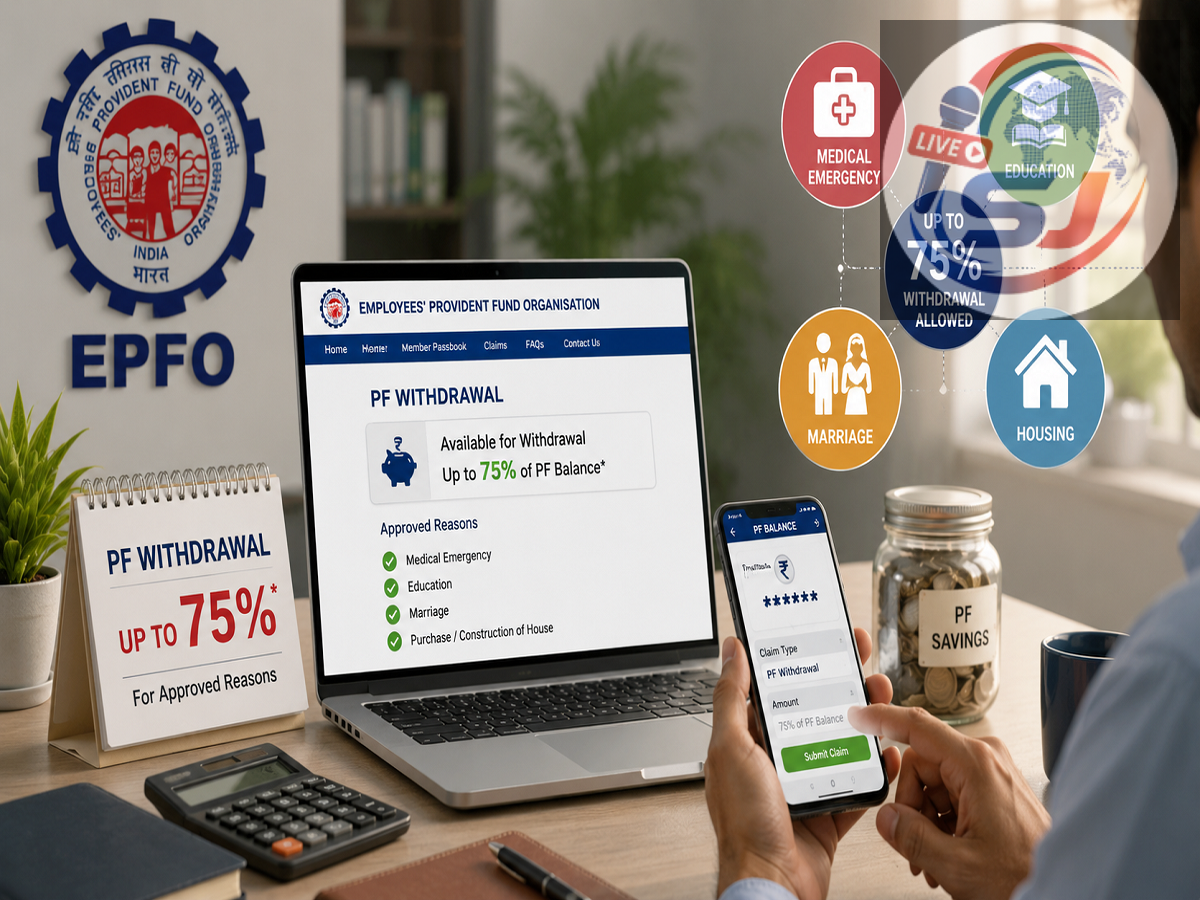
EPFO Withdrawal Rules: Provident Fund savings are primarily designed to provide financial security after retirement, but EPF members may also access a substantial part of their accumulated balance when certain financial needs arise. The revised framework allows eligible members to withdraw up to 75% of their EPF balance in specified situations, including unemployment, medical treatment, education, marriage and housing-related requirements.
The Employees' Provident Fund (EPF) is one of the most important long-term savings instruments for salaried employees in India. A portion of an eligible employee's salary is contributed regularly towards the provident fund, with the employer also making contributions according to applicable rules.
While the accumulated amount is intended to support employees after retirement, EPFO provisions also allow members to access their savings before retirement under specified circumstances.
Recent information shared in Parliament has brought renewed attention to the rules governing partial and final withdrawals from EPF accounts.
Government Explains EPF Withdrawal Provisions in Lok Sabha
Details regarding the withdrawal framework were provided in the Lok Sabha by Minister of State for Labour and Employment Shobha Karandlaje while responding to a question concerning access to EPF savings.
The question was raised by Trinamool Congress MP Kirti Azad.
According to the information cited in the report, eligible EPF members can withdraw up to 75% of their accumulated balance depending on the applicable circumstances and conditions.
The withdrawal facility is designed to help members meet significant financial requirements without necessarily exhausting their entire retirement corpus.
When Can EPF Members Withdraw Money?
The withdrawal framework covers several important financial needs. Depending on eligibility and applicable conditions, members may access their provident fund savings for purposes including medical treatment, education, marriage and housing.
Housing-related withdrawals may be available for purposes such as:
-
Purchasing a house
-
Constructing a residential property
-
Carrying out repairs or improvements
-
Meeting eligible home loan-related expenses
Members should check the specific eligibility requirements before applying because the amount available can vary according to the purpose and applicable EPFO provisions.
Up to 75% Withdrawal Under Specified Conditions
One of the important provisions highlighted in the report is the ability to access up to 75% of the EPF balance under prescribed circumstances.
The framework is intended to provide greater flexibility to employees who face financial requirements while still in service.
However, members should remember that withdrawing money from EPF reduces the amount that remains invested for retirement. Frequent or large withdrawals can also reduce the benefit of long-term compounding.
Therefore, EPF withdrawals should ideally be evaluated according to the urgency of the financial requirement and the member's broader retirement plan.
Medical Withdrawals Made More Accessible
Medical emergencies are among the circumstances for which EPF savings may be accessed.
The reported provisions allow withdrawals for eligible illness or treatment-related requirements. The report also states that there is no fixed numerical cap on the number of medical withdrawals, although applicable eligibility conditions and withdrawal limits continue to apply.
This can provide financial support to employees facing substantial healthcare expenses without requiring them to wait until retirement to access their provident fund savings.
Minimum Membership Requirement Reduced for Several Advances
Another important change relates to the minimum period of EPF membership required for certain advance withdrawals.
According to the report, the qualifying membership period for several categories of advances has been reduced to 12 months.
This could make the facility available to employees earlier in their careers, provided they satisfy the other conditions associated with the particular withdrawal category.
EPF Withdrawal for Education Allowed Up to 10 Times
Education expenses can place significant financial pressure on families, particularly when funding higher studies.
Under the provisions described in the report, an EPF member may make withdrawals for eligible education-related purposes up to 10 times during the membership period, subject to prescribed rules.
Members planning to use their provident fund for education should verify how much can be withdrawn and which educational expenses qualify before submitting a claim.
Marriage-Related Withdrawals Allowed Up to Five Times
EPF savings may also be accessed for eligible marriage expenses.
The revised framework cited in the report permits qualifying members to make up to five withdrawals for marriage-related purposes during their EPF membership.
As with other advances, the availability and amount of the withdrawal remain subject to EPFO's applicable conditions.
What Happens to EPF If You Lose Your Job?
The rules also provide financial support during unemployment.
According to the reported provisions, an employee who becomes unemployed may withdraw up to 75% of the EPF balance, while the remaining 25% stays in the provident fund account.
Keeping part of the money invested helps ensure that the member does not immediately exhaust the entire retirement corpus after losing employment.
It may also allow the remaining savings to continue within the provident fund system until the member becomes eligible for further withdrawal or resumes employment.
Waiting Period for Final EPF Settlement
While partial withdrawals have become more flexible under the framework described in the report, the rules concerning complete withdrawal are intended to discourage employees from prematurely exhausting retirement savings when changing jobs.
The report states that the waiting period for final EPF settlement is 12 months under the revised provisions.
For withdrawal benefits associated with the Employees' Pension Scheme (EPS), the reported waiting period is 36 months.
These longer waiting periods are intended to encourage continuity of retirement savings rather than full withdrawal whenever an employee changes or temporarily leaves a job.
Why Preserving Your PF Corpus Still Matters
Easier access to provident fund savings can provide valuable support during genuine financial emergencies. However, EPF remains fundamentally a retirement-focused investment.
Every withdrawal reduces the corpus available to earn future interest. For younger employees in particular, money withdrawn today could otherwise remain invested for many years and benefit from compounding.
Members should therefore consider alternatives before withdrawing PF for non-urgent expenditure. Where a withdrawal is necessary, taking only the amount actually required may help preserve more of the retirement corpus.
Check Eligibility Before Submitting an EPF Claim
The amount that can be withdrawn is not necessarily identical for every member or every purpose. Eligibility can depend on factors such as the reason for withdrawal, membership period, available balance and other conditions prescribed by EPFO.
Employees should therefore verify the latest rules applicable to their specific claim before initiating a withdrawal.
The broader objective of the revised framework is to strike a balance between two needs: giving employees access to their own savings during important life events or financial difficulties while protecting enough of the corpus to support them after retirement.
Disclaimer: EPF and EPS withdrawal conditions, eligibility requirements and claim procedures may be revised from time to time. Members should verify the latest applicable provisions through official EPFO channels before making any financial decision or submitting a withdrawal claim.