
EPFO Withdrawal Rules 2026: Form 121 to Replace 15G and 15H for PF TDS Relief, Check New Rules
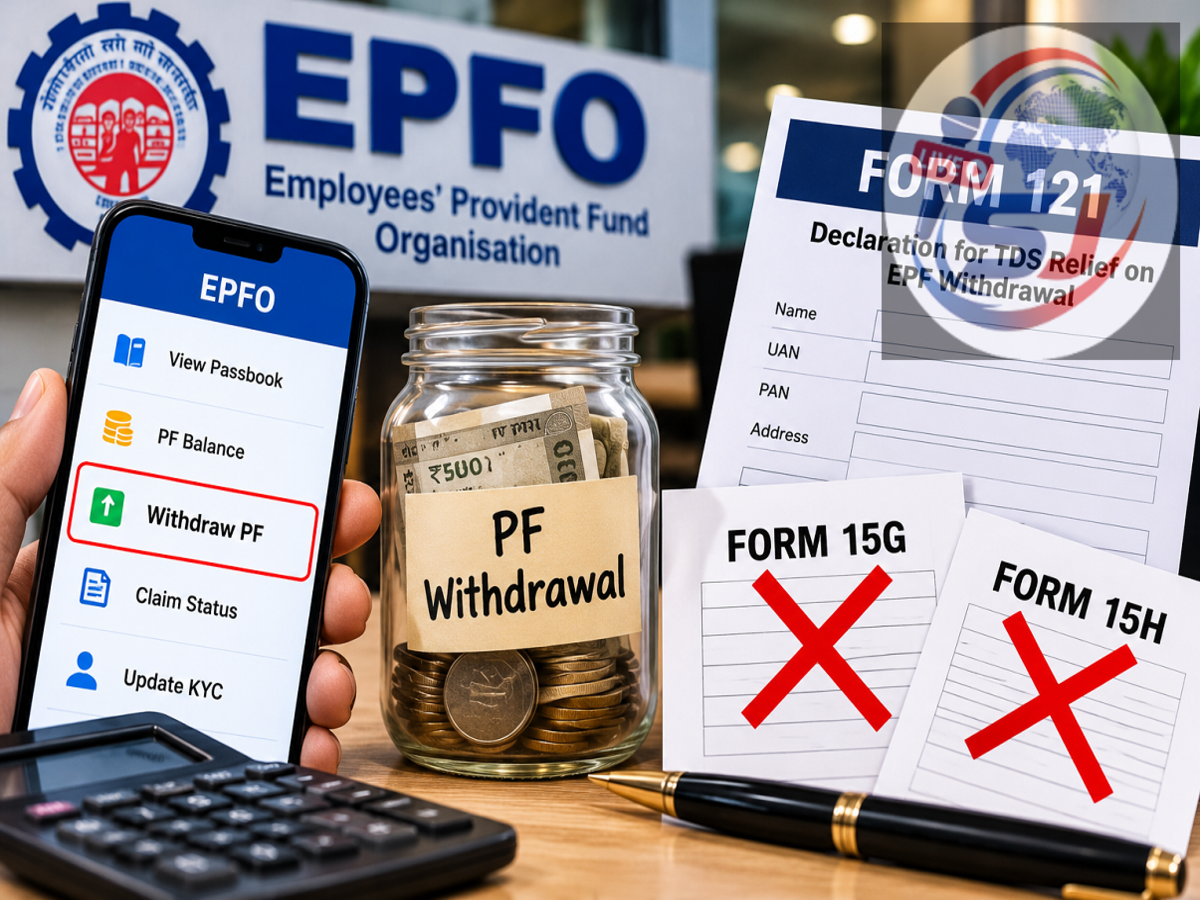
EPFO New Rules 2026: Employees planning to withdraw money from their Employees' Provident Fund (EPF) accounts should pay attention to an important reported change in the documentation required to claim relief from Tax Deducted at Source (TDS).
According to an October 11, 2026 report, the Employees' Provident Fund Organisation (EPFO) has announced that Form 121 will replace Forms 15G and 15H for eligible declarations seeking non-deduction of TDS on PF withdrawals from tax year 2026–27.
The change is linked to the Income-tax Act, 2025, and is intended to simplify the declaration process by introducing a common form instead of separate forms based on age.
However, submitting Form 121 does not automatically make a PF withdrawal tax-free. Eligibility conditions continue to apply, and employees must understand the difference between TDS relief and the actual tax treatment of their withdrawals.
Here is a detailed explanation of the reported EPFO Form 121 rule, who may use it, how it differs from Forms 15G and 15H, and what PF account holders should check before withdrawing their savings.
EPFO Form 121: What Is the New Rule?
Under the earlier declaration system, eligible taxpayers could submit Form 15G or Form 15H to request that tax not be deducted from certain payments.
These declarations were also relevant to qualifying EPF withdrawals where TDS would otherwise apply.
According to the supplied report, EPFO has communicated through its official social media account that Form 121 will be used for eligible TDS non-deduction declarations beginning with tax year 2026–27.
The proposed change means that eligible account holders would no longer need to select between Forms 15G and 15H solely on the basis of their age.
Instead, a common declaration form would be used under the new income tax framework.
Importantly, this concerns the declaration required for TDS relief, not a complete replacement of the regular EPF withdrawal claim process.
Form 15G vs Form 15H vs Form 121: What Has Changed?
Forms 15G and 15H have traditionally served different categories of taxpayers.
Form 15G was generally used by eligible individuals below 60 years of age and certain other eligible persons, subject to prescribed conditions.
Form 15H was intended for eligible resident senior citizens aged 60 years or above.
The reported Form 121 system seeks to combine the relevant declaration process under a common form.
| Particulars |
Earlier System |
Reported New System |
|---|---|---|
| Declaration form |
Form 15G or Form 15H |
Form 121 |
| Applicable framework |
Earlier income tax provisions |
Income-tax Act, 2025 |
| Age-based distinction |
Separate forms |
Common form |
| Purpose |
Request non-deduction of eligible TDS |
Request non-deduction of eligible TDS |
| Eligibility requirements |
Applicable tax conditions |
Applicable tax conditions |
| Reported effective period |
Earlier tax years |
Tax year 2026–27 onward |
The change does not mean that every PF account holder can avoid TDS by submitting a declaration.
Only individuals meeting the applicable legal conditions can use the relevant relief provisions.
Who Can Submit Form 121 for PF Withdrawal?
According to the supplied report, Form 121 is intended for individuals eligible to request non-deduction of TDS.
One of the central considerations is whether the taxpayer meets the conditions relating to estimated tax liability for the relevant tax year.
The report also states that a valid Permanent Account Number (PAN) is required for claiming the relief through the declaration process.
Employees should understand that merely having a PAN does not automatically establish eligibility.
Likewise, someone whose income falls within the taxable range cannot assume that filing Form 121 will eliminate the requirement to deduct tax.
The correct position depends on the taxpayer's circumstances and the applicable statutory conditions.
Submitting an incorrect declaration may create tax compliance problems.
Does Form 121 Make PF Withdrawal Completely Tax-Free?
No. This is one of the most important distinctions for employees to understand.
A declaration seeking non-deduction of TDS and the taxability of an EPF withdrawal are two separate matters.
TDS is a mechanism through which tax may be collected at the time of payment.
The final tax liability depends on the income tax provisions applicable to the withdrawal and the taxpayer's overall circumstances.
For example, a PF withdrawal may qualify for tax exemption under the relevant provisions even without a TDS declaration.
In other circumstances, a withdrawal may be taxable, and the taxpayer may need to report the amount in the income tax return.
Submitting Form 121 does not override the legal conditions governing the tax treatment of EPF withdrawals.
When Does TDS Apply to EPF Withdrawals?
Under the established EPF withdrawal tax framework, TDS has generally been relevant where an employee withdraws accumulated PF funds before completing five years of qualifying continuous service and the withdrawal exceeds the prescribed threshold.
The commonly applicable threshold under the earlier provisions has been ₹50,000, subject to the relevant conditions and exceptions.
Certain situations, such as qualifying transfers between recognised provident fund accounts or specific circumstances involving termination of employment, may receive different treatment under the applicable rules.
The new declaration form should not be confused with a general announcement that all PF withdrawals will become taxable.
Employees should verify the rules applicable to their tax year and particular withdrawal before submitting a claim.
Is Form 121 Required for Every PF Withdrawal?
No. The reported change does not make Form 121 compulsory for all EPFO members.
It is relevant to eligible account holders who need to submit a declaration requesting non-deduction of TDS.
An employee making a withdrawal that is already exempt from tax or not subject to TDS under the applicable conditions may not need such a declaration.
Similarly, an employee who does not satisfy the declaration requirements cannot simply submit Form 121 to avoid a deduction.
The necessity of the form depends on the nature of the withdrawal and the taxpayer's eligibility.
Why Is EPFO Replacing Forms 15G and 15H?
The reported objective is to simplify tax-related declarations under the updated income tax framework.
Previously, taxpayers needed to determine which declaration form applied to them.
The use of separate forms could create confusion, particularly among individuals unfamiliar with tax documentation.
A common form may reduce this complexity by standardising the declaration process.
However, simplification of paperwork does not mean that the government has removed the underlying tax rules.
Taxpayers will still be responsible for providing accurate information and meeting the prescribed conditions.
What Should PF Account Holders Check Before Applying?
Employees planning to withdraw PF savings should first confirm whether their withdrawal is subject to TDS.
They should also check whether their PAN details are valid and correctly recorded in their EPFO account.
Other important considerations include the length of qualifying service, the withdrawal amount, and estimated tax liability for the year.
If a declaration is necessary, account holders should use the form prescribed for the relevant tax year.
They should avoid relying on outdated instructions or third-party websites that may continue to display older forms.
The latest EPFO portal instructions and official tax rules should be checked before submitting documents.
How Can Employees Avoid Mistakes During PF Withdrawal?
Errors in tax declarations can delay processing or lead to incorrect deductions.
Account holders should ensure that their personal details, PAN information, and bank account records are accurate.
They should also understand whether they are requesting a full PF settlement, an advance, or another type of withdrawal, because different conditions may apply.
Employees should never provide false income estimates merely to claim relief from TDS.
If tax has been deducted, the amount may be reflected in the taxpayer's tax records and considered while determining the final income tax liability.
Depending on eligibility, excess tax deducted may be recoverable through the income tax return process.
EPFO Form 121 Rule 2026: Key Takeaway
The reported introduction of Form 121 represents an administrative change in the process for eligible PF account holders seeking non-deduction of TDS.
From tax year 2026–27, the new form is reported to replace Forms 15G and 15H for this purpose.
However, Form 121 is not a universal tax exemption certificate, and it does not automatically make every PF withdrawal tax-free.
Employees must continue to satisfy the applicable income tax conditions, provide correct information, and use the prescribed declaration only where eligible.
Before withdrawing PF money, account holders should verify the latest instructions issued by EPFO and the Income Tax Department.
Disclaimer: This article is based on the supplied October 11, 2026 report. The reported transition to Form 121 has not been independently verified against the latest official EPFO circular or notified tax forms in this response. Tax rules and eligibility requirements should be confirmed through official notifications or a qualified tax professional.