
EPFO Wage Limit Raised to ₹25,000: Check How PF Deduction and Take-Home Salary May Change
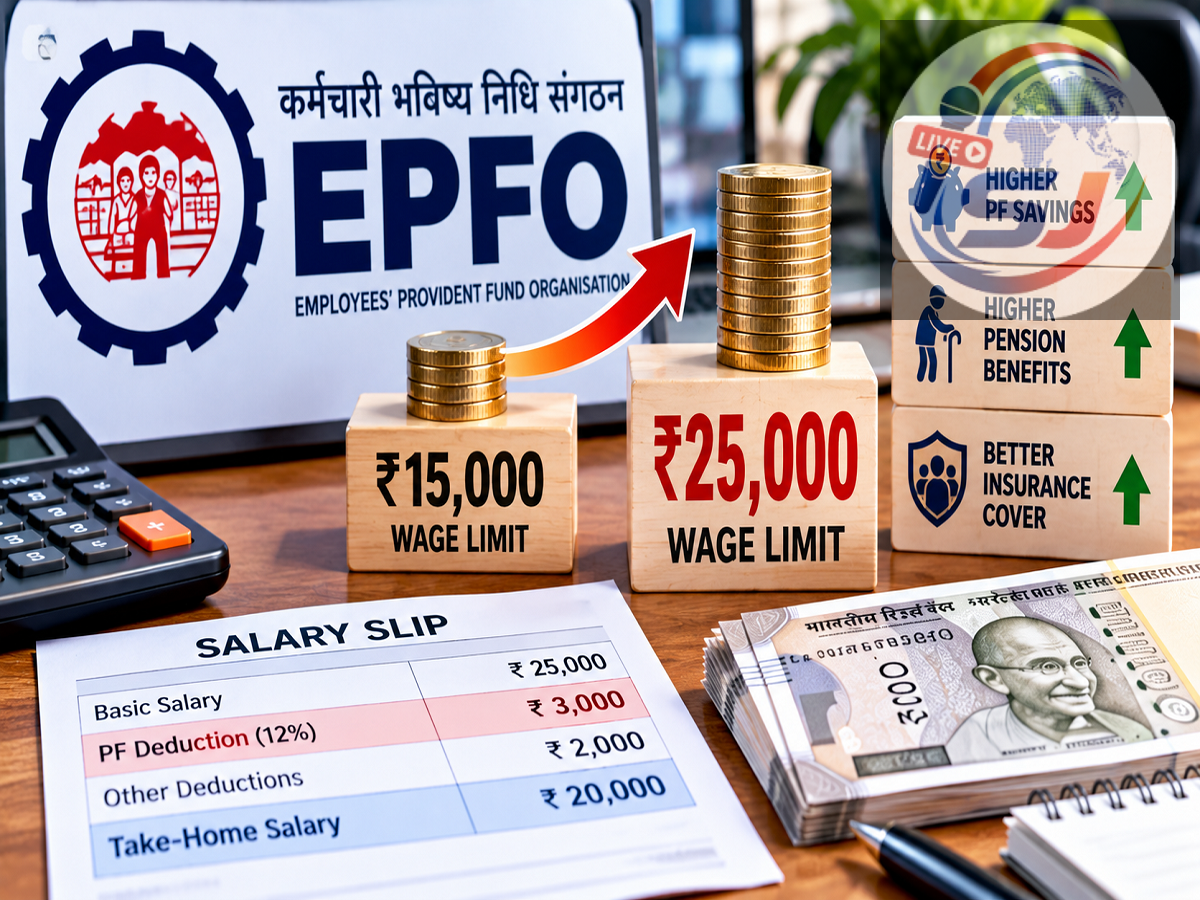
A major change in the provident fund wage threshold could affect the salary structure and retirement savings of millions of employees in India's organised sector. According to the supplied report, the wage ceiling for mandatory Employees' Provident Fund Organisation (EPFO) coverage has been increased from ₹15,000 to ₹25,000 per month, with the change taking effect from September 17, 2026.
The report estimates that more than 51 lakh additional employees could come under the social-security framework following the revision, gaining access to benefits linked to provident fund, pension and insurance coverage.
But the impact may not be identical for everyone. An employee earning ₹10,000 in basic wages could see little change, while someone earning ₹20,000 could newly come under mandatory coverage under the framework described in the source. Employees earning above ₹25,000 may also see a higher PF contribution in situations where their contribution was previously capped at the earlier statutory wage ceiling.
Here's how the change is explained across different salary levels.
Basic Salary of ₹10,000: What Changes?
For an employee whose applicable basic salary is ₹10,000 per month, the report says there should be no major change because of the higher ceiling.
Such an employee was already below the earlier ₹15,000 threshold and therefore fell within mandatory EPFO coverage under the previous framework.
PF deductions for these workers would consequently continue as applicable, rather than starting solely because the ceiling has now moved to ₹25,000.
In simple terms, raising the upper eligibility threshold does not create a new coverage category for someone who was already within it.
₹20,000 Basic Salary: This Group Could See a Bigger Change
The impact becomes more significant in the ₹15,000-to-₹25,000 wage bracket.
The source explains that under the earlier ₹15,000 ceiling, a new employee joining with a basic salary of ₹20,000 could remain outside mandatory PF coverage because the starting wage was above the statutory threshold.
Under the revised ₹25,000 ceiling described in the report, an employee earning ₹20,000 would now fall within the mandatory coverage range.
As a result, such workers would come within the framework of EPF, Employees' Pension Scheme (EPS) and Employees' Deposit Linked Insurance (EDLI), according to the source.
The immediate effect could be a reduction in take-home salary because an employee PF contribution would begin to be deducted. At the same time, that money would be directed toward long-term retirement savings and associated social-security benefits.
Salary Above ₹25,000: How Could PF Contribution Change?
The supplied report also provides an example for existing PF members whose contributions had previously been restricted to the earlier statutory wage ceiling of ₹15,000.
Using a 12% employee contribution rate, the calculation under the old ceiling was:
12% of ₹15,000 = ₹1,800 per month
Using the revised ₹25,000 ceiling, the corresponding calculation becomes:
12% of ₹25,000 = ₹3,000 per month
That represents a difference of ₹1,200 per month in the employee contribution under this particular example.
If this higher deduction applies to an employee, the amount credited as take-home salary could decrease correspondingly, while a larger amount would go toward PF savings.
However, actual payroll impact can depend on an employee's PF membership status, applicable wages, employment terms and the way contributions are structured by the employer. Employees should therefore check their salary slip or payroll department rather than assuming that every worker earning above ₹25,000 will automatically see exactly the same ₹1,200 reduction.
Why Does a Higher PF Deduction Reduce Take-Home Pay?
Provident fund contributions are deducted from eligible wages and deposited into the employee's retirement account.
Therefore, if the contribution rises from ₹1,800 to ₹3,000 in the example above, the employee has ₹1,200 more directed toward PF each month.
That can reduce immediate disposable income, but it also increases the amount being accumulated for retirement.
The trade-off is essentially between money available in the bank account today and money set aside for long-term financial security.
PF Wage Ceiling Changed After a Long Gap
According to the supplied article, the previous wage-ceiling revision took place in September 2014, making this the first such increase in around 12 years.
The report links the latest revision to increases in wages and salaries over that period. It states that average earnings for regular salaried workers have moved closer to ₹23,000 per month and that minimum wages in several states have crossed the previous ₹15,000 threshold.
Under that reasoning, retaining the old threshold would have left a growing number of workers outside the mandatory coverage bracket described in the source.
What Happens to PF, Pension and Insurance Benefits?
The effect of EPFO coverage goes beyond the monthly employee PF deduction.
Employees brought within the applicable social-security framework may also receive benefits connected with EPF retirement savings, EPS pension coverage and EDLI insurance, subject to the rules governing each scheme.
For workers in the ₹15,000-to-₹25,000 wage bracket, the reported change is therefore particularly significant because they are the group most directly affected by expansion of the mandatory wage threshold.
Take-Home Salary May Fall, but Retirement Contributions Can Rise
Employees naturally pay close attention to their in-hand salary, so a higher PF deduction can initially look like a loss.
But PF deductions are fundamentally different from an ordinary fee or charge. The employee contribution is directed toward the worker's provident fund savings, subject to EPFO rules, rather than simply disappearing as an expense.
For example, moving from a ₹1,800 employee contribution to ₹3,000 means an additional ₹1,200 per month is being directed toward PF in the illustration provided by the source.
Over a longer period, higher contributions can result in a larger retirement corpus, although the final amount will depend on contribution history, applicable interest rates and EPFO rules.
Check Your Salary Slip to Understand the Actual Impact
Employees should not assume that the revised wage ceiling will affect every salary in exactly the same way.
Those already earning below the earlier ₹15,000 threshold may see little change. Employees in the ₹15,000-to-₹25,000 bracket could be the most directly affected under the framework described in the supplied report, while the impact on workers earning more than ₹25,000 will depend on how their PF contribution is currently calculated.
Checking the basic/PF wage, employee PF deduction, employer contribution and EPS component on the salary slip can provide a clearer picture of the actual impact.
The broader objective of a higher mandatory wage ceiling is to extend retirement, pension and insurance coverage to more workers. For employees affected by higher deductions, this may mean slightly less money in hand each month but a greater portion of earnings being directed toward long-term social-security benefits.