
EPFO Wage Limit Hike to ₹25,000: How PF Deduction Could Affect Your In-Hand Salary and Pension
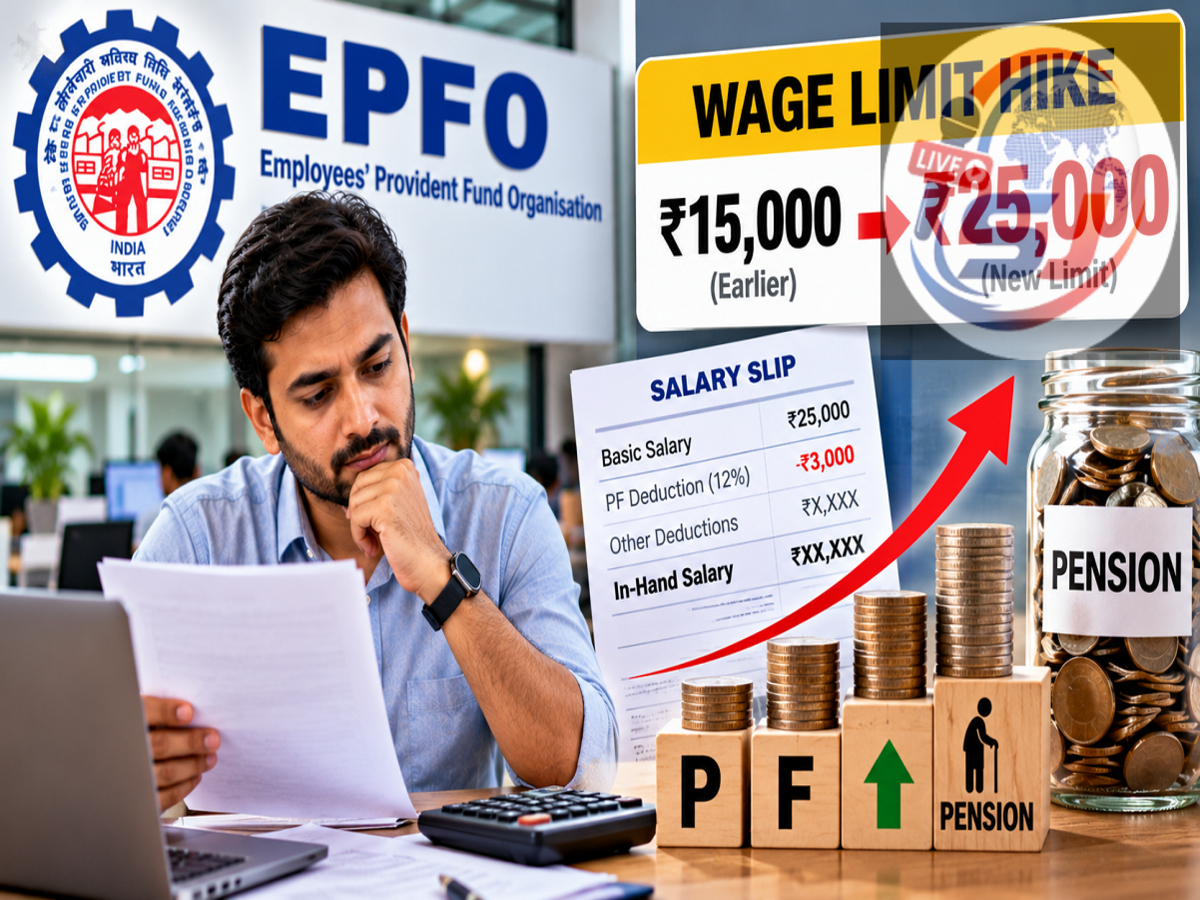
EPFO Wage Limit Update 2026: The reported increase in the Employees' Provident Fund Organisation (EPFO) wage ceiling from ₹15,000 to ₹25,000 could significantly affect salaried employees. If PF contributions are calculated on the higher wage limit, an employee's monthly contribution could rise from ₹1,800 to ₹3,000. While this may reduce take-home salary, it could also increase retirement savings and potentially expand social security coverage.
For millions of private-sector employees, the amount deducted from their salary towards the Employees' Provident Fund (EPF) is an important part of monthly financial planning.
A higher PF contribution means more money is set aside for retirement. However, it can also leave employees with less money available for immediate household expenses.
According to a report published on October 8, 2026, the revised wage ceiling of ₹25,000 could influence employee contributions, employer contributions and eligibility for certain EPFO-linked benefits.
The actual financial impact depends on the applicable EPFO notification, an employee's PF-contributory wages and the salary structure followed by their employer.
EPFO Wage Limit: What Changes From ₹15,000 to ₹25,000?
The wage ceiling is the salary threshold used for determining mandatory EPF coverage and certain contribution calculations under the applicable rules.
Under the earlier ₹15,000 ceiling, an employee contributing 12% of capped PF wages would deposit ₹1,800 every month.
If the contribution base increases to ₹25,000, the employee's contribution at the same 12% rate would become ₹3,000.
This represents an additional monthly deduction of ₹1,200.
The contribution rate itself remains 12% in this illustration. What changes is the wage amount on which the contribution is calculated.
EPFO PF Calculation: Old vs New Wage Limit
| Particulars |
₹15,000 Wage Base |
₹25,000 Wage Base |
|---|---|---|
| PF-Contributory Monthly Wages |
₹15,000 |
₹25,000 |
| Employee PF Contribution (12%) |
₹1,800 |
₹3,000 |
| Employer Contribution (12%) |
₹1,800 |
₹3,000 |
| Combined Monthly Contribution |
₹3,600 |
₹6,000 |
| Employee's Annual Contribution |
₹21,600 |
₹36,000 |
| Combined Annual Contribution |
₹43,200 |
₹72,000 |
These are illustrative calculations assuming both employee and employer contributions are made on the respective wage bases. They do not mean every employee will automatically begin contributing ₹3,000.
How Much Will Your In-Hand Salary Decrease?
One of the biggest questions among employees is whether a higher PF deduction will reduce their monthly take-home salary.
Consider an employee whose PF contribution was previously calculated on ₹15,000.
Under the earlier calculation, the employee contributed ₹1,800 monthly.
If the employer starts calculating PF on ₹25,000, the contribution increases to ₹3,000.
Illustrative impact on employee salary
Additional Monthly PF Deduction
₹1,200
Additional Annual PF Savings
₹14,400
This assumes the employee's PF contribution increases from ₹1,800 to ₹3,000 without any compensating salary adjustment.
In this situation, monthly in-hand salary could fall by ₹1,200, assuming all other salary components remain unchanged.
However, the result may differ for employees whose companies already calculate PF on actual basic wages rather than a capped amount.
Calculate Your Possible PF Deduction
Use this calculator to compare the two contribution bases at the standard 12% employee contribution rate.
Monthly PF-contributory wages (₹)
At ₹15,000 Ceiling
₹1,800
Monthly employee PF
At ₹25,000 Ceiling
₹3,000
Monthly employee PF
Additional monthly contribution
₹1,200
Additional annual contribution
₹14,400
Illustrative capped-wage calculation only. Actual payroll deductions depend on applicable rules and your employer's contribution policy.
Will Employers Also Have to Contribute More?
Under the standard EPF contribution structure, both the employee and employer contribute 12% of eligible PF wages.
Therefore, if the contribution base increases from ₹15,000 to ₹25,000, the employer's total statutory contribution could also rise from ₹1,800 to ₹3,000.
However, the employer's contribution is not necessarily credited entirely to the employee's EPF balance.
For eligible members, a portion is allocated to the Employees' Pension Scheme (EPS), subject to the applicable pension wage ceiling and contribution rules.
The remaining employer contribution goes towards EPF.
Employees should also remember that some companies include the employer's PF contribution in the overall Cost to Company (CTC). In such cases, higher employer contributions could affect other salary components, depending on how the compensation package is structured.
Could the Higher Wage Ceiling Benefit 51 Lakh Employees?
According to the October 8 report, increasing the wage ceiling to ₹25,000 could bring approximately 51 lakh additional workers within the scope of mandatory provident fund coverage.
This estimate concerns the potential expansion of coverage and should not be interpreted as confirmation that all 51 lakh employees have already been enrolled.
The possible expansion could provide more workers with access to formal retirement savings and applicable social security benefits.
EPFO-linked benefits extend beyond monthly PF contributions and include pension and insurance protection for eligible members.
What Happens to EPS Pension and EDLI Insurance?
The Employees' Pension Scheme (EPS) provides pension benefits to eligible members who satisfy the scheme's conditions.
The Employees' Deposit Linked Insurance Scheme (EDLI) provides insurance protection to eligible employees' nominees or beneficiaries in the event of death while in service.
A higher wage ceiling could have implications for these benefits, but the effect would depend on corresponding scheme provisions and notifications.
A higher EPF contribution ceiling does not automatically establish a higher EPS pension ceiling or increase EDLI benefits.
For pension calculations, factors such as pensionable salary, pensionable service and the applicable EPS rules remain important.
Will Every Employee's PF Deduction Increase?
No. A change in the wage ceiling does not necessarily produce the same salary impact for every employee.
Employees whose PF contributions are already calculated on actual wages above ₹25,000 may see little or no change in their monthly deductions.
Others whose contributions were previously capped at ₹15,000 could experience a larger increase if the revised ceiling applies to their payroll.
Employees earning below ₹15,000 in PF-contributory wages would generally not see an increase merely because the upper ceiling has changed, assuming their wages and contribution rate remain the same.
What Should Employees Check on Their Salary Slips?
Employees should review the PF deduction shown on their salary slips and compare it with their PF-contributory wages.
They should also check whether their employer calculates PF on capped wages or actual eligible wages.
If the contribution amount changes, employees can ask their payroll or human resources department for an explanation.
For official updates, members can visit the EPFO website and check applicable notifications and circulars.
Final Takeaway
The reported increase in the EPFO wage ceiling from ₹15,000 to ₹25,000 could have an important impact on retirement savings and monthly take-home salary.
Under the standard 12% contribution calculation, an employee's PF deduction could rise from ₹1,800 to ₹3,000, resulting in an additional monthly contribution of ₹1,200 and annual employee savings of ₹14,400.
However, these figures represent a specific capped-wage example rather than a universal salary change.
Important: The ₹25,000 ceiling and its implementation must be verified against the applicable official EPFO notification. Employees should not assume that their payroll deductions, EPS benefits or EDLI coverage have automatically changed solely on the basis of a news report.