
EPFO Wage Limit at ₹25,000: How October PF Deduction Could Affect a ₹20,000 Salary
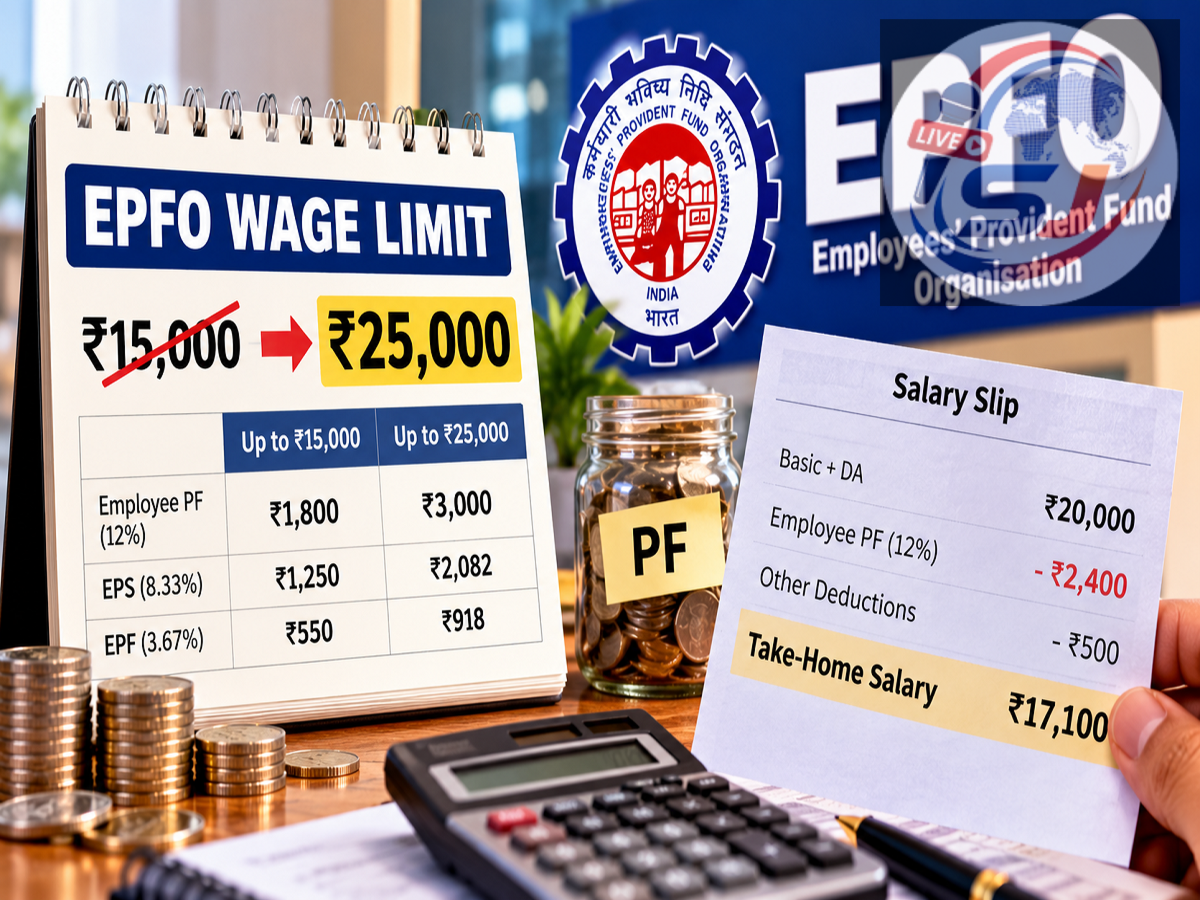
EPFO Wage Ceiling 2026: Employees earning around ₹20,000 per month may notice a change in their salary structure after the Employees' Provident Fund Organisation (EPFO) wage ceiling was raised from ₹15,000 to ₹25,000. The change expands the salary base on which eligible employees can come under mandatory provident fund and pension coverage.
According to the information provided, the revised ceiling means employees whose eligible Basic Pay and Dearness Allowance (DA) together are up to ₹25,000 may now fall within the mandatory coverage threshold, subject to the applicable EPF rules.
For some employees, this could mean a higher monthly PF contribution and consequently a lower amount credited as take-home salary. However, the exact impact will depend on how an employer currently calculates PF contributions and the employee's existing coverage status.
Here is the calculation for someone with eligible wages of ₹20,000.
EPFO Wage Ceiling Increased From ₹15,000 to ₹25,000
Previously, the statutory wage ceiling used for mandatory EPF coverage was ₹15,000 per month.
Under the revised threshold cited in the report, this limit has been increased to ₹25,000.
This change is particularly relevant for workers whose Basic Pay plus DA falls between ₹15,000 and ₹25,000. Employees in this salary range who were previously outside mandatory coverage in certain circumstances could now come within the expanded threshold.
It is important to remember that PF calculations are generally linked to eligible wages such as Basic Pay and DA, rather than an employee's entire gross salary or CTC.
₹20,000 Salary: How Much PF Could Be Deducted?
The standard employee EPF contribution is generally 12% of eligible wages.
If an employee's eligible Basic Pay plus DA is ₹20,000, the calculation would be:
₹20,000 × 12% = ₹2,400 per month
This means an employee contributing on the entire ₹20,000 wage base could see ₹2,400 deducted as the employee's monthly PF contribution.
Under the earlier ₹15,000 ceiling, a contribution restricted to that ceiling would work out to:
₹15,000 × 12% = ₹1,800 per month
The difference between the two figures is:
₹2,400 - ₹1,800 = ₹600 per month
Therefore, in a scenario where an employee was previously contributing only ₹1,800 and is now required to contribute ₹2,400, the monthly employee contribution would increase by ₹600.
How Could This Affect Take-Home Salary?
Consider an employee whose eligible Basic Pay plus DA is ₹20,000.
| Particulars | Earlier Illustration | Revised Illustration |
|---|---|---|
| Wage base used | ₹15,000 | ₹20,000 |
| Employee contribution rate | 12% | 12% |
| Employee PF contribution | ₹1,800 | ₹2,400 |
| Difference | — | ₹600 more |
In this simplified example, the employee could receive around ₹600 less as monthly take-home pay, assuming all other salary components and deductions remain unchanged.
Over 12 months, the additional contribution would amount to:
₹600 × 12 = ₹7,200
However, this ₹7,200 is not simply "lost" salary. It represents additional money being directed towards the employee's retirement-related savings, subject to EPFO rules.
What If Your Eligible Salary Is ₹25,000?
At eligible wages of ₹25,000, a 12% employee contribution would be:
₹25,000 × 12% = ₹3,000 per month
Compared with ₹1,800 on the old ₹15,000 wage base, this represents an increase of:
₹3,000 - ₹1,800 = ₹1,200 per month
That would translate into an additional annual employee contribution of:
₹1,200 × 12 = ₹14,400
Again, the actual change in take-home salary will depend on whether the employee was already contributing PF on actual wages above the previous ceiling.
What Happens to the Employer's Contribution?
The employer also contributes towards the employee's EPF-related benefits according to the applicable rules.
A portion of the employer's contribution is allocated towards the Employees' Pension Scheme (EPS), while the remaining applicable portion goes towards EPF.
This distinction matters because an increase in the pensionable wage ceiling can affect the amount allocated towards the pension component.
Employees should therefore avoid assuming that the entire employer contribution is credited directly into their EPF balance.
Will Everyone Earning ₹20,000 Get a Smaller Salary?
Not necessarily.
The impact depends heavily on the employee's existing PF arrangement.
For example, some employers may already be calculating PF contributions on an employee's actual Basic Pay and DA even when those wages exceed the earlier statutory ceiling. Such employees may see little or no change purely because of the higher ceiling.
The more noticeable impact could arise for eligible employees whose contributions were previously restricted to a lower wage base or who newly come within mandatory coverage because of the revised ceiling.
Salary structures can also differ between companies, so employees should check their payslip and speak with their payroll or HR department to understand how the revised rules apply to them.
Why Higher PF Deduction Can Help in the Long Run
A higher deduction may reduce disposable monthly income, but it can also increase the amount being directed towards long-term retirement benefits.
For instance, if an additional ₹600 is contributed every month, that is ₹7,200 more over a year before considering the applicable interest and other long-term effects.
Over several years, higher contributions and compounding can make a meaningful difference to an employee's retirement corpus.
An increased pensionable wage base could also influence EPS-related benefits for eligible members, although the eventual pension depends on the applicable pension formula, pensionable salary, pensionable service and other EPFO rules.
Check Your October Salary Slip Carefully
Employees who are potentially affected by the higher EPFO wage ceiling should examine their salary slips once the revised contribution begins reflecting in payroll.
Compare the Basic Pay plus DA, employee PF contribution, employer contribution and net take-home salary with the previous month's figures.
If an employee with ₹20,000 in eligible wages sees the contribution base move from ₹15,000 to the full ₹20,000, the illustrative employee PF deduction could rise from ₹1,800 to ₹2,400 per month.
That could reduce monthly take-home pay by around ₹600, assuming no other payroll component changes.
The important point is that the reduction in take-home pay represents a higher retirement contribution rather than an additional tax or penalty. The exact impact, however, will vary according to an employee's wage structure, existing PF arrangement and the EPFO rules applicable to the individual.