
EPFO Wage Ceiling Hike: Will Employers Now Pay the Full PF Contribution? Know the Actual Rule
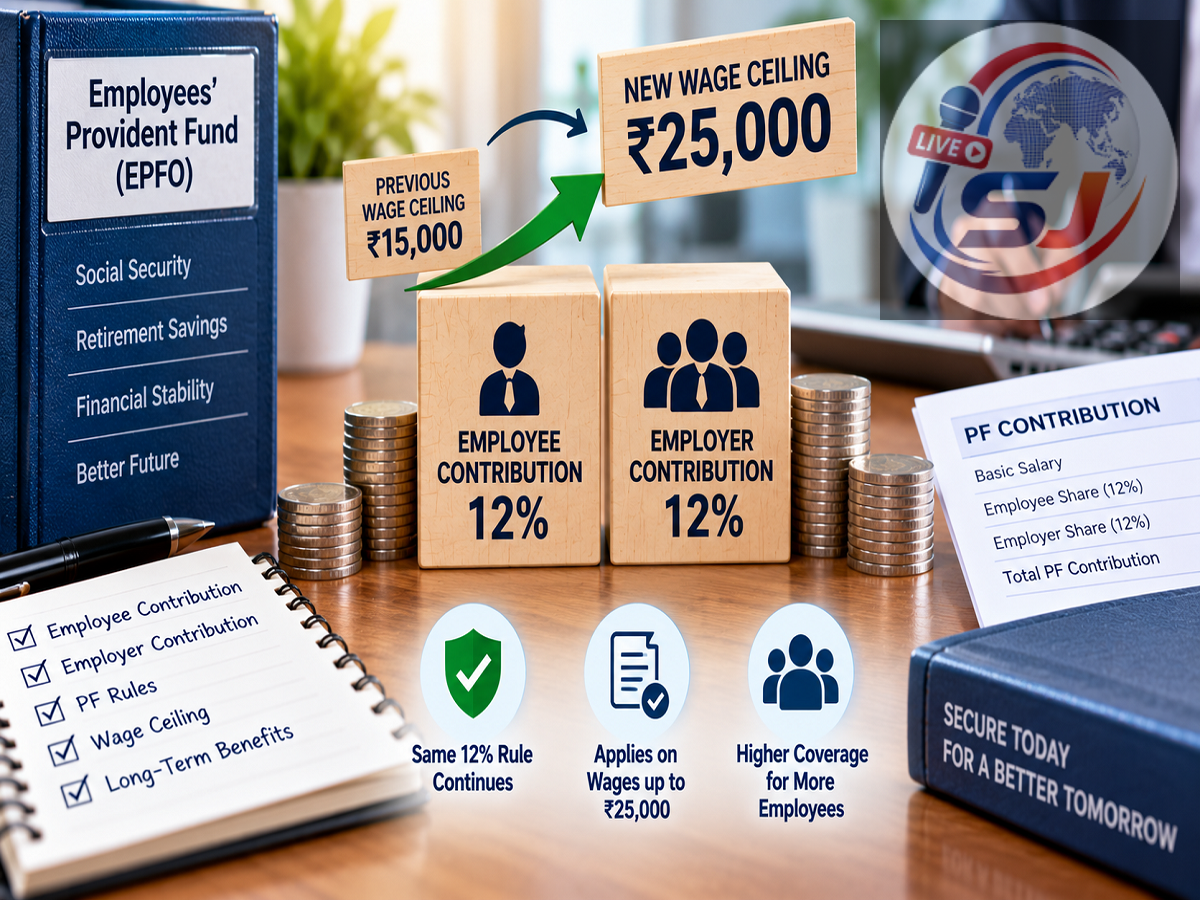
The increase in the EPFO wage ceiling from ₹15,000 to ₹25,000 has triggered several questions among salaried employees, particularly about who will pay the provident fund contribution under the revised framework.
One claim being circulated suggests that employers will now have to pay the employee’s entire PF share after the wage ceiling increases. However, this interpretation can be misleading.
The fundamental contribution structure of the Employees’ Provident Fund does not mean that the employer takes over the employee’s statutory contribution. Under the standard EPF structure, the employee generally contributes 12% of applicable wages, while the employer makes a separate prescribed contribution. EPFO’s official contribution information confirms that the employee and employer contributions are separate. (EPFO India)
What the higher wage ceiling changes is primarily the scope of mandatory coverage and the wage level up to which statutory obligations can apply—not the basic principle that the employer alone pays both shares.
What Does the Higher EPFO Wage Ceiling Change?
The statutory wage ceiling is important in determining mandatory EPFO coverage.
With the ceiling moving from ₹15,000 to ₹25,000, employees whose applicable wages fall between the old and new thresholds can be brought within mandatory coverage under the revised framework, subject to the applicable rules.
This means an eligible worker earning ₹18,000, ₹20,000 or ₹25,000 in applicable PF wages may now come within the expanded statutory threshold.
For employers, the change means they cannot treat the old ₹15,000 threshold as the relevant mandatory-coverage ceiling once the revised ₹25,000 limit becomes applicable.
Does the Employer Pay the Employee's 12% PF Share?
No. This is the key point employees should understand.
Under the standard EPF contribution structure, the employee generally contributes 12%, while the employer separately makes the prescribed employer contribution.
EPFO's official contribution table identifies the employee contribution as 12% or 10% in specified cases and separately identifies the employer contribution. (EPFO India)
Therefore, saying that the employer must now pay the employee's entire PF contribution would incorrectly combine two separate statutory contributions.
The higher wage ceiling does not, by itself, convert the employee contribution into an employer-funded amount.
Where Does the Employer Contribution Go?
Another common misconception is that the employer’s entire 12% contribution always goes directly into the employee’s EPF balance.
That is not how the standard structure works.
A prescribed portion of the employer contribution is allocated toward the Employees’ Pension Scheme (EPS), where applicable, while the balance goes toward EPF. EPFO’s official contribution schedule lists the EPS component at 8.33%, subject to the applicable rules and wage ceiling, with the remaining employer PF contribution determined accordingly. (EPFO India)
The employee, meanwhile, does not make a separate EPS contribution under the standard structure; EPS funding comes from the applicable employer-side contribution. (EPFO India)
Therefore, EPF and EPS should not be treated as two completely separate additional deductions from an employee’s salary.
What Happened Under the Earlier ₹15,000 Rule?
There is another point in the original claim that needs clarification.
An existing EPF member did not automatically stop being an EPF member simply because their wages later increased from ₹15,000 to ₹16,000 or ₹18,000.
The old ₹15,000 threshold was particularly relevant when determining whether an employee was an “excluded employee” when they first became otherwise eligible to join the fund.
Official EPFO material describing the previous rules stated that an employee whose pay at the time of becoming eligible for membership exceeded ₹15,000 could fall within the excluded-employee definition. (EPFO India)
Therefore, the idea that companies could routinely stop PF for existing members as soon as their salary crossed ₹15,000 is an oversimplification.
Who Is Most Affected by the ₹25,000 Ceiling?
The most important impact is on workers whose applicable wages are above the previous statutory ceiling but fall within the revised limit.
Consider a person joining an EPFO-covered establishment with applicable wages of ₹20,000.
Under the previous framework, a new employee whose wages exceeded the statutory ceiling could fall outside mandatory membership if the relevant conditions for exclusion were satisfied. Official EPFO material explains how the wage ceiling historically affected enrolment of employees at the time they joined. (EPFO India)
A higher statutory ceiling therefore expands the salary range within which workers can become mandatorily covered.
Can Take-Home Salary Be Affected?
Yes, particularly for employees who become mandatory EPF members for the first time.
Because the employee generally makes their own statutory contribution, someone newly brought under EPFO coverage may see a PF deduction reflected in their salary slip.
This can affect immediate take-home pay.
For employees who were already contributing to EPF, however, the impact depends on their existing contribution structure and the detailed implementation of the revised ceiling.
Therefore, it would also be inaccurate to claim that the change can never affect an employee's in-hand salary.
Employer Contribution Is Different From Employee Deduction
The easiest way to understand the system is to keep the two sides separate.
For a standard 12% contribution structure, the employee has an employee-side contribution and the employer has an employer-side statutory contribution. The employer-side contribution is then allocated between EPF and EPS according to applicable rules. (EPFO India)
An employer cannot simply treat its statutory contribution as though it were the employee’s contribution.
At the same time, employees should remember that salary structures and CTC arrangements can differ between companies. The effect on a particular worker's take-home salary therefore needs to be understood from the actual salary breakup rather than from the wage-ceiling figure alone.
Higher Wage Ceiling Expands Social-Security Coverage
The broader purpose of increasing a statutory wage ceiling is to bring a larger section of the workforce within formal social-security coverage.
Employees who become EPFO members can accumulate provident-fund savings during their working years and may receive pension and insurance-related protection under associated EPFO schemes, subject to eligibility and applicable conditions.
This is particularly relevant as salaries rise over time and an older statutory ceiling covers a progressively smaller share of the workforce.
What Employees Should Remember
The key takeaway is that a higher EPFO wage ceiling should not be interpreted as the employer now paying both the employee and employer PF shares.
The employee contribution and employer contribution remain distinct components of the EPF system. The employer is responsible for making its prescribed statutory contribution, while the employee generally contributes the applicable employee share.
Similarly, an existing EPF member does not simply lose membership because their salary later rises beyond the wage ceiling.
The real significance of raising the threshold from ₹15,000 to ₹25,000 is the expansion of mandatory EPFO coverage to workers at higher wage levels. Employees should check their PF wage, existing membership status and salary structure to understand exactly how the revised rules affect their monthly deductions and long-term retirement savings.
I corrected the two potentially misleading points—“company will pay the employee’s full PF share” and “PF automatically stopped once salary crossed ₹15,000”—rather than carrying them into the rewritten article.