
EPFO PF Withdrawal Rules 2026: Can You Withdraw ₹25,000, ₹50,000 or ₹75,000 From a ₹1 Lakh PF Balance?
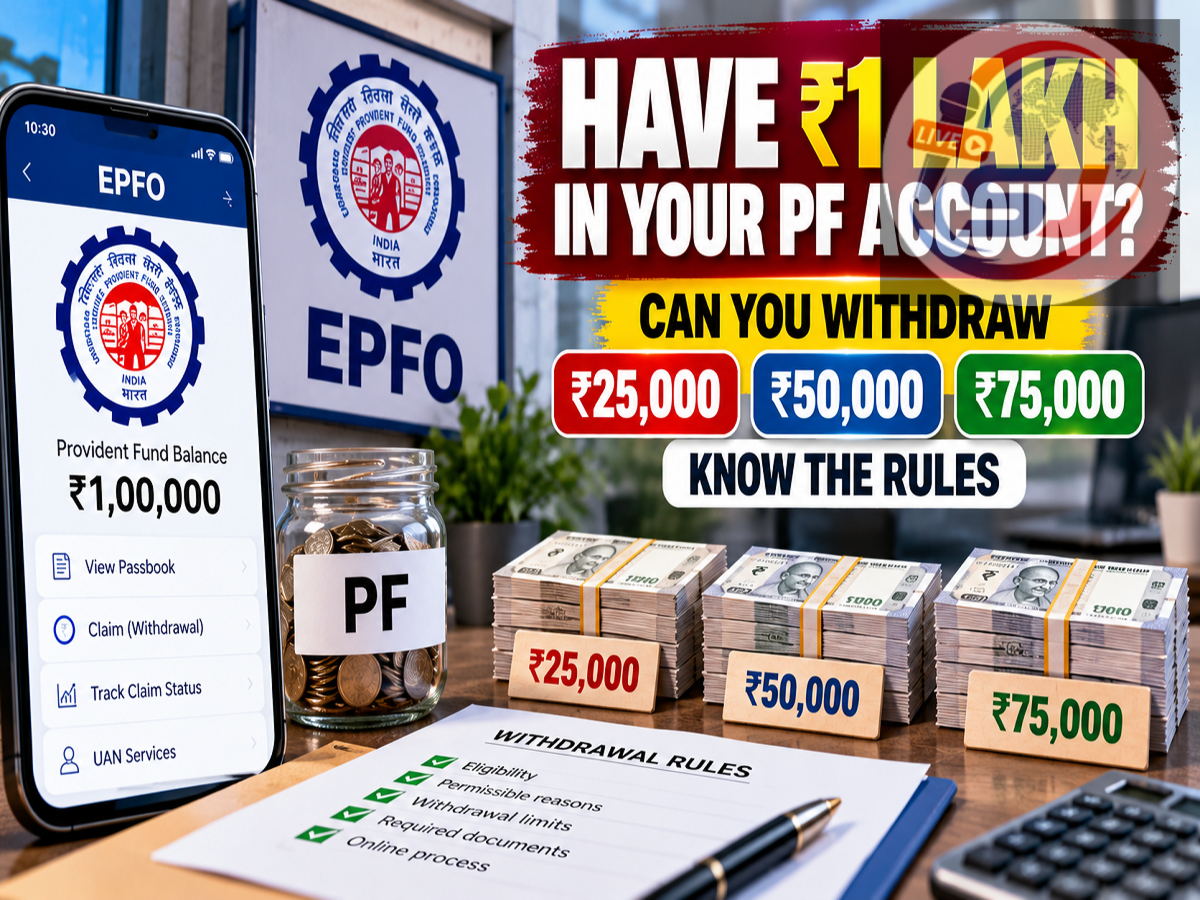
EPFO PF Withdrawal Rules October 2026: Employees contributing to the Employees' Provident Fund (EPF) often depend on their accumulated savings during financial emergencies. Whether the requirement involves medical treatment, children's education, marriage expenses or purchasing a house, provident fund savings can provide important financial support.
Under the revised withdrawal framework reported in October 2026, eligible EPFO members may withdraw up to 75% of their available PF balance for permitted purposes.
But does this mean an employee with ₹1 lakh in their PF account can withdraw ₹75,000 immediately? Can they choose ₹25,000 or ₹50,000 instead?
The answer depends on eligibility, the reason for withdrawal, the applicable service requirements and the balance available under the relevant withdrawal rules.
PF Withdrawal Calculator: How Much Is 75% of Your Balance?
For an employee with a PF balance of ₹1,00,000, the basic calculation is straightforward.
Select your PF balance
₹50,000
₹1,00,000
₹2,00,000
₹5,00,000
75% calculation
₹75,000
Remaining 25%
₹25,000
This calculator shows the arithmetic 75% ceiling only. Actual withdrawal eligibility and the permitted amount depend on EPFO rules and account details.
For a ₹1 lakh balance, ₹25,000 and ₹50,000 are both below the 75% threshold, while ₹75,000 equals that threshold. However, being below the threshold does not automatically make a withdrawal eligible for approval.
New EPFO Rules: Why Must 25% of the PF Balance Remain in the Account?
The revised withdrawal framework generally requires employees to retain at least 25% of their eligible provident fund savings.
This requirement is designed to protect part of an employee's retirement corpus while allowing access to money during important financial situations.
For example, if an eligible member has ₹1 lakh in their PF account, the standard calculation would be:
| Withdrawal Request |
Amount Remaining |
Within 75% Ceiling? |
|---|---|---|
| ₹25,000 |
₹75,000 |
Yes |
| ₹50,000 |
₹50,000 |
Yes |
| ₹75,000 |
₹25,000 |
Yes |
| ₹80,000 |
₹20,000 |
No |
| ₹1,00,000 |
₹0 |
No |
The figures assume the entire ₹1 lakh is eligible for the calculation. Approval depends on the applicable withdrawal category and other requirements.
The government has confirmed that the revised framework includes both employee and employer EPF contributions when determining the eligible balance.
Three Main Categories Under the Revised PF Withdrawal Framework
Earlier, EPFO members had to navigate multiple provisions for withdrawing money for different purposes.
The simplified framework groups partial withdrawals into three broad categories.
1. Essential Needs
This category covers important personal and family requirements, including medical treatment, education and marriage.
Eligible employees can apply for withdrawals to meet qualifying expenses, subject to the relevant conditions.
2. Housing Needs
Members may seek PF advances for permitted housing-related purposes, such as purchasing or constructing a home.
Certain housing loan repayments, repairs and renovations may also qualify under the applicable provisions.
3. Special Circumstances
This category addresses situations in which employees require access to their provident fund savings because of exceptional circumstances.
The simplified framework allows eligible members to apply without specifying a particular reason under this category.
These three categories replaced the earlier collection of 13 partial-withdrawal provisions.
How Many Times Can Employees Withdraw PF Money?
The frequency of withdrawal depends on the purpose.
| Purpose |
Reported Withdrawal Frequency |
|---|---|
| Medical treatment |
No fixed lifetime limit reported; eligibility conditions apply |
| Education |
Up to 10 times during membership |
| Marriage |
Up to 5 times during membership |
| Housing-related needs |
Up to 5 times, subject to applicable conditions |
| Special circumstances |
Subject to category-specific rules |
The revised framework increased the number of permitted withdrawals for education and marriage.
However, the number of permitted applications should not be confused with the amount available for each withdrawal.
Even if an employee qualifies for multiple withdrawals, the remaining eligible balance and applicable conditions continue to determine how much can be claimed.
Minimum Service Requirement Reduced to 12 Months
One of the important changes concerns the minimum employment or EPF membership period required for partial withdrawals.
Previously, different withdrawal purposes carried different service requirements, some extending to several years.
Under the revised framework, the minimum service requirement has generally been standardised at 12 months.
This makes the rules easier to understand and potentially allows eligible employees to access savings earlier in their careers.
Nevertheless, completing 12 months of service does not mean every withdrawal request will automatically be approved.
Employees must still satisfy the conditions associated with the relevant category.
PF Withdrawal After Job Loss: Can You Take Out the Entire Balance?
The rules for unemployment-related withdrawals differ from those for regular partial withdrawals during employment.
Under the revised framework, unemployed members may access up to 75% of their PF balance, subject to the applicable conditions.
The remaining amount can generally be claimed after 12 months of unemployment.
The waiting period for premature final EPF settlement was extended from two months to 12 months, while the period for final pension withdrawal was extended to 36 months.
Certain circumstances, including retirement and other qualifying events, may be covered by separate settlement provisions.
Employees should therefore verify which rule applies to their employment status before submitting a claim.
How to Apply for PF Partial Withdrawal Online
Eligible members can generally submit a PF advance claim through the EPFO member portal.
The usual process involves the following steps:
-
Visit the official EPFO member portal and sign in using your Universal Account Number (UAN).
-
Confirm that your Aadhaar, bank account and other required KYC details are correctly linked.
-
Open the online claim section.
-
Select the appropriate advance or withdrawal option, such as Form 31, where applicable.
-
Enter the requested amount and select the relevant withdrawal purpose.
-
Complete the required verification and submit the application.
-
Track the claim status through the EPFO portal.
The precise steps and documentation requirements may vary depending on the claim category and current portal functionality.
Why Employees Should Avoid Unnecessary PF Withdrawals
Provident fund savings are primarily intended to provide financial support after retirement.
Withdrawing money repeatedly can reduce the amount available in later years.
For example, if ₹75,000 remains invested and hypothetically earns 8.25% annually for 10 years, it could grow to approximately ₹1.66 lakh through annual compounding.
This is only an illustration. Actual EPF interest crediting and eligibility are governed by EPFO rules, and future interest rates may change.
The example demonstrates why withdrawing retirement savings for non-essential expenses can carry a long-term opportunity cost.
EPFO PF Withdrawal Rules 2026: What Employees Should Remember
The revised EPFO framework offers greater flexibility for members who need access to their provident fund savings.
For someone with an eligible PF balance of ₹1 lakh, the general 75% withdrawal calculation allows up to ₹75,000 while retaining ₹25,000.
Requests for ₹25,000 or ₹50,000 may also fall within the percentage ceiling, but approval depends on the relevant conditions.
The framework also simplifies withdrawal categories, reduces the general minimum service requirement to 12 months and increases the permitted number of education- and marriage-related withdrawals.
The key point is that the 75% figure represents a general withdrawal ceiling, not an unconditional entitlement to receive that amount.
Employees should check their latest EPFO passbook, confirm eligibility and review the applicable claim rules before applying.
Disclaimer: This article provides general information based on the EPFO withdrawal framework and reports available as of October 14, 2026. Actual eligibility, settlement amounts and processing requirements are determined by EPFO rules and individual account details.