
EPFO PF Withdrawal Rules 2026: Can You Withdraw 75% of Your PF Balance? Check Limits for Marriage, Medical and Housing Needs
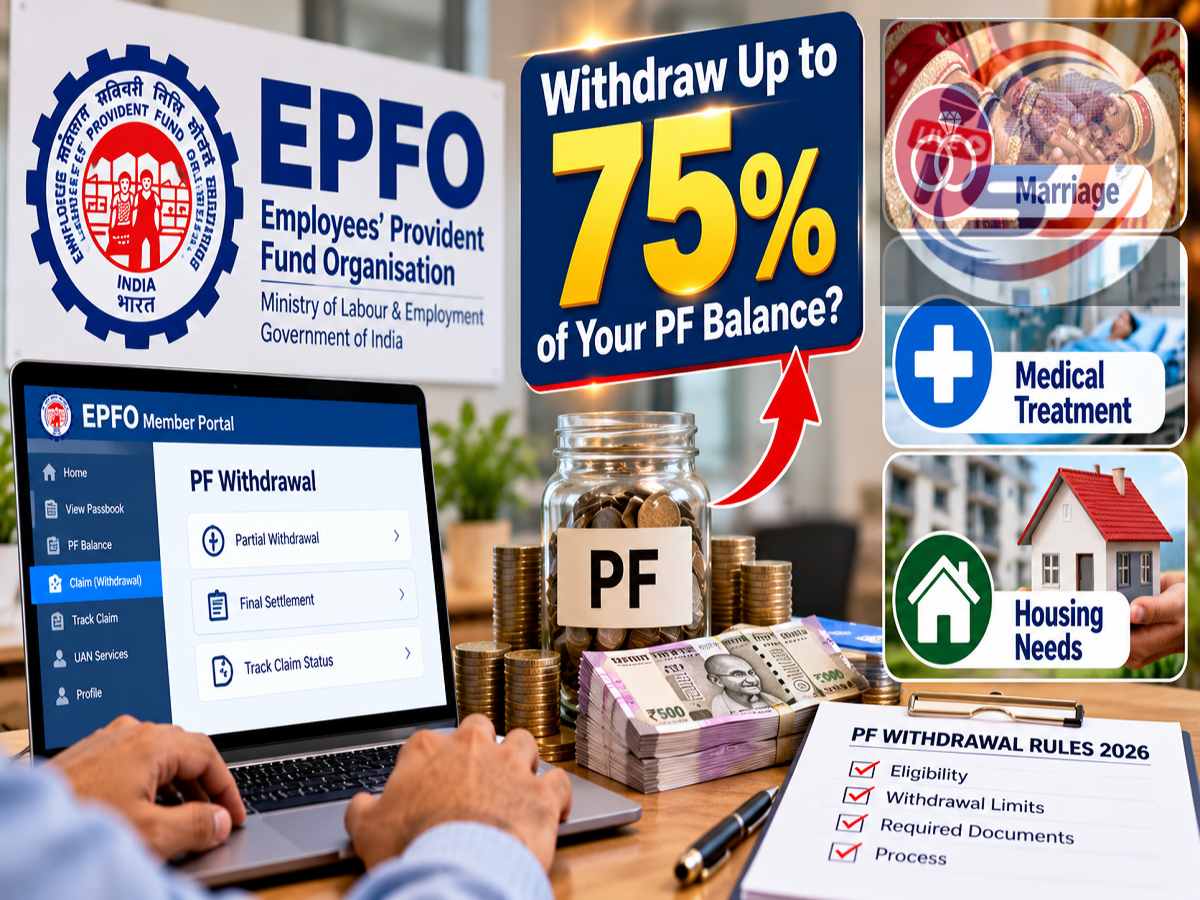
EPFO PF Withdrawal Rules 2026: Employees' Provident Fund Organisation (EPFO) members planning to withdraw money from their provident fund accounts should understand the applicable rules before submitting a claim. According to an October 14, 2026 report, withdrawal limits and eligibility conditions differ depending on whether the money is required for medical treatment, education, marriage, housing or other permitted purposes. The report also highlights the 75% withdrawal facility, which has attracted considerable attention among PF subscribers.
However, the amount available for withdrawal depends on the applicable EPFO provisions, the member's employment status, service history and the specific reason for the claim.
EPFO PF Withdrawal Rules 2026: What Has Changed?
Provident fund savings are primarily intended to provide financial support after retirement.
However, EPFO also permits eligible members to access part of their accumulated savings for certain needs before retirement.
These withdrawals are commonly known as PF advances or partial withdrawals.
The October 14 report discusses withdrawal limits for different purposes and the rules surrounding access to up to 75% of the PF balance.
It is important to understand that a 75% withdrawal facility does not automatically mean every employed EPFO member can withdraw 75% of their account balance for any reason.
Eligibility depends on the applicable withdrawal provision.
The supplied report does not include an official EPFO circular specifying newly revised limits for each category. Members should therefore verify the current rules before applying.
PF Withdrawal for Medical Treatment
Medical emergencies can create sudden financial pressure on employees and their families.
EPFO permits eligible members to apply for provident fund advances for specified medical treatment requirements.
Medical withdrawals may be available for the member's own treatment or for eligible family members, subject to the applicable provisions.
Under the traditional EPF Scheme framework, the permissible medical advance is generally linked to six months' basic wages and dearness allowance or the employee's own contribution with interest, whichever is lower.
However, members should check whether updated provisions apply to their particular claim.
Medical advances generally differ from full PF settlement because the employee remains a member of the provident fund system.
PF Withdrawal for Marriage Expenses
Marriage-related expenses are another commonly discussed reason for partial PF withdrawals.
Under the traditional EPF withdrawal framework, eligible members could withdraw funds for their own marriage or the marriage of specified family members.
The rules included minimum service requirements and limits on the amount and number of withdrawals.
For example, the earlier framework generally required seven years of membership for marriage-related advances and permitted withdrawal of up to 50% of the employee's own contribution with interest, subject to conditions.
However, these conditions should not automatically be treated as the final rules applicable in October 2026.
The report refers to revised withdrawal arrangements but does not provide the full official notification.
Members should check the applicable provisions displayed through EPFO before submitting a marriage-related claim.
EPFO Withdrawal for Children's Education
EPFO also provides for withdrawals connected with certain educational expenses.
Under earlier provisions, eligible members could seek an advance for qualifying post-matriculation education expenses.
The permissible amount was generally linked to the employee's contribution and accumulated interest, with service and frequency conditions.
Education-related withdrawals are intended to help members manage eligible academic expenses without closing their PF accounts.
However, the rules governing eligible courses, required documents and permissible withdrawal amounts may depend on the current EPFO framework.
Members should review the latest instructions before applying.
PF Withdrawal for Buying or Building a House
Housing is another major reason employees seek access to their provident fund savings.
EPFO has provisions covering eligible expenses related to purchasing a house, constructing residential property and repaying certain housing loans.
The permissible withdrawal amount may depend on factors such as the member's service period, wages, PF balance and the specific housing purpose.
Different provisions can apply to purchasing property, constructing a home and repaying an existing loan.
Consequently, there is no single withdrawal limit that can accurately describe every housing-related PF claim.
Employees should verify the appropriate withdrawal category before applying.
EPFO PF Withdrawal Limits: Category-Wise Overview
| Withdrawal Purpose |
General Position |
|---|---|
| Medical Treatment |
Partial withdrawal permitted subject to applicable conditions |
| Marriage |
Eligibility, service requirements and limits apply |
| Education |
Permitted for qualifying educational expenses |
| House Purchase |
Amount depends on the applicable housing provision |
| House Construction |
Subject to specified eligibility conditions |
| Housing Loan Repayment |
Separate conditions may apply |
| Unemployment |
Special withdrawal provisions may apply |
| Retirement |
Withdrawal and settlement rules depend on retirement status and applicable provisions |
The table provides a general overview. It is not a substitute for the current EPFO withdrawal notification.
Can Employees Withdraw 75% of Their PF Balance?
The 75% withdrawal provision is particularly relevant because it has been discussed in connection with unemployment and changes to PF withdrawal procedures.
Under an established unemployment-related provision, an eligible member could withdraw up to 75% of the accumulated provident fund balance after remaining unemployed for at least one month.
The remaining balance could become eligible for withdrawal under the applicable conditions after a further period of unemployment.
However, any changes announced in 2026 need to be examined separately.
A report referring to a 75% withdrawal facility should not be interpreted as permission for all members to withdraw that proportion while continuing in employment.
The precise conditions depend on the official rules in force when the application is made.
How Many Times Can You Withdraw PF Money?
The number of permissible partial withdrawals depends on the reason for the claim and the applicable EPFO provision.
Some categories have historically included restrictions on how frequently advances may be claimed.
Others may allow eligible withdrawals according to specific circumstances and available balances.
The October 14 report mentions category-wise withdrawal frequency but does not provide the complete revised limits.
Therefore, it would be misleading to state that every EPFO member can withdraw money a fixed number of times across all categories.
Members should check the current rules for their chosen withdrawal purpose.
How to Apply for PF Advance Withdrawal Online
Eligible EPFO members can generally submit online withdrawal claims through the Unified Member Portal.
The usual process involves signing in with the Universal Account Number (UAN) and password.
After logging in, the member can access the online claim facility and review the available withdrawal options.
The applicant must select the relevant claim type, enter the required information and complete the applicable verification process.
The system may request supporting details or documentation depending on the withdrawal category.
Once submitted, the claim is processed according to EPFO's applicable procedures.
Approval is subject to eligibility and verification.
Documents and Details Required for PF Withdrawal
Members should ensure that their EPFO account information is accurate before filing a claim.
Important details may include the UAN, Aadhaar information, bank account details and other required KYC records.
The bank account used for receiving the payment should be correctly linked and verified.
Additional documentation may be required depending on the type of withdrawal.
Incorrect personal details, mismatched bank information or incomplete records can create processing difficulties.
Members should correct such discrepancies before submitting an application.
Will PF Withdrawal Reduce Your Retirement Savings?
Yes. A partial withdrawal reduces the amount remaining in the provident fund account.
It can also reduce the future interest that would otherwise accumulate on the withdrawn money.
For example, withdrawing ₹3 lakh from an EPF account means that amount will no longer remain invested in the account to earn future EPF interest.
Over a long period, the impact on retirement savings may be substantial.
Employees should therefore consider whether the withdrawal is necessary and whether other suitable financial resources are available.
Is PF Withdrawal Tax-Free?
Tax treatment depends on the type of withdrawal and the member's circumstances.
Certain eligible PF advances may receive tax treatment different from a final settlement.
For final withdrawals, the length of continuous service and other applicable conditions can be important.
Under the relevant tax provisions, withdrawals after five years of qualifying continuous service are generally eligible for exemption, subject to applicable conditions and exceptions.
Members should not assume that every PF withdrawal is automatically tax-free.
They should review the relevant rules before submitting a claim, especially when considering a final settlement.
How to Check PF Withdrawal Claim Status
After submitting an online claim, members can check its progress through the official EPFO services.
The claim status facility generally displays whether an application is under processing, settled or subject to another status.
Processing times may vary depending on the claim type, account details and verification requirements.
If a claim remains pending or is rejected, the member should review the reason provided and take the necessary corrective action.
Members can also use EPFO's official grievance channels for unresolved issues.
EPFO PF Withdrawal Rules 2026: What Members Should Remember
Provident fund withdrawals are governed by different eligibility conditions depending on their purpose.
Medical expenses, marriage, education, housing and unemployment do not necessarily follow identical rules.
The 75% withdrawal facility also has specific conditions and should not be confused with unrestricted access to PF savings.
Before applying, members should confirm the relevant withdrawal category, available balance, required service period and supporting documentation.
They should also consider the impact of the withdrawal on their future retirement savings.
Conclusion
The October 14, 2026 report highlights the importance of understanding EPFO's category-wise withdrawal rules before accessing provident fund savings.
Members may be eligible for partial withdrawals for specified medical, educational, marriage and housing needs, while separate provisions govern unemployment-related withdrawals.
The key point is that withdrawal limits, frequency and eligibility depend on the applicable EPFO rules. A 75% withdrawal provision does not automatically apply to every member or every purpose.
Employees should verify the latest official instructions through EPFO before submitting a withdrawal request.
Disclaimer: This article explains general EPFO withdrawal provisions and the issues raised in the supplied October 14, 2026 report. The report does not include the complete text of a new official EPFO circular. Specific withdrawal limits, service requirements and claim conditions should be verified against the rules currently in force.