
EPFO New PF Withdrawal Rules 2026: Repeated Withdrawals May Face Limits, Check Marriage, Education and Medical Rules
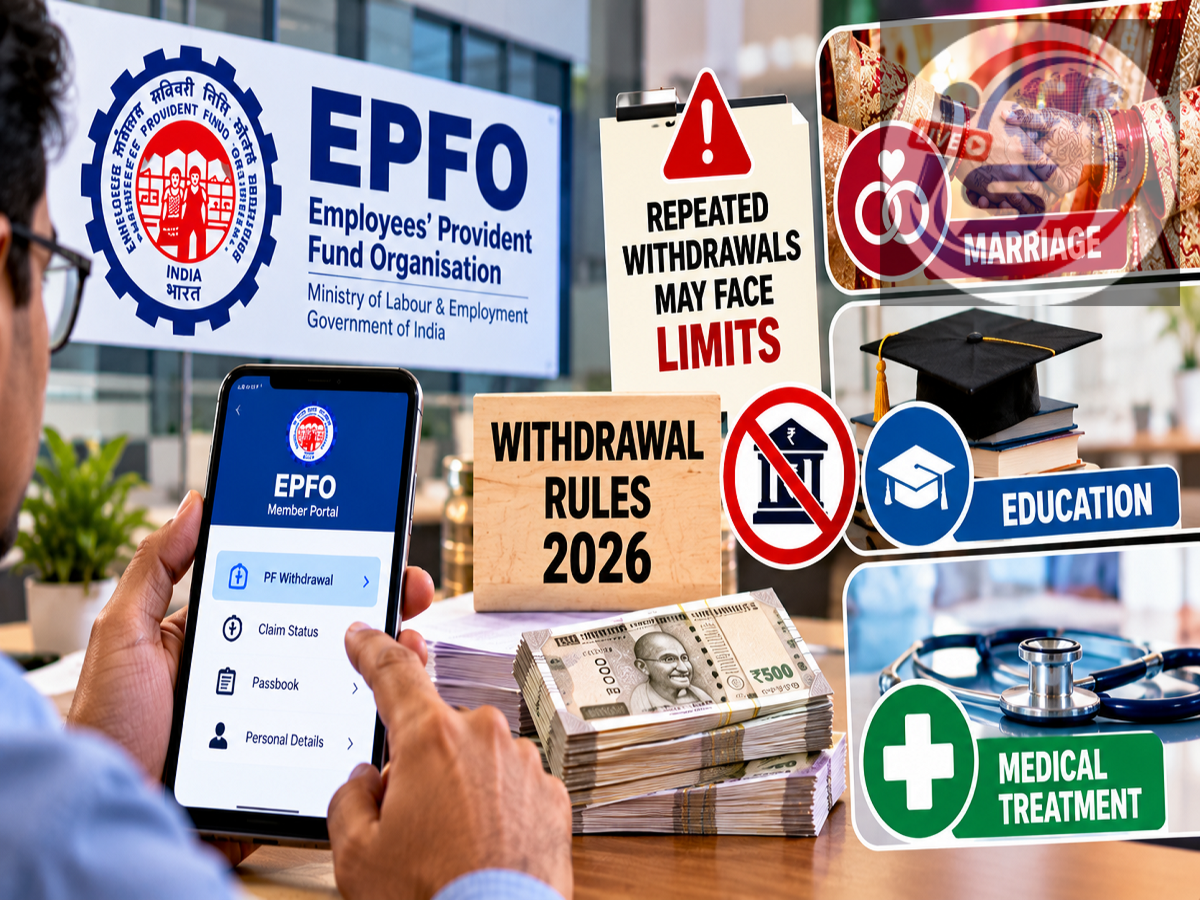
EPFO PF Withdrawal Rules 2026: Employees' Provident Fund Organisation (EPFO) members who frequently withdraw money from their provident fund accounts should pay attention to the latest reported changes in advance withdrawal rules. According to an October 14, 2026 report, EPFO has revised the framework for partial PF withdrawals, with limits applying to different categories such as marriage, education, medical treatment and housing. The changes are intended to regulate access to retirement savings while allowing eligible members to withdraw money for important financial needs.
However, the brief report does not provide the complete official notification or specify the revised numerical limits. Members should verify the applicable rules before submitting a withdrawal claim.
EPFO PF Withdrawal Rules 2026: What Is the Latest Update?
Provident fund savings play an important role in providing financial security to salaried employees after retirement.
However, employees sometimes need to access their accumulated savings before retirement to meet urgent financial requirements.
EPFO permits eligible members to apply for partial withdrawals, commonly called PF advances, for specified purposes.
The October 14 report indicates that the organization has changed certain advance withdrawal conditions and introduced or revised category-wise restrictions.
According to the report, members may no longer be able to make repeated withdrawals without considering the applicable limits.
This does not mean that every PF withdrawal has been stopped.
Instead, the reported changes concern the eligibility conditions and limits that apply to different withdrawal purposes.
Why Does EPFO Restrict Frequent PF Withdrawals?
The Employees' Provident Fund is primarily designed as a long-term retirement savings arrangement.
Employees and employers contribute according to the applicable rules, helping members accumulate funds during their working years.
When employees withdraw money frequently, their remaining retirement balance decreases.
They also lose the opportunity to earn future interest on the amount withdrawn.
For example, if a member withdraws ₹2 lakh from their PF account, that amount is no longer available to accumulate interest within the account.
Over a long period, repeated withdrawals can substantially reduce the savings available at retirement.
Withdrawal limits can therefore help balance immediate financial needs with long-term retirement protection.
EPFO Advance Withdrawal Categories Explained
The EPFO framework provides different withdrawal provisions depending on the reason for requesting money.
These generally cover specified medical expenses, education, marriage, housing and other permitted circumstances.
Each category can have its own eligibility requirements, maximum withdrawal amount and frequency restrictions.
The conditions for one purpose should not automatically be applied to another.
For example, a medical emergency may be treated differently from a withdrawal intended for a family wedding.
Similarly, buying a house may involve different eligibility criteria from paying educational expenses.
PF Withdrawal for Medical Treatment
Medical emergencies can create sudden financial pressure on employees.
EPFO has provisions allowing eligible members to withdraw part of their provident fund savings for qualifying medical needs.
Such withdrawals may be available for treatment involving the member or eligible family members, subject to the relevant conditions.
Under the traditional EPF framework, medical advances have generally been linked to six months' basic wages and dearness allowance or the employee's own contribution with interest, whichever is lower.
However, the October 2026 report refers to revised rules without providing the complete updated provisions.
Members should therefore check the currently applicable medical withdrawal limits before applying.
PF Withdrawal for Marriage Expenses
Marriage-related withdrawals are another commonly used PF advance category.
Under earlier provisions, eligible employees could withdraw funds for their own marriage or the marriage of specified family members.
The traditional framework generally required seven years of qualifying membership and permitted withdrawals up to a prescribed percentage of the employee's contribution with interest.
Frequency restrictions also applied.
The latest report suggests that category-wise limits remain important under the revised withdrawal framework.
However, the exact number of permitted marriage-related withdrawals under the reported 2026 changes has not been established by the supplied excerpt.
Members should confirm the applicable rules rather than relying on older limits alone.
PF Withdrawal for Children's Education
Education expenses can place a significant financial burden on families, especially when children pursue higher studies.
EPFO has provisions permitting eligible members to access provident fund savings for specified educational purposes.
Under the earlier framework, such advances were subject to minimum service requirements and limits based on the employee's own contribution.
The reported 2026 changes make it important to verify whether those conditions have been modified.
Members should check the eligibility criteria, permitted withdrawal amount and any restrictions on the number of claims.
They should also ensure that the educational purpose meets the conditions specified under the applicable rules.
PF Withdrawal for House Purchase and Construction
Buying or constructing a house is another major reason employees consider using their provident fund savings.
EPFO has provisions covering qualifying housing-related expenses.
Depending on the applicable rule, a withdrawal may be permitted for purchasing a residential property, constructing a house or repaying an eligible housing loan.
The permissible amount can depend on the member's wages, accumulated balance, length of service and the specific housing provision.
Some housing-related withdrawals may also have restrictions on repeat claims.
Therefore, employees should verify the exact provision that applies to their situation before submitting an application.
EPFO Withdrawal Rules 2026: Category-Wise Overview
| Withdrawal Category |
Purpose |
What Members Should Check |
|---|---|---|
| Medical |
Eligible Treatment Expenses |
Maximum Amount and Medical Eligibility |
| Marriage |
Own or Eligible Family Member's Marriage |
Service Period, Withdrawal Limit and Frequency |
| Education |
Qualifying Educational Expenses |
Eligible Course, Amount and Number of Claims |
| House Purchase |
Buying Residential Property |
Service Requirement and Maximum Withdrawal |
| House Construction |
Constructing a Residential Property |
Applicable Housing Conditions |
| Housing Loan Repayment |
Repayment of Eligible Housing Loans |
Loan Eligibility and Withdrawal Limit |
| Unemployment |
Financial Support After Job Loss |
Unemployment Period and Available Withdrawal Percentage |
The exact revised numerical limits are not provided in the supplied report and should be checked against the official EPFO notification.
Can You Withdraw 75% of Your PF Balance?
The 75% withdrawal provision has received considerable attention among EPFO subscribers.
Under an established unemployment-related provision, eligible members could withdraw up to 75% of their accumulated provident fund balance after remaining unemployed for at least one month.
The remaining amount could become eligible for withdrawal under the applicable conditions after a further period of unemployment.
However, this should not be confused with unrestricted partial withdrawals for employed members.
The rules governing medical, marriage, education and housing advances may differ.
Any new 2026 provision relating to 75% withdrawals should be evaluated according to the official EPFO notification.
Members should not assume that they can withdraw 75% of their PF balance repeatedly or for every purpose.
How Many Times Can Employees Withdraw PF Money?
This is one of the most important questions raised by the October 14 report.
The number of permissible withdrawals depends on the applicable category and the rules in force.
Some types of PF advances have historically been subject to a maximum number of claims.
Other categories may have different restrictions or conditions.
The supplied report states that limits have changed but does not provide a complete category-wise frequency table.
Therefore, it is not possible to confirm an exact number of permitted withdrawals for each category based solely on the excerpt.
Employees should review the latest EPFO instructions before planning repeated advances.
How to Apply for PF Advance Withdrawal Online
Eligible members can generally apply through the EPFO Unified Member Portal.
The application process involves logging in with the Universal Account Number (UAN) and password.
After signing in, members can access the online claim facility and select the relevant withdrawal option.
They must provide the required information and complete the applicable verification process.
Depending on the claim category, supporting details or documents may be required.
Once submitted, the application is processed according to the relevant eligibility conditions.
Approval is not automatic and depends on verification.
What Documents Are Needed for PF Withdrawal?
Members should ensure that their UAN is active and their personal information is correct.
Their Aadhaar and bank account details should also be properly linked and verified where required.
Depending on the type of claim, additional information may be necessary.
Incorrect bank details or mismatched personal information can delay processing.
Employees should review their EPFO records before applying to avoid unnecessary complications.
Will Frequent PF Withdrawals Affect Retirement Savings?
Yes. Every partial withdrawal reduces the amount remaining in the provident fund account.
The withdrawn amount also stops earning future EPF interest.
Consider an employee who withdraws ₹1 lakh on three separate occasions.
The total amount removed from retirement savings would be ₹3 lakh, excluding the future interest that could otherwise have accumulated.
Over several years, this reduction can become financially significant.
Therefore, PF advances should be considered carefully, especially when the member is approaching retirement.
Where Can Employees Check the Official Rules?
Employees should refer to the official EPFO website at epfindia.gov.in and the Unified Member Portal for the latest withdrawal instructions.
They should review the applicable advance withdrawal provisions and eligibility requirements before submitting a claim.
It is particularly important to confirm whether a new notification changes the maximum amount, minimum service period or number of permitted withdrawals.
Members should also be cautious about social media messages that present proposed changes as immediately effective rules.
EPFO New Withdrawal Rules 2026: Key Takeaway
The October 14 report indicates that EPFO has revised its partial withdrawal framework, with category-wise restrictions affecting repeated PF advances.
Medical treatment, marriage, education and housing withdrawals may follow different eligibility conditions and limits.
However, the supplied report does not identify the exact revised withdrawal limits or provide the official notification establishing them.
Employees should therefore avoid assuming that all previous rules have been replaced or that every member faces the same withdrawal restrictions.
Before withdrawing PF money, members should verify the current rules, check their eligibility and consider the impact on long-term retirement savings.
Disclaimer: This article is based on the supplied October 14, 2026 report. The detailed EPFO circular and category-wise revised limits have not been independently verified. Members should confirm the applicable withdrawal provisions through official EPFO channels before making financial decisions.