
EPF Withdrawal Rules 2026: PF Advance Allowed for These 5 Needs, Check 75% Limit and Claim Frequency
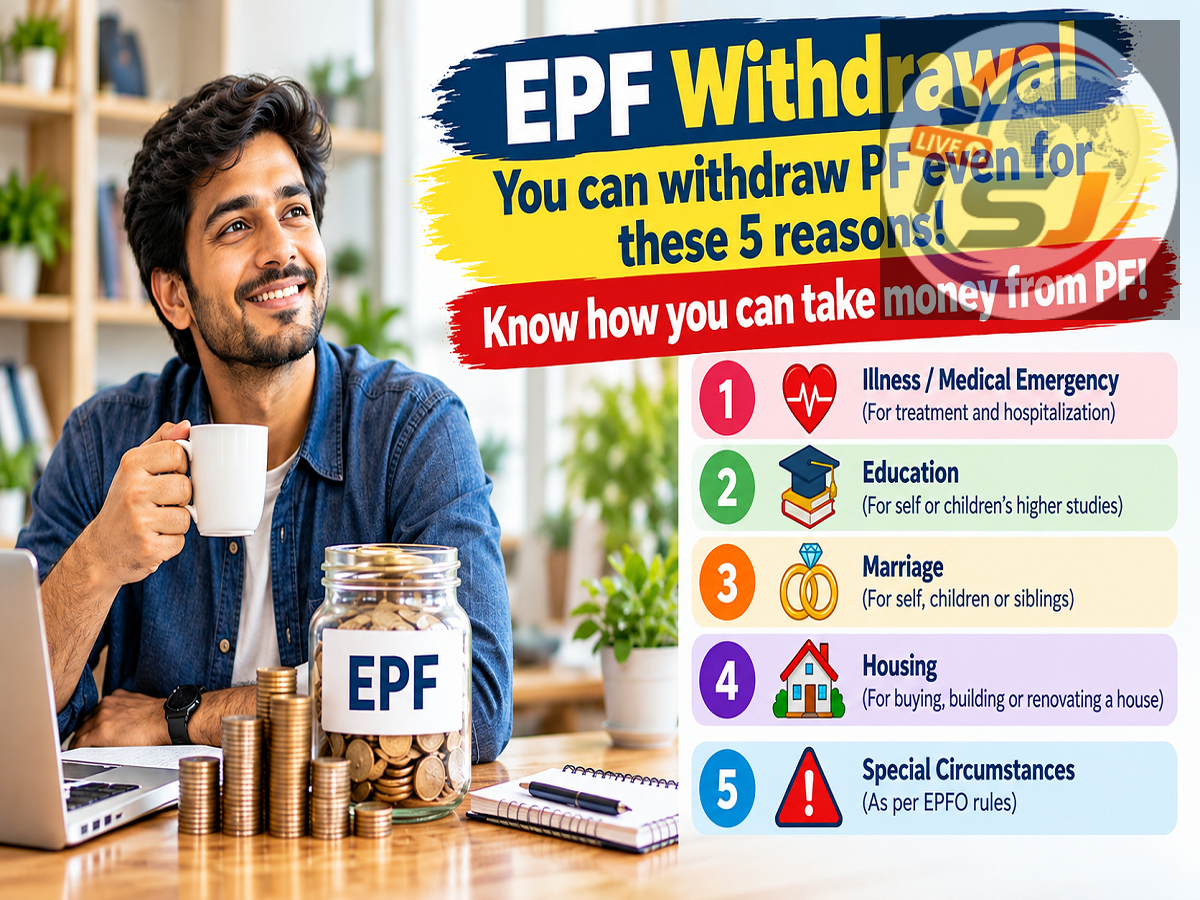
Your Employees' Provident Fund (EPF) is primarily meant to build a retirement corpus, but you may not always have to wait until retirement to access the money. Under the rules described in the supplied report, eligible EPFO members can take a partial advance from their PF balance for certain important financial needs.
These include medical treatment, higher education, marriage, buying or constructing a house, repaying a home loan and certain notified emergencies.
The report also states that, subject to eligibility conditions, members can withdraw up to 75% of their total PF balance, including the employee contribution, employer contribution and accumulated interest.
However, the number of times an advance can be claimed differs depending on why the money is required.
Here is a detailed look at the five categories and the limits described in the report.
What Is an EPF Advance?
An EPF advance is a partial withdrawal from the money accumulated in an employee's provident fund account.
Unlike a normal loan, the amount is taken from the member's own accumulated retirement savings. This is why withdrawing PF should generally be considered carefully even when the member qualifies for an advance.
Every withdrawal reduces the amount left in the account to earn future interest.
For someone with many years remaining until retirement, the impact can be particularly significant because the withdrawn amount also loses the opportunity to compound over the remaining service period.
1. PF Advance for Medical Treatment
Medical emergencies can create a sudden need for cash, and the report identifies treatment-related expenses as one of the permitted reasons for taking a PF advance.
The withdrawal can be used for treatment of the member or an eligible family member.
According to the supplied information, no fixed limit on the number of medical advance claims has been specified. In cases of serious illness or medical emergency, a member can make a claim when required, subject to the applicable EPFO conditions.
This makes the medical category different from education, marriage and housing, where the report specifies limits on the number of claims.
2. EPF Withdrawal for Higher Education
Education is another purpose for which an eligible EPFO member may access PF savings before retirement.
The report says an advance can be claimed for higher-education expenses involving the member or eligible children/family members.
Under the rules described in the source, an EPF member may make an education-related advance claim up to 10 times during the entire period of service.
This could help families meet major higher-education expenses without depending entirely on other forms of borrowing.
However, using retirement savings for education should still be weighed against alternatives because repeated withdrawals can substantially reduce the eventual retirement corpus.
3. PF Advance for Marriage Expenses
Marriage-related expenses are also covered under the partial withdrawal provisions described in the report.
An eligible member can withdraw money for his or her own marriage or for the marriage of children or siblings.
The source states that the facility can be used up to five times during the member's entire EPF membership period.
This does not mean that the entire PF balance can necessarily be withdrawn every time. The amount available will remain subject to the applicable withdrawal and eligibility conditions.
4. PF Withdrawal for House, Plot and Home Loan
Housing represents one of the broadest categories covered by the PF advance rules in the supplied report.
Several property-related requirements have been grouped under the housing category.
These include:
-
Buying a new flat
-
Purchasing a ready-built house
-
Buying a residential plot
-
Constructing your own house
-
Repaying an outstanding home loan
-
Repairing or renovating an existing house
According to the report, a member can use the housing-related advance facility up to five times during the entire period of employment.
This can make accumulated PF savings a potential source of funds for major housing requirements.
But withdrawing a large amount for property also has a long-term cost: the money taken out will no longer remain in the PF account to earn future interest.
5. PF Advance During Special Emergencies
The fifth category covers certain special circumstances or emergencies.
According to the report, where a particular crisis or emergency has been notified by EPFO's Central Board of Trustees (CBT), an eligible member may take a PF advance up to twice in a financial year.
This provision should not be interpreted as allowing two unrestricted withdrawals every year for any personal reason.
The source specifically links the facility to special circumstances or emergencies notified under the applicable framework.
EPF Advance Limits at a Glance
| Reason for PF Advance | Claim Frequency Mentioned in Report |
|---|---|
| Medical treatment | No fixed frequency limit stated |
| Higher education | Up to 10 times during service |
| Marriage | Up to 5 times during membership |
| Housing/property needs | Up to 5 times during service |
| Notified special circumstances | Up to 2 times in a financial year |
These limits relate to the claim frequencies described in the supplied report. Members should check the applicable EPFO conditions for their particular withdrawal category before filing a claim.
Can You Withdraw 75% of Your PF Balance?
The report states that eligible members may withdraw up to 75% of the total balance accumulated in their PF account, subject to applicable conditions.
For this calculation, the total balance is described as including:
Employee contribution + Employer contribution + Accumulated interest
For example, if an eligible member had a total PF balance of ₹8 lakh, 75% would mathematically equal:
₹8,00,000 × 75% = ₹6,00,000
However, this does not automatically mean every member can withdraw ₹6 lakh for every purpose.
The actual admissible amount can depend on the applicable withdrawal category and other eligibility cond