
Dearness Allowance 2026: Types of DA, Calculation Formula, Latest Rates and Income Tax Rules Explained
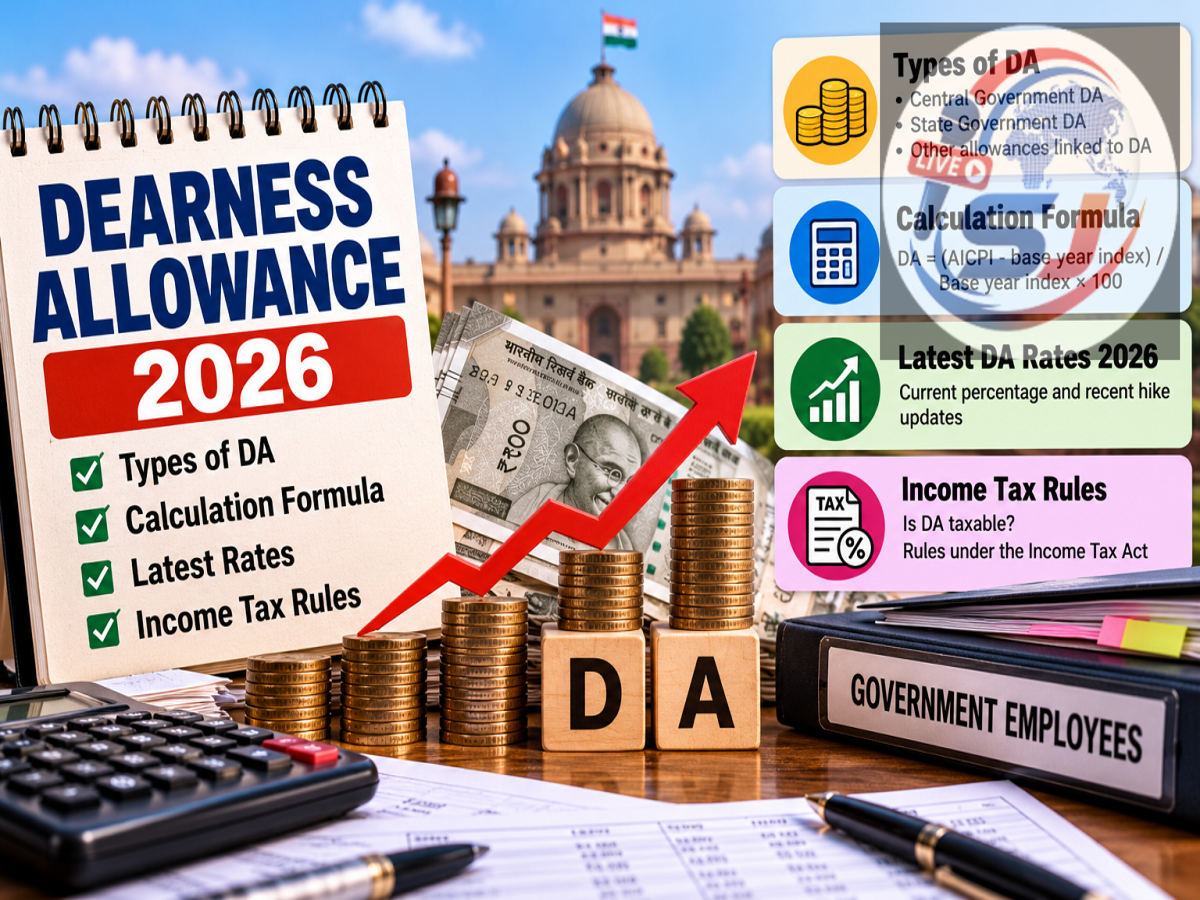
Dearness Allowance (DA) Explained: Dearness Allowance is an important component of the salary structure for eligible government employees in India. It is designed to provide partial financial protection against rising inflation and the increasing cost of everyday goods and services.
Whenever the government revises the DA rate upward, eligible employees receive an increase in their salary. Pensioners may also benefit through a corresponding revision in Dearness Relief (DR).
However, many employees are unfamiliar with how DA is calculated, how often it changes, and whether it is taxable.
The government uses inflation-related data, particularly the All India Consumer Price Index for Industrial Workers (AICPI-IW), to determine DA revisions under the applicable pay commission framework.
Here is a detailed explanation of the different types of Dearness Allowance, how the rates are calculated, who receives the benefit, and how DA affects salary and income tax.
What Is Dearness Allowance?
Dearness Allowance is a cost-of-living allowance provided to eligible employees to help offset the impact of inflation.
As the prices of essential goods and services increase, the purchasing power of money declines.
DA is intended to compensate employees for part of this increase in living expenses.
For central government employees, DA is generally calculated as a percentage of basic pay.
For example, if an employee's basic salary is ₹30,000 and the applicable DA rate is 60%, the monthly Dearness Allowance would be:
₹30,000 × 60% = ₹18,000
The employee would receive ₹18,000 as DA in addition to basic pay and other applicable salary components.
However, DA does not necessarily compensate for every increase in the cost of living.
How Often Does the Government Increase DA?
The central government generally revises Dearness Allowance twice a year.
The two revision cycles ordinarily take effect from January 1 and July 1.
Announcements are often made after the relevant inflation data has become available and the government has approved the revision.
In many years, the decisions are announced around March and September or October.
If the revised rate is approved after its effective date, eligible employees may receive arrears for the intervening months.
However, the actual announcement date, revised percentage and arrears payment depend on the government's official decision.
State governments may follow different revision schedules and rates.
What Is AICPI-IW and Why Is It Important?
The All India Consumer Price Index for Industrial Workers, commonly known as AICPI-IW, is a major inflation indicator used in calculating central government DA.
The index tracks changes in the prices of a selected basket of goods and services consumed by industrial-worker households.
These may include food, clothing, housing-related expenses, fuel and other household necessities.
When the index rises, it indicates an increase in the prices represented by the index basket.
The DA formula uses the relevant index values to estimate the inflation-linked allowance payable under the applicable rules.
For central government employees covered by the 7th Pay Commission structure, the calculation generally considers the average of the previous 12 months' AICPI-IW readings.
How Is Dearness Allowance Calculated?
Under the 7th Central Pay Commission framework, the commonly used formula is:
DA (%) = [(Average AICPI-IW for the last 12 months, converted to the 2001 base ÷ 261.42) − 1] × 100
The AICPI-IW index currently uses the 2016=100 series, so the appropriate conversion factor is required when applying the older formula.
An equivalent commonly cited expression using the 2016-base series is:
DA (%) = [(12-month average AICPI-IW on the 2016 base × 2.88 ÷ 261.42) − 1] × 100
This formula is used to understand the inflation-linked calculation under the relevant pay commission structure.
The final payable DA rate is determined through the government's approved calculation and rounding procedures.
Employees should not treat unofficial projections as confirmed rates until the government issues the necessary order.
DA Rate January 2026: What Was the Reported Increase?
According to the supplied report, the Dearness Allowance rate for central government employees was increased from 58% to 60%, effective January 2026.
This represents an increase of two percentage points.
It is important to distinguish between a two-percentage-point DA increase and a 2% increase in the employee's total salary.
The additional DA is calculated on the eligible basic pay, not the employee's entire gross salary.
For example, an employee with a basic salary of ₹40,000 would receive ₹800 more per month when DA rises from 58% to 60%.
The actual change in take-home salary may differ because of applicable deductions and taxes.
How Much Does a 2% DA Hike Increase Your Salary?
The following table illustrates the effect of an increase from 58% to 60%.
| Basic Monthly Salary | DA at 58% | DA at 60% | Monthly Increase |
|---|---|---|---|
| ₹18,000 | ₹10,440 | ₹10,800 | ₹360 |
| ₹25,500 | ₹14,790 | ₹15,300 | ₹510 |
| ₹35,400 | ₹20,532 | ₹21,240 | ₹708 |
| ₹44,900 | ₹26,042 | ₹26,940 | ₹898 |
| ₹56,100 | ₹32,538 | ₹33,660 | ₹1,122 |
| ₹67,700 | ₹39,266 | ₹40,620 | ₹1,354 |
These are illustrative calculations based on the DA rates stated in the supplied report. They do not include other allowances, deductions or taxes.
How Many Types of Dearness Allowance Are There?
Dearness Allowance is often discussed in two broad categories in the context of public-sector and wage-related compensation.
However, the exact classification depends on the employee's service rules and wage structure.
1. Industrial Dearness Allowance (IDA)
Industrial Dearness Allowance is associated with eligible employees working in certain public-sector enterprises.
IDA is generally linked to inflation and is commonly revised on a quarterly basis under the applicable industrial DA framework.
The calculation method can differ from the DA formula used for regular central government employees.
Employees working in central public-sector enterprises should therefore check the pay structure and DA rules applicable to their organisation.
2. Variable Dearness Allowance (VDA)
Variable Dearness Allowance is commonly associated with minimum-wage arrangements for workers in specified scheduled employments.
VDA helps adjust wage payments in response to changes in the relevant consumer price index.
The applicable rate is revised according to the rules and notifications governing the particular employment category.
VDA should not be confused with the regular Dearness Allowance paid to central government employees.
The calculation methods, revision schedules and eligibility conditions can be different.
What Is the Difference Between DA, IDA and VDA?
| Category | Main Beneficiaries | Revision Basis |
|---|---|---|
| Dearness Allowance (DA) | Eligible central and state government employees | Applicable inflation index and government rules |
| Industrial Dearness Allowance (IDA) | Eligible employees of certain public-sector enterprises | Relevant industrial DA framework, often quarterly |
| Variable Dearness Allowance (VDA) | Workers covered by applicable minimum-wage notifications | Relevant consumer price index and wage notifications |
| Dearness Relief (DR) | Eligible government pensioners | Applicable pension rules and inflation-linked revisions |
These categories do not necessarily use identical formulas or rates.
Who Is Eligible for Dearness Allowance?
Dearness Allowance is generally available to eligible central government employees and employees of state governments under their respective service rules.
Certain public-sector employees also receive inflation-linked allowances under their applicable pay structures.
Government pensioners may receive Dearness Relief instead of salary-based DA.
Private-sector employees do not automatically become entitled to government DA merely because they receive a monthly salary.
Whether a private-sector employee receives a similar allowance depends on the employment contract, wage agreement and applicable labour laws.
What Is the Difference Between DA and DR?
Dearness Allowance and Dearness Relief serve similar purposes but apply to different groups.
DA is paid to eligible serving employees as part of their salary.
DR is provided to eligible pensioners to help offset the effects of inflation on pension income.
Both are generally expressed as a percentage of the applicable basic pay or basic pension.
For example, if a pensioner receives a basic pension of ₹20,000 and the applicable DR rate is 60%, the monthly Dearness Relief would be ₹12,000.
The total of basic pension and DR would be ₹32,000 before any other applicable adjustments.
Is Dearness Allowance Taxable?
Yes. Dearness Allowance received as part of salary is generally taxable under Indian income tax rules.
It forms part of an employee's salary income and must be accounted for when calculating taxable income.
An increase in DA can therefore increase gross salary as well as the amount subject to income tax.
However, the actual tax liability depends on the employee's total income, applicable tax regime, deductions, rebates and other relevant provisions.
Employees should review their salary statements and Form 16 when preparing their income tax returns.
DA may also be relevant to certain other salary-related calculations where the applicable rules specifically include it.
Does DA Increase Automatically When Inflation Rises?
DA is linked to inflation, but an increase in the consumer price index does not automatically mean that employees immediately receive a higher allowance.
The relevant index data must first be available.
The applicable formula is then used to determine the revised rate, which is subject to the government's approval and official notification.
Therefore, projected DA figures based on monthly AICPI-IW readings are estimates until a formal announcement is made.
Will DA Be Merged With Basic Pay Under the 8th Pay Commission?
With discussions surrounding the 8th Central Pay Commission, some employee organisations have demanded that Dearness Allowance be merged with basic pay.
The purpose of such a proposal is to reflect accumulated inflation in the revised salary structure.
However, a demand for DA merger does not mean the government has approved it.
Any change to the treatment of DA under a future pay structure would depend on the commission's recommendations and the central government's final decision.
Employees should distinguish between official notifications and proposals submitted by employee associations.
Dearness Allowance 2026: Final Takeaway
Dearness Allowance plays an important role in protecting eligible government employees against rising living costs.
For central government employees, DA is generally revised twice a year using the applicable AICPI-IW-based calculation framework.
Industrial Dearness Allowance and Variable Dearness Allowance operate under different rules and apply to different categories of workers.
DA is also generally taxable as salary income, which means the final increase in take-home pay may be lower than the gross allowance increase.
Understanding the DA formula, revision cycle and applicable employment rules can help employees calculate the impact of inflation-linked increases on their salaries.
Employees and pensioners should rely on official government notifications for confirmed DA and DR rates rather than unapproved projections.
Disclaimer: This article provides general information about Dearness Allowance, its calculation and taxation. DA rates, eligibility conditions and formulas may vary according to the applicable pay structure and official government orders. The January 2026 rate mentioned above is based on the supplied report.
Clarify the reported January rateAdd a quick DA calculation summary