Dairy Farming Loan 2026: Can You Start a Dairy Farm With Just 25% Investment? Check NABARD Subsidy Rules
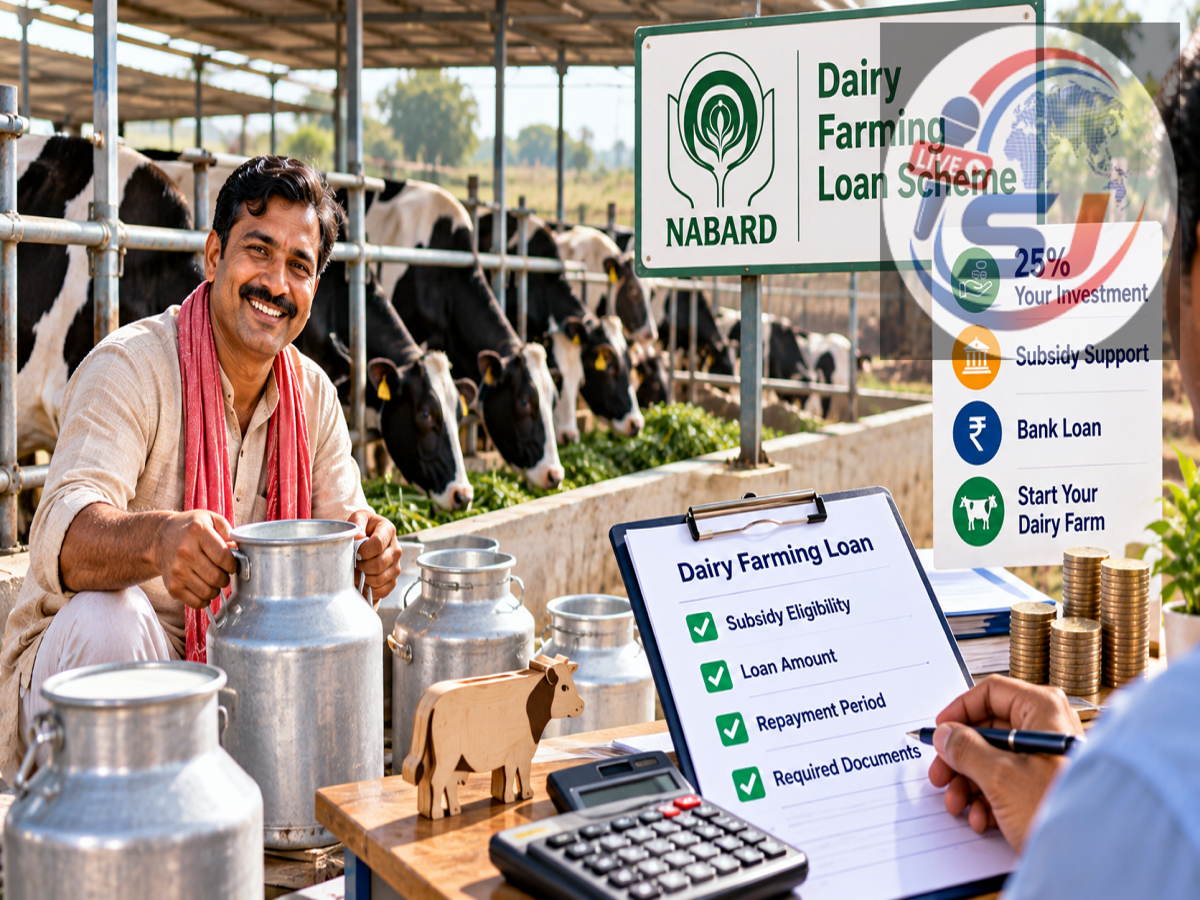
Dairy Farming Loan and Subsidy 2026: Dairy farming is becoming an attractive business opportunity for farmers, rural entrepreneurs, and people looking to generate additional income. With growing demand for milk and dairy products, starting a small dairy farm can offer regular earnings when the business is properly managed.
However, purchasing cows or buffaloes, constructing animal sheds, arranging fodder, and installing equipment require considerable initial investment. To support entrepreneurs, banks and government institutions offer various financing options for eligible dairy-related activities.
A recent report claims that individuals can establish a dairy farm by investing only 25% of the total project cost while obtaining bank financing for the remaining 75%. It also mentions government subsidies of 25% and 33.33% under a NABARD-linked programme.
An important clarification: These subsidy percentages are associated with the older Dairy Entrepreneurship Development Scheme (DEDS), which is not an active, universally available subsidy programme in 2026. Applicants should not assume that every new dairy farm qualifies for these benefits.
Here is a detailed explanation of dairy farming loans, NABARD's role, available government support, eligibility requirements, and the process of applying for financial assistance.
Can You Start a Dairy Farm With Only 25% of the Project Cost?
Some banks may finance a substantial portion of an eligible dairy farming project, allowing entrepreneurs to contribute the remaining amount from their own resources.
For example, consider a dairy farming project costing ₹10 lakh.
| Project Component |
Illustrative Amount |
|---|---|
| Total project cost |
₹10,00,000 |
| Entrepreneur's contribution (25%) |
₹2,50,000 |
| Potential bank loan (75%) |
₹7,50,000 |
| Automatic government subsidy |
Not guaranteed |
This example demonstrates a possible financing arrangement, not a universal government rule.
The actual margin requirement, sanctioned loan amount, interest rate, collateral conditions, and repayment schedule depend on the lending bank, applicant profile, and project viability.
NABARD Dairy Subsidy: What Happened to the Old Scheme?
The Dairy Entrepreneurship Development Scheme was previously implemented with NABARD's involvement to encourage dairy entrepreneurship.
Under that programme, eligible general-category beneficiaries could receive a back-ended capital subsidy of 25% of the eligible project cost, while SC/ST beneficiaries could receive 33.33%, subject to prescribed ceilings and conditions.
The scheme also covered certain dairy-related activities, including small dairy units and equipment.
However, DEDS was discontinued after the financial year 2019–20. Its historical subsidy rates should not be advertised as newly introduced NABARD subsidy rules for 2026.
Women applicants were not automatically entitled to the 33.33% rate solely because of gender under the old scheme.
Dairy Farming Loan Options Available in 2026
Although the old DEDS subsidy is no longer available, farmers and entrepreneurs can explore other financing options.
1. Regular Dairy Farming Loans From Banks
Commercial banks, regional rural banks and cooperative banks may provide loans for dairy farming activities.
Depending on the bank's lending policy, financing may cover the purchase of milch animals, animal sheds, dairy equipment and other eligible expenses.
The bank will assess the applicant's repayment capacity, projected milk production, animal health arrangements and expected business income before sanctioning a loan.
2. Animal Husbandry Infrastructure Development Fund (AHIDF)
The Animal Husbandry Infrastructure Development Fund has supported eligible investments in dairy processing, value-added dairy products, animal feed manufacturing, breed improvement and related infrastructure.
Under its published framework, eligible projects could receive financing of up to 90% of project cost, along with a 3% interest subvention, subject to scheme conditions.
However, AHIDF is not a blanket subsidy for purchasing two or three cows. The government's published approval covered the period through March 31, 2026. Applicants in October 2026 should confirm whether an extension or fresh sanction is available before relying on these benefits.
3. Kisan Credit Card for Animal Husbandry
The Kisan Credit Card facility also supports eligible livestock farmers with working capital requirements.
This can help cover recurring expenses such as animal feed, veterinary care and other operational costs.
The Department of Animal Husbandry and Dairying has confirmed that eligible animal husbandry farmers can access KCC facilities for working capital.
What Expenses Can a Dairy Farming Loan Cover?
Depending on the bank and loan product, eligible expenses may include:
-
Purchase of cows or buffaloes.
-
Construction or improvement of animal sheds.
-
Milking machines and basic dairy equipment.
-
Fodder cutting and storage equipment.
-
Water supply and animal care infrastructure.
-
Working capital for feed, veterinary treatment and other recurring needs.
Financing for milk chilling units, processing facilities or transport vehicles may require a different loan category or a more detailed commercial project proposal.
Who Can Apply for Dairy Farming Financial Assistance?
Eligibility varies by bank and scheme. Potential applicants may include individual farmers, livestock owners, rural entrepreneurs, self-help groups, farmer producer organisations and dairy cooperatives.
Banks generally evaluate the applicant's identity, credit history, available space for animals, access to water and fodder, and projected ability to repay the loan.
There is no universal rule guaranteeing approval to every applicant aged 18 or above. Likewise, family-member restrictions and subsidy eligibility depend on the specific scheme rather than a single nationwide dairy loan policy.
Documents Required for a Dairy Farming Loan
Applicants should prepare a detailed project report explaining how the proposed dairy unit will operate.
Commonly requested documents include Aadhaar or another accepted identity proof, PAN where applicable, address proof, bank statements, photographs and relevant land or shed documents.
Banks may also request quotations for animals and equipment, details of existing livestock, projected milk sales and information about the proposed milk buyer.
For larger projects, additional financial records, registrations or technical approvals may be required.
How to Apply for a Dairy Farming Loan in 2026
The application process generally begins with selecting the appropriate loan product.
-
Prepare a dairy farming project report with the number of animals, estimated milk production, operating costs and expected income.
-
Visit a commercial bank, regional rural bank or cooperative bank offering dairy loans.
-
Ask about the required margin contribution, interest rate, collateral and repayment period.
-
Confirm whether any currently active central or state government subsidy applies to the specific project.
-
Submit the application along with the required documents.
-
Allow the bank to evaluate the project's feasibility and conduct any necessary verification.
-
Review the sanction letter carefully before accepting the loan.
Applicants should not pay unofficial agents who promise guaranteed NABARD subsidies or immediate loan approval.
How Much Can a Small Dairy Farm Earn?
Dairy farming income depends on milk yield, local procurement prices, animal health, feed costs and the number of productive animals.
For instance, a small unit with four lactating animals producing an average of eight litres per animal daily would generate approximately 32 litres of milk per day.
At an illustrative selling price of ₹40 per litre, gross daily revenue would be ₹1,280.
That would equal approximately ₹38,400 over a 30-day period, before deducting feed, labour, veterinary expenses, electricity, transportation, loan repayments and other costs.
This is only an example. Actual production varies, and animals may have dry periods during which milk output falls or stops.
Farmers should calculate net profit rather than relying on gross milk sales alone.
Final Takeaway
Starting a dairy farm with a 25% personal contribution may be possible under certain bank financing arrangements, but it is not a guaranteed nationwide entitlement.
The previously advertised 25% and 33.33% NABARD-linked subsidies belonged to the discontinued Dairy Entrepreneurship Development Scheme. The Government of India confirmed that DEDS ended in April 2020.
Farmers planning a dairy business in 2026 should compare bank loan products, check state-specific assistance programmes and prepare a realistic project report before investing.
For reliable information, visit the NABARD official website or the Department of Animal Husbandry and Dairying.
Editorial note: The supplied October 7, 2026 report describes historical DEDS subsidy rates as though they are currently available. This article distinguishes discontinued benefits from financing options that applicants can independently verify.