
Condom GST Rate in India 2026: Is It Tax-Free? Why Do Sales Reportedly Rise During Navratri?
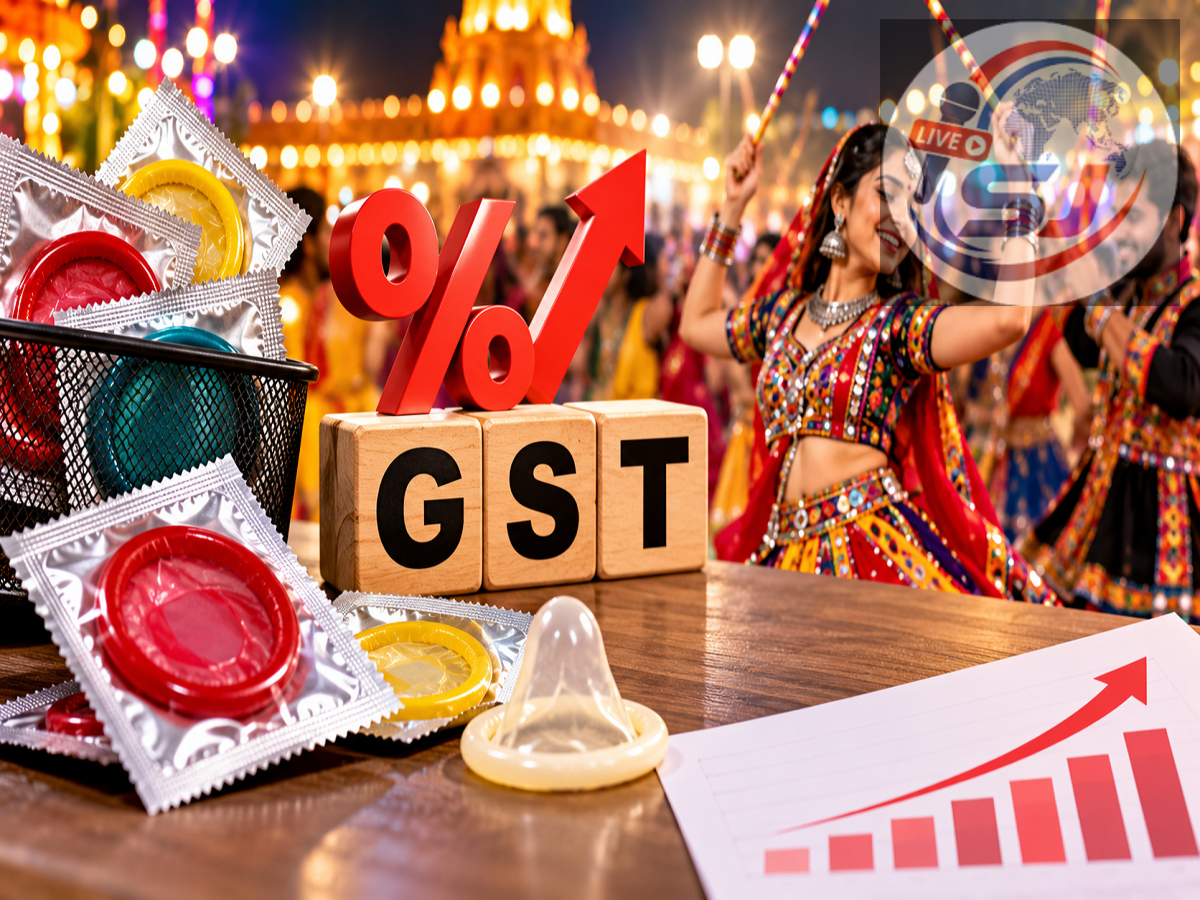
Condom GST Rate in India 2026: With Navratri celebrations bringing thousands of people together for Garba and Dandiya events, an unusual question often attracts attention: Do condom sales actually increase during the festival? Another important question is how much Goods and Services Tax (GST) the government charges on condoms in India.
Condoms are among the most widely used contraceptive products and play an important role in reproductive health, family planning and protection against sexually transmitted infections (STIs).
In India, condoms are exempt from GST, meaning customers are not charged GST on their purchase. Meanwhile, claims that condom sales rise sharply during Navratri, particularly in Gujarat, continue to circulate every year.
However, there is an important distinction between the officially prescribed tax treatment of condoms and unverified reports about changes in their sales during festivals.
Here is a detailed explanation of the GST rules, the reasons behind the exemption and what is actually known about Navratri-related sales claims.
How Much GST Is Charged on Condoms in India?
Condoms are exempt from GST in India.
This means customers do not have to pay an additional GST amount when purchasing condoms from pharmacies, supermarkets or other authorised retailers.
The product falls under the applicable GST classification for contraceptive articles made from rubber.
The HSN code mentioned in the supplied report is 40141010.
The exemption is relevant because condoms are essential preventive healthcare and family-planning products.
Removing GST from such products helps avoid an additional indirect tax burden on consumers.
However, it is important to understand that a GST exemption does not mean condoms are distributed free of charge at every retail outlet.
Consumers still pay the product's selling price unless they receive it through a free public-health distribution programme.
Condom GST Rate 2026: Important Details
| Particulars |
Details |
|---|---|
| Product |
Condoms |
| GST Treatment |
Exempt |
| Effective GST Charged to Consumers |
0% |
| HSN Code Mentioned in Report |
40141010 |
| Additional GST on Retail Purchase |
Not applicable |
| Main Purpose |
Contraception and protection against STIs |
The distinction between an exempt supply and a taxable supply carrying a zero-percent rate can matter for GST accounting, even though neither results in GST being charged to the consumer on the product.
Did the GST Rate on Condoms Change in 2025?
India witnessed discussions and revisions involving GST rates on several products and services during 2025.
However, according to the supplied report, the GST exemption applicable to condoms continued.
Some outdated online articles may suggest that condoms attract GST at 12% or 18%.
Such information should not be relied upon without checking the current official classification and exemption notification.
For consumers, the important point is that condoms remain exempt from GST under the tax treatment described in the report.
Why Are Condoms Exempt From GST?
Condoms serve an important public-health function.
They are used to help prevent unintended pregnancies and reduce the risk of transmission of several sexually transmitted infections, including HIV.
Affordable access to condoms is an important component of reproductive healthcare and family-planning initiatives.
India has also operated public-health programmes that promote awareness about contraception and safer sexual practices.
The GST exemption is consistent with treating condoms as an essential health-related product rather than an ordinary discretionary purchase.
Nevertheless, the retail price may still vary according to brand, product type, packaging and seller.
Why Do Reports of Higher Condom Sales Appear During Navratri?
Navratri is one of the most widely celebrated festivals in Gujarat.
Cities such as Ahmedabad, Surat, Vadodara and Rajkot host Garba and Dandiya events that attract large numbers of participants.
These celebrations create opportunities for social gatherings, cultural activities and community interaction.
Around this period, some media reports have historically suggested that sales of condoms and other contraceptive products increase in certain markets.
However, the existence of such reports does not establish that Navratri celebrations themselves cause an increase in sexual activity or contraceptive purchases.
Reliable conclusions would require detailed sales data collected over multiple years and across different locations.
Do Condom Sales Increase by 35% During Navratri?
Some older media reports have cited local pharmacists or chemist associations claiming that condom and contraceptive sales rise by approximately 35% during the Navratri period.
Other reports have mentioned estimated increases ranging from 25% to 50%.
These figures have attracted attention, particularly in connection with Gujarat's Garba celebrations.
However, there are important limitations.
The supplied article does not identify a comprehensive official government dataset confirming these percentages across Gujarat.
It is also unclear whether the reported figures refer specifically to condoms, all contraceptive products or sales at a limited number of pharmacies.
As a result, the figures should be treated as historical media claims rather than verified statewide statistics.
What Do the Reported Numbers Actually Mean?
| Reported Claim |
What Can Be Concluded |
|---|---|
| Condom sales increase by 35% during Navratri |
A figure cited in some older media reports, not established as a statewide fact |
| Contraceptive demand rises by 25%–50% |
An unverified range reported in some accounts |
| Pharmacies experience higher festival-period sales |
May reflect individual retailer experiences |
| Condom sales increase throughout Gujarat |
Requires representative statewide data |
| Garba events directly cause higher sales |
A causal connection has not been established |
These distinctions are important because a sales trend observed at a few stores cannot automatically represent the behaviour of an entire state.
What Do Local Pharmacy Owners Say?
Local chemists and pharmacy owners are sometimes quoted in reports about changing demand for contraceptive products during festivals.
Some retailers have suggested that sales rise during periods when large numbers of people attend social events.
However, individual observations can be influenced by several factors, including customer footfall, promotional activity, inventory availability and local purchasing patterns.
For example, a pharmacy near a busy commercial area may experience increased sales during a festival simply because more people are visiting the neighbourhood.
That does not necessarily mean the same trend is occurring in residential areas or other cities.
To establish a meaningful pattern, researchers would need to compare sales records across multiple locations and equivalent periods in different years.
Can Festival-Related Sales Claims Be Verified?
A reliable assessment of condom sales during Navratri would require more than anecdotal statements.
Researchers would need consistent sales figures from pharmacies, distributors and manufacturers.
The data would also need to distinguish between condom sales and purchases of other contraceptive products.
Another important factor would be the comparison period.
A temporary increase in sales might appear significant when compared with a quiet week but less unusual when compared with other major festivals or holiday periods.
Without these controls, reported percentage increases may create a misleading impression.
This is why festival-related claims should be presented carefully rather than treated as confirmed statistics.
Why Is Condom Awareness Important?
Regardless of whether sales increase during Navratri, public awareness about condoms remains important.
When used correctly and consistently, condoms can help reduce the risk of unintended pregnancy and transmission of several sexually transmitted infections.
They are widely available through pharmacies, healthcare providers and certain public-health programmes.
Consumers should check packaging integrity, expiry dates and product instructions before use.
They should also purchase condoms from reliable sellers and store them according to the manufacturer's recommendations.
Condom GST and Navratri Sales: What Is the Reality?
The two major issues discussed in the report have different levels of certainty.
The GST treatment of condoms is a matter of tax classification and can be checked against official government notifications.
By contrast, claims about Navratri-related sales increases are largely based on older media accounts and observations attributed to local retailers.
Although some reports have suggested increases of 25% to 50%, the supplied information does not establish a verified statewide trend.
The key takeaway is that condoms are exempt from GST in India, while claims of a major sales surge during Navratri remain insufficiently supported by comprehensive public data.
Consumers should rely on official tax information for GST-related questions and avoid drawing broad conclusions about people's behaviour from isolated retail sales reports.
Editorial note: This article is based on the supplied October 19, 2026 report. The GST classification should be cross-checked against current CBIC notifications before publication. Historical claims about festival-related sales increases have not been independently verified.