
CNG Filling Tips: Does Refuelling in the Afternoon Give You Less Gas? Know the Science Behind It
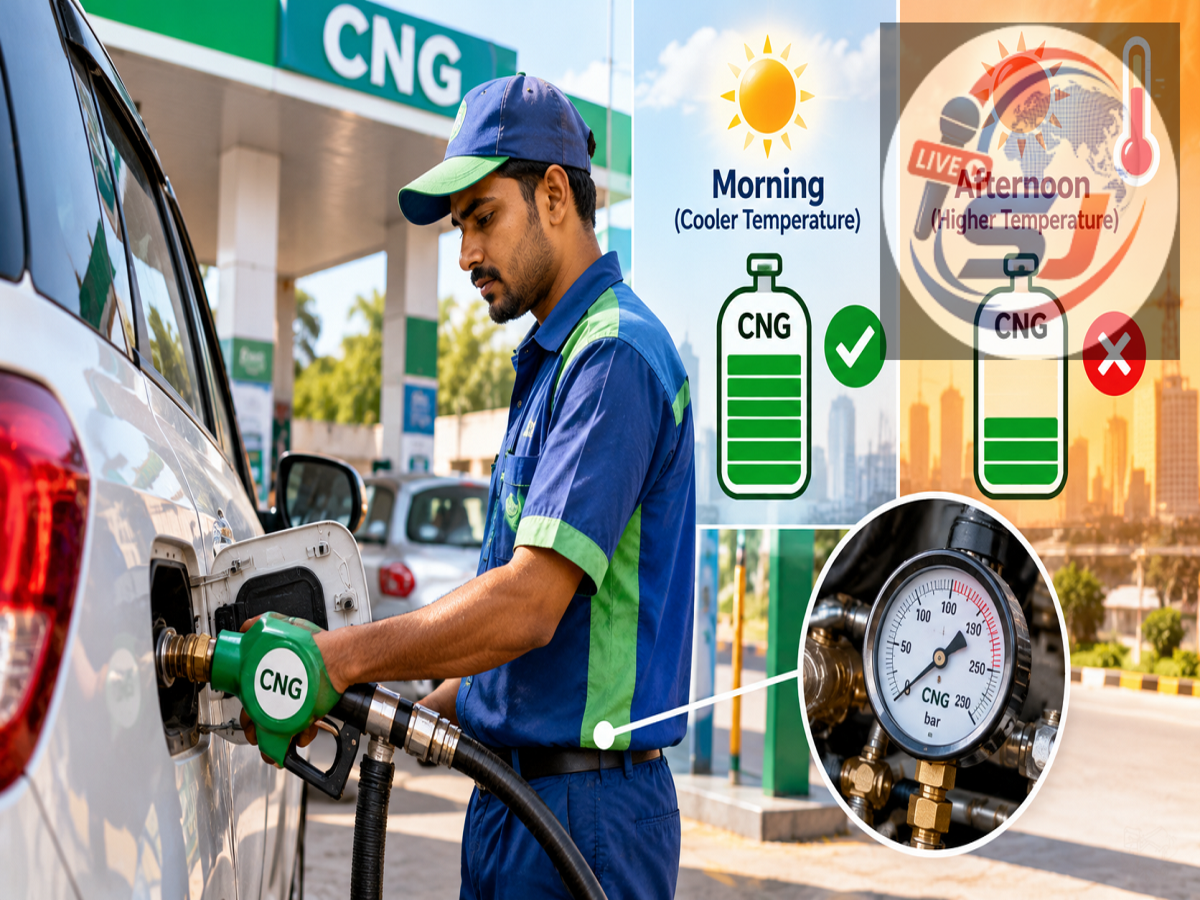
CNG Filling Tips 2026: Many CNG vehicle owners believe that filling their tanks during the afternoon results in less gas compared to refuelling early in the morning or late at night. But is there any scientific explanation behind this belief, or is it simply a common misconception? Temperature can influence how much compressed natural gas fits inside a vehicle's cylinder, although the actual difference depends on several factors.
With petrol and diesel prices remaining a major concern for motorists, Compressed Natural Gas (CNG) has become a popular alternative for people looking to reduce their daily travelling expenses. However, understanding how temperature and pressure affect CNG filling can help vehicle owners make better refuelling decisions.
Does Filling CNG in the Afternoon Really Reduce the Quantity?
There is some scientific truth behind this widely discussed claim. CNG is stored under high pressure, and its density changes with temperature.
When the temperature rises, gas becomes less dense at the same pressure. This means a cylinder filled with warmer CNG at a particular pressure can contain less gas by mass than one filled with cooler CNG at that same pressure.
During hot afternoons, the temperature of the gas, vehicle cylinder and surrounding environment may be higher than during the early morning or nighttime.
As a result, the cylinder may reach the filling station's pressure limit before receiving as much gas as it could under cooler conditions.
However, this does not mean every afternoon refill delivers less CNG. Modern dispensing equipment, temperature compensation systems and actual filling conditions can influence the final quantity.
Why Does a CNG Tank Fill Up Faster in Hot Weather?
Have you ever noticed that your CNG vehicle's tank appears to fill quickly during summer afternoons?
The explanation involves the relationship between gas temperature, pressure and volume.
Unlike petrol or diesel, which are liquids, CNG is a compressed gas. Its behaviour is influenced significantly by changes in temperature.
When CNG enters a vehicle's cylinder, its pressure increases. The compression and filling process can also raise the gas temperature.
If the gas is already warm, the cylinder may reach the dispenser's pressure cutoff sooner.
Consequently, the filling process can stop even though the cylinder contains less gas by mass than it might after a cooler fill.
Importantly, a pressure gauge showing a full cylinder does not necessarily mean that the same mass of gas has been added during every refill.
Morning vs Afternoon vs Night: When Is CNG Filling Better?
The following comparison explains how temperature may affect CNG refuelling.
| Filling Time |
Typical Temperature |
Possible Effect on CNG Filling |
|---|---|---|
| Early Morning |
Relatively Cool |
Cooler gas may allow more CNG mass at the same pressure |
| Afternoon |
Relatively Hot |
Higher temperatures may reduce the mass stored at a given pressure |
| Evening |
Moderate |
Results depend on gas and cylinder temperatures |
| Late Night |
Relatively Cool |
Conditions may favour a denser fill |
These are general tendencies rather than guaranteed outcomes. The temperature of the gas delivered by the station can differ from the surrounding air temperature.
Do You Get Less CNG but Pay the Same Amount?
This is where many vehicle owners misunderstand the situation.
CNG is generally sold by weight in India, measured in kilograms rather than litres.
For example, if a dispenser accurately delivers 8 kg of CNG, the customer pays for 8 kg regardless of whether the filling takes place in the morning or afternoon.
Therefore, hot weather does not automatically mean customers are charged for gas they never received.
The potential difference is in how many kilograms can be stored inside the cylinder before the pressure limit is reached.
A cooler filling condition may sometimes allow the vehicle to take in a greater mass of CNG, potentially increasing the driving range between refills.
Can Filling CNG at Night Improve Vehicle Mileage?
Refuelling at night does not directly improve the engine's fuel efficiency.
Your vehicle's mileage primarily depends on factors such as driving habits, traffic conditions, tyre pressure, engine maintenance and fuel quality.
However, if a cooler filling condition allows the cylinder to hold more kilograms of CNG, the vehicle may travel farther before needing another refill.
That additional driving range should not be confused with an improvement in kilometres per kilogram.
For instance, a car delivering 25 km per kg will not automatically become more fuel-efficient simply because its cylinder was filled at night.
Important Tips for CNG Vehicle Owners
To make CNG refuelling safer and more convenient, motorists should follow a few basic precautions:
-
Choose a reliable CNG station: Use authorised outlets with properly maintained dispensing equipment.
-
Check the quantity displayed: Remember that CNG is sold by kilograms, not by cylinder pressure.
-
Avoid unnecessary waiting: A cooler refill may offer an advantage, but travelling a long distance solely to fill CNG at night may cancel out any benefit.
-
Maintain your CNG system: Follow the manufacturer's recommended cylinder inspections and servicing schedule.
-
Follow station safety instructions: Switch off the engine and comply with passenger and refuelling safety requirements.
Final Verdict: Should You Fill CNG in the Morning or Afternoon?
Filling CNG during cooler hours can sometimes allow more gas to be stored in the cylinder because cooler gas is denser at the same pressure.
However, the difference is not fixed, and factors such as dispenser pressure, gas temperature, cylinder temperature and temperature-compensation technology can affect the result.
The bottom line: Morning or nighttime refuelling may provide a small advantage in the amount of CNG your cylinder can hold, but afternoon refuelling does not automatically mean you are receiving less gas than you paid for.
For everyday CNG users, choosing a trustworthy filling station, checking the kilograms delivered and maintaining the vehicle properly are more important than following a strict refuelling schedule.