
Breaking Your FD Early? Here’s How Much You Could Lose on a ₹5 Lakh Fixed Deposit
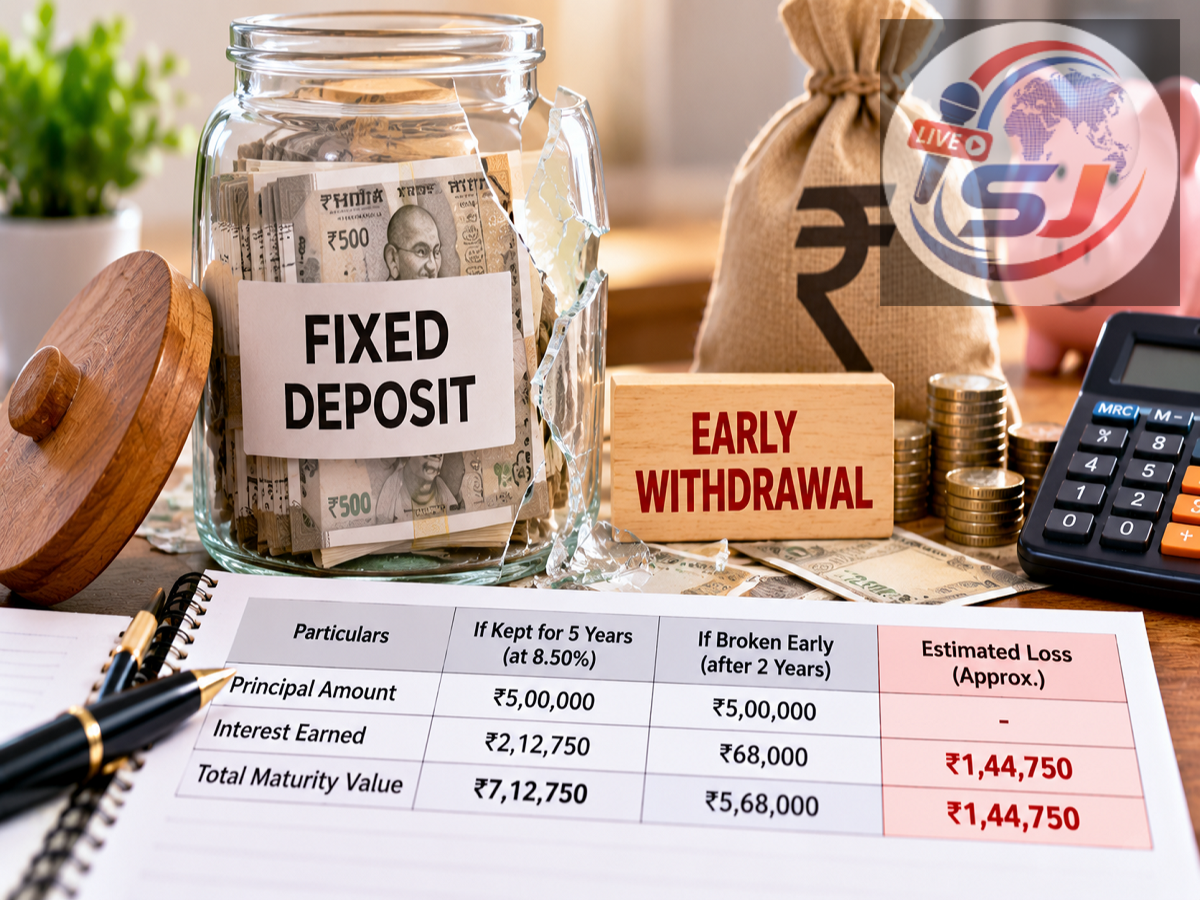
FD Premature Withdrawal Rules 2026: Fixed deposits are widely used by people who want predictable returns without taking direct market risk. But an unexpected financial requirement can force an investor to close an FD before its scheduled maturity date.
When that happens, the calculation is not as simple as receiving the promised interest for the period the money remained with the bank.
In most premature-closure cases, the bank first determines the interest rate applicable to the actual period for which the deposit remained invested. It may then apply a premature-withdrawal penalty according to its rules.
As a result, an investor can receive considerably less interest than originally expected.
Here's an easy example using a ₹5 lakh FD.
What Happens When You Break an FD Before Maturity?
Suppose you book a fixed deposit for five years at an annual interest rate of 7.5%.
After two years, however, you suddenly need the money and decide to close the deposit.
The bank generally does not simply pay 7.5% interest for those two years.
Instead, it can look at the FD rate that was applicable on the original booking date for a deposit of the period the money actually remained with the bank—in this example, two years.
If the applicable two-year rate was lower than 7.5%, that lower rate becomes relevant.
The bank may then reduce it further by applying its premature-closure penalty.
₹5 Lakh FD Example: Understanding the Loss
Consider this hypothetical case:
-
Original FD amount: ₹5 lakh
-
Original tenure: 5 years
-
Contracted interest rate: 7.50%
-
FD closed after: 2 years
-
Rate applicable for a 2-year deposit when FD was booked: 7.00%
-
Premature-withdrawal penalty: 1 percentage point
After applying the penalty, the effective rate could become approximately:
7.00% - 1.00% = 6.00%
This means the investor could effectively receive interest based on 6% rather than the original 7.5% five-year rate, subject to the bank's exact premature-closure rules.
| Particular | Illustration |
|---|---|
| Deposit | ₹5,00,000 |
| Original Tenure | 5 years |
| Original FD Rate | 7.50% |
| Premature Closure | After 2 years |
| Applicable 2-Year Rate | 7.00% |
| Assumed Penalty | 1 percentage point |
| Effective Rate for Illustration | 6.00% |
This example is illustrative only. Banks can use different penalty structures.
The Loss Is Not Just the Penalty
This is where many FD investors get confused.
If a bank charges a 1-percentage-point premature-withdrawal penalty, it does not necessarily mean that your only loss is 1% of the deposit.
There can effectively be two impacts.
First, you may lose access to the higher interest rate originally promised for the longer tenure.
Second, a penalty may be deducted from the rate applicable to the period for which the deposit actually remained invested.
So if your original five-year FD carried 7.5%, but the applicable two-year rate was 7%, and the bank imposes a 1-percentage-point penalty, the effective rate could fall to around 6% in this simplified illustration.
Why Doesn't the Original FD Rate Continue?
FD interest rates are linked to deposit tenures.
A bank may offer one rate for a one-year deposit, another for two years and a different rate for five years.
When you agree to keep your money deposited for five years, the bank offers the rate attached to that tenure.
If you withdraw after only two years, you have not completed the originally agreed tenure.
The bank can therefore recalculate the return according to the premature-withdrawal terms accepted when the FD was opened.
How Much Could ₹5 Lakh Earn at Different Rates?
The effect becomes easier to understand with a simplified comparison.
If ₹5 lakh remained invested for two years, approximate returns would differ depending on the effective interest rate and compounding method.
| Effective Annual Rate | Approx. Value After 2 Years* |
|---|---|
| 7.50% | ₹5.78 lakh |
| 7.00% | ₹5.72 lakh |
| 6.50% | ₹5.69 lakh |
| 6.00% | ₹5.63 lakh |
*Illustrative values assuming quarterly compounding and no tax adjustment.
The difference can become more significant with larger deposits or longer periods.
Actual bank calculations may differ because of the applicable rate, compounding method, premature-withdrawal policy and exact number of days the deposit remained invested.
Do All Banks Charge the Same FD Penalty?
No.
There is no reason to assume that every bank applies exactly the same premature-closure penalty.
Depending on the bank, deposit size and FD product, the penalty may differ.
Some deposits may carry a lower penalty, while certain special FDs may have stricter withdrawal conditions. Banks may also offer specific products with no premature-withdrawal facility.
Before opening an FD, investors should therefore check the section titled "premature withdrawal," "premature closure" or similar terms.
Some FDs May Not Allow Early Withdrawal
Not every fixed deposit can be freely closed before maturity.
For example, a five-year tax-saving FD generally comes with a statutory lock-in and does not provide ordinary premature withdrawal in the same way as a regular FD, subject to applicable rules and permitted exceptions.
Certain special or non-callable deposits may also restrict premature closure.
This is why investors should not assume that every FD can be broken simply by paying a penalty.
Should You Break the FD or Take a Loan Against It?
If the need for money is temporary, breaking an FD may not always be the only option.
Many banks provide loans or overdraft facilities against eligible fixed deposits.
Under such an arrangement, the FD can continue earning interest while the depositor borrows against it.
The bank generally charges interest on the loan at a rate linked to the FD rate.
Whether this is better than premature closure depends on the amount needed, duration of borrowing, loan rate, premature-closure loss and the investor's ability to repay.
A comparison of the actual numbers is therefore important.
FD Laddering Can Reduce Premature-Closure Problems
Another way to manage liquidity is to avoid placing all available savings into a single large FD.
Suppose an investor has ₹5 lakh.
Instead of creating one ₹5 lakh deposit, the investor could consider splitting the amount across multiple deposits with different maturity dates, depending on financial needs.
If an emergency arises, only one smaller FD may need to be closed rather than breaking the entire ₹5 lakh deposit.
This approach is commonly referred to as FD laddering.
It does not eliminate premature-withdrawal penalties, but it can provide greater flexibility.
Keep Emergency Money Separate From Long-Term FDs
A common reason for premature closure is putting money into an FD that may be required for short-term expenses.
Before locking funds into a multi-year deposit, investors should consider keeping an emergency reserve separately.
Money required for medical expenses, household emergencies or near-term commitments may need greater liquidity.
An FD can provide predictable returns, but the benefit is strongest when the investor can stay invested for the planned tenure.
Tax Can Also Affect Your Final FD Return
FD interest is generally taxable according to the investor's applicable income-tax position.
TDS provisions may also apply when interest crosses the prescribed threshold and relevant conditions are met.
Therefore, the amount credited after premature closure should not automatically be treated as the investor's final post-tax return.
Tax treatment depends on individual circumstances and applicable rules.
Check These Rules Before Opening an FD
Before placing a large amount in a fixed deposit, investors should check the interest rate for the chosen tenure, compounding frequency and premature-closure conditions.
It is equally important to know whether the bank applies a penalty and how it determines the interest rate if the FD is closed early.
Investors should also check whether partial withdrawal, an overdraft or a loan against the FD is available.
These details can become much more important than a small difference in headline interest rates when an emergency occurs.
Breaking an FD Early Can Change the Entire Return Calculation
Premature FD closure does not usually mean that an investor simply receives the originally promised interest until the withdrawal date.
The bank can recalculate interest according to the rate applicable to the actual completed deposit period and then apply the premature-withdrawal penalty specified in its terms.
In the hypothetical ₹5 lakh example, an FD originally booked for five years at 7.5% could end up earning an effective rate closer to 6% if it is closed after two years, assuming the applicable two-year rate was 7% and a 1-percentage-point penalty applies.
The actual loss can be higher or lower depending on the bank.
Before breaking an FD, investors should ask the bank for the exact premature maturity amount and compare it with alternatives such as a loan or overdraft against the deposit.
Disclaimer: This article is for informational purposes only and does not constitute investment, banking or tax advice. Interest rates, premature-withdrawal penalties and calculation methods vary among banks and FD products. The ₹5 lakh examples above are illustrative. Check your bank's specific deposit terms and the premature maturity value before closing an FD.
Clarify the ₹5 lakh return comparisonAdd a clear loss calculation