
Breaking Your FD Early? Here’s How Much You Could Lose on a ₹5 Lakh Fixed Deposit
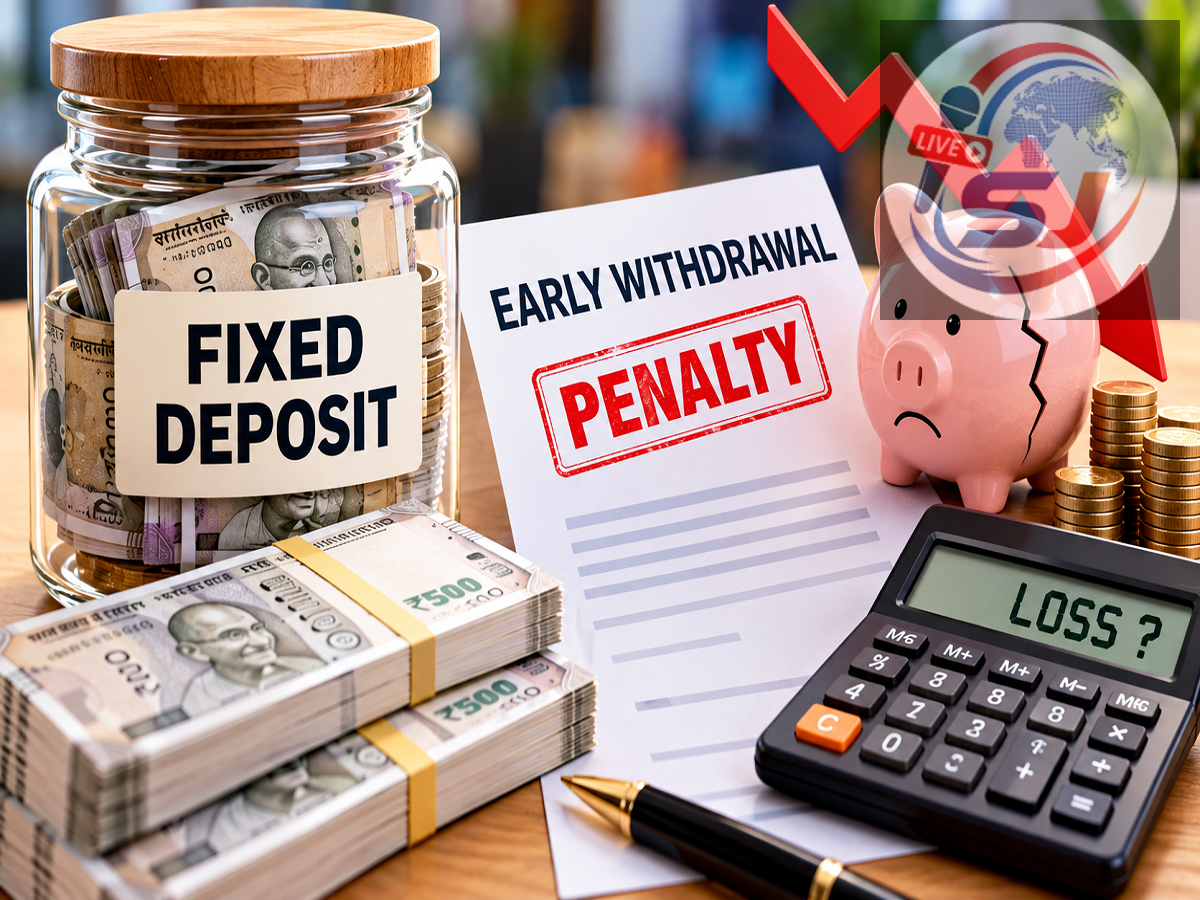
Fixed deposits (FDs) remain a popular savings option for people who prefer predictable returns and relatively low investment risk. You deposit a lump sum with a bank for a predetermined period, and the bank pays interest according to the applicable terms.
But what happens when an emergency arises and you need the money before the FD reaches maturity?
Prematurely closing a fixed deposit can affect your returns in more than one way. You may not receive interest at the rate originally promised for the full tenure, and the bank may also impose a premature withdrawal penalty.
The actual financial impact depends on the bank's rules, the original FD tenure, how long the deposit remained with the bank and the interest rate applicable to that shorter period.
Here is an example involving a ₹5 lakh FD to understand how premature closure can affect your money.
Why Does the Interest Rate Change When You Break an FD?
Suppose you open a two-year fixed deposit when the bank is offering an annual interest rate of 7%.
You may naturally expect your money to earn 7% throughout the deposit period. However, that rate was offered on the condition that the FD would remain invested for the agreed two-year tenure.
Now imagine you need the money after only 10 months.
In such a situation, the bank may calculate your return using the interest rate that was applicable to a 10-month deposit when you originally booked the FD, rather than giving you the two-year rate.
The example in the source assumes that the applicable rate for 10 months was 6% per annum.
Premature Withdrawal Penalty Can Reduce Returns Further
The lower applicable interest rate may not be the only reduction.
Depending on the bank's policy, an additional penalty can be imposed for closing the fixed deposit before maturity.
In this example, the bank charges a 1% premature withdrawal penalty. If the applicable rate for the actual 10-month period is 6%, a 1% penalty effectively brings the illustrative rate down to around 5%.
This is why depositors should check both the applicable interest rate and the premature closure penalty before withdrawing an FD.
₹5 Lakh FD Example: How the Calculation Changes
Consider an FD of ₹5 lakh booked for two years at 7% annual interest.
If the deposit continues until maturity, the source estimates that its value after two years could be approximately ₹5.72 lakh.
Now consider a different situation.
You need the money after 10 months and decide to close the FD. For this illustration, the bank applies the 10-month interest rate of 6% and then deducts a 1% premature closure penalty.
That leaves an effective illustrative interest rate of around 5%.
At 5% for 10 months, interest on ₹5 lakh would be approximately ₹20,833, taking the amount received to roughly ₹5.21 lakh.
Full Tenure vs Premature FD Closure
| Scenario | Illustrative Interest Rate | Period | Estimated Amount |
|---|---|---|---|
| FD held until maturity | 7% | 2 years | Around ₹5.72 lakh |
| FD closed early | 5% | 10 months | Around ₹5.21 lakh |
| Difference | — | — | Around ₹51,000 |
The source therefore shows a difference of approximately ₹51,000 between the two scenarios. However, this comparison involves different holding periods—two years versus 10 months—and should not be interpreted as a ₹51,000 bank penalty. It reflects the difference between the illustrated maturity amount and the amount available after closing the deposit at 10 months. Taxes are also excluded from the example.
Premature FD Rules Can Differ From Bank to Bank
There is no single premature withdrawal calculation that should be assumed for every fixed deposit.
Banks can have different policies. One bank may reduce the applicable interest rate, another may levy a premature closure penalty, while some deposits may experience both adjustments.
Before closing an FD, ask your bank for the exact amount that would be credited to your account.
You should specifically check which interest rate will be applied and how much premature withdrawal penalty will be deducted.
Need Money Temporarily? Check for a Loan Against FD
Closing your FD may not always be necessary when you face a short-term cash requirement.
Some banks provide loans or overdraft facilities against fixed deposits. Under such an arrangement, the FD may continue while you gain access to funds for your immediate requirement.
However, borrowing against an FD also comes with an interest cost. You should therefore compare the cost of the loan or overdraft with the financial impact of prematurely closing the deposit before deciding.
What If Your FD Is Close to Maturity?
If only a few months remain before maturity, compare the numbers carefully before breaking the deposit.
Waiting until maturity may allow you to receive the returns applicable to the original tenure, whereas premature closure could result in a lower applicable interest rate and a penalty.
At the same time, taking an expensive loan simply to avoid breaking an FD may not make financial sense when money is urgently required. The cost of both alternatives needs to be compared.
Ask These Questions Before Closing Your FD
Before submitting a premature closure request, find out the exact amount you would receive if you close the FD today, which interest rate the bank will use for the calculation, and what premature withdrawal penalty will apply.
Then compare that figure with the amount you would receive by keeping the FD until maturity. This simple comparison can give you a much clearer picture of the financial impact of breaking your deposit early.
Disclaimer: This article is intended for general informational purposes only. Fixed deposit interest rates, premature closure penalties and other conditions differ across banks and deposit products. Check the latest terms with your bank or consult a qualified financial professional before making a financial decision.