
Bank Strike September 28-30: Banks Open on September 27, Check Full 5-Day Schedule and Services
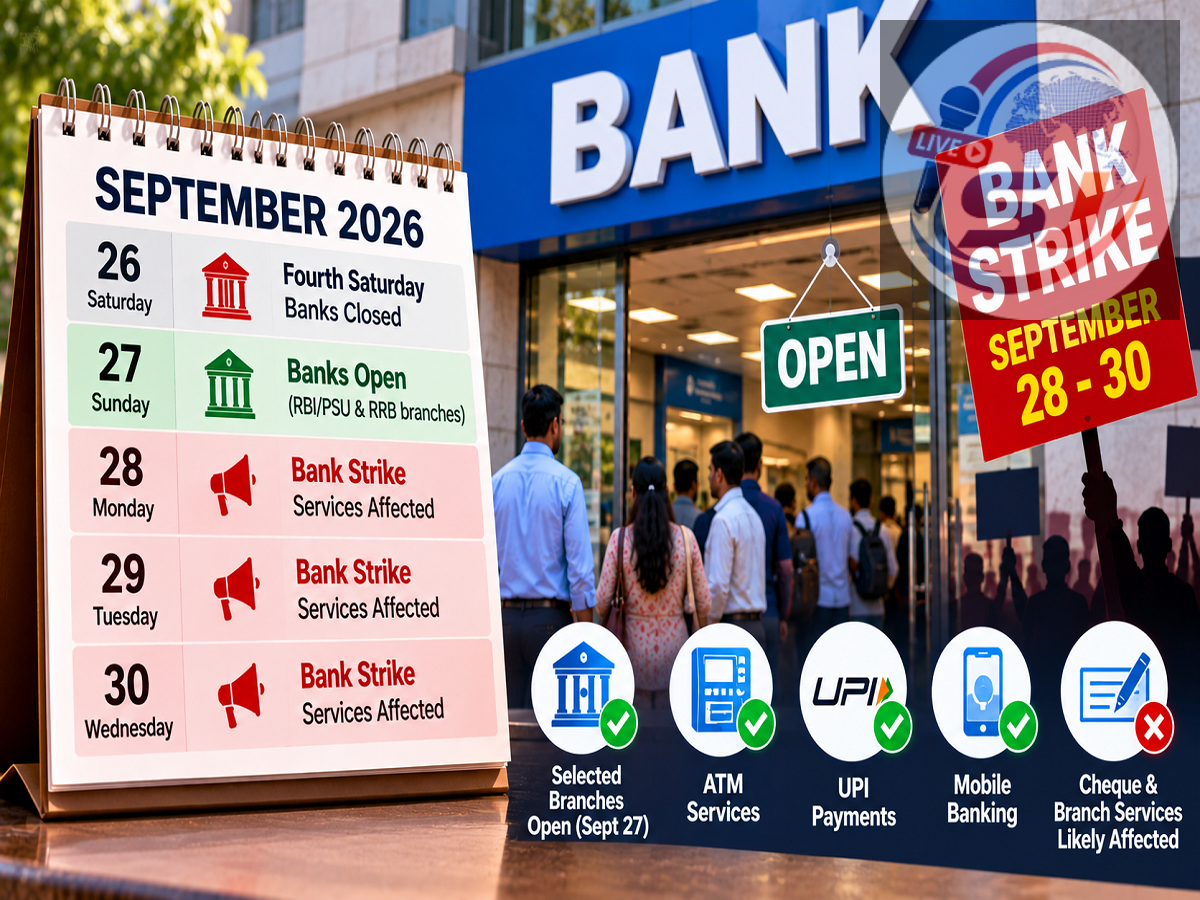
Bank customers should plan important branch-related transactions carefully as a proposed three-day nationwide bank strike approaches at the end of September 2026. The United Forum of Bank Unions (UFBU) has called for a strike on September 28, 29 and 30, which could disrupt several services that depend on branch employees.
The strike comes immediately after the fourth Saturday of the month. However, customers should note an important update: although September 27 is a Sunday, public-sector banks (PSBs) and Regional Rural Banks (RRBs) are scheduled to remain open under a special arrangement ahead of the proposed strike.
Therefore, reports claiming that all banks will remain continuously closed from September 26 through September 30 need to be read with caution.
Bank Strike and Holiday Schedule: September 26-30
Here is the updated schedule customers should know:
| Date | Day | Status | Likely Impact |
|---|---|---|---|
| September 26 | Saturday | Fourth Saturday | Regular bank holiday |
| September 27 | Sunday | Special working day for PSBs and RRBs | Participating branches expected to open |
| September 28 | Monday | Proposed bank strike | Branch services may be disrupted |
| September 29 | Tuesday | Proposed bank strike | Branch services may be disrupted |
| September 30 | Wednesday | Proposed bank strike | Branch services may be disrupted |
The special opening on September 27 is intended to give customers an additional opportunity to complete essential banking work before the three-day strike begins.
Customers should nevertheless confirm the working status and timings of their specific branch before visiting on Sunday.
Why Has a Three-Day Bank Strike Been Called?
UFBU has called for nationwide industrial action from September 28 to September 30, 2026.
The strike is linked to unresolved demands raised by bank employee unions. A major issue is the demand for a five-day banking week, under which all Saturdays would be declared holidays for bank employees.
Currently, banks generally remain closed on the second and fourth Saturdays, while other Saturdays are working days unless a separate holiday applies.
Unions have also raised concerns over a Performance Linked Incentive, or PLI, framework.
The government and bank managements have been holding discussions with unions and have appealed for the proposed strike to be reconsidered.
Why Are Banks Opening on September 27?
Ordinarily, Sunday would be a weekly bank holiday.
But because the proposed strike starts immediately afterward, a special arrangement has reportedly been made for public-sector banks and Regional Rural Banks to function on Sunday, September 27.
This gives customers an additional day to complete work that requires a physical branch.
It also allows banks to prepare operationally for possible disruption during the following three days.
Customers should not assume that every private-sector bank or every individual branch will follow the same schedule. Checking directly with the bank before travelling is advisable.
Which Banking Services Could Be Most Affected?
If the strike proceeds with significant employee participation, branch-dependent services are likely to experience the greatest disruption.
These could include counter-based cash deposits or withdrawals, cheque-related processing, submission and verification of loan documents, locker-related services and other requests requiring assistance from branch employees.
Businesses that depend on branch banking for daily operations may also face delays.
The level of disruption could differ between banks and locations depending on staff participation and contingency arrangements.
Will UPI Work During the Bank Strike?
UPI is expected to remain available.
The proposed strike primarily concerns bank employees and branch operations; it does not automatically shut down the digital infrastructure used for UPI transactions.
Customers should generally be able to continue making payments and transferring money through supported UPI applications.
However, digital systems can experience technical issues independently, so uninterrupted service cannot be guaranteed in every circumstance.
What About NEFT, RTGS and IMPS?
Electronic banking channels are also expected to remain important alternatives during the strike.
Customers may be able to use services such as IMPS, NEFT and RTGS, subject to the respective system's operating arrangements and their bank's digital infrastructure.
Mobile banking and internet banking should also remain useful for routine transactions that do not require assistance from branch employees.
For an important or time-sensitive transfer, customers may still prefer to complete the transaction before the strike period rather than waiting until the last moment.
Will ATMs Remain Open?
ATMs are expected to remain operational during the proposed strike.
Banks are also expected to make efforts to maintain sufficient cash availability and minimise inconvenience to customers.
Nevertheless, heavy cash withdrawals over an extended holiday or strike period can sometimes lead to temporary shortages at individual ATMs.
Customers who require cash should plan reasonably in advance, but there is no need for panic withdrawals.
What About Cheque Clearance?
Cheque-related services could be more vulnerable to disruption than fully digital transactions because certain processes may depend on banking operations and staff availability.
Customers with an important cheque deposit, clearance requirement or transaction deadline around September 28-30 may want to complete the process earlier.
Keep in mind that depositing a cheque before the strike does not necessarily guarantee that final clearance will occur before the industrial action begins.
September 30 Is Also an Important Banking Date
The proposed strike's third day falls on September 30, which is the end of the first half of the financial year.
Banks carry out several important accounting and operational processes around this period, including reconciliation, provisioning and treasury-related work.
A strike at the end of September could therefore create operational challenges beyond ordinary customer-facing branch services.
This is one reason authorities and banks are taking precautionary measures to minimise disruption.
Should You Finish Bank Work by September 25?
Customers who can conveniently complete urgent branch-related work by Friday, September 25 may prefer to do so.
This is particularly relevant for time-sensitive document submissions, cheque-related work, loan paperwork, locker operations or transactions requiring assistance from bank staff.
However, September 25 is not necessarily the final opportunity for every customer.
Under the special arrangement, public-sector banks and Regional Rural Banks are expected to open on Sunday, September 27, giving customers another opportunity before the proposed strike.
Because the arrangement may not apply identically to every bank or branch, customers should confirm locally before planning a Sunday visit.
Don't Assume Banks Are Closed for Five Straight Days
The calendar from September 26 to September 30 contains a fourth-Saturday holiday followed by three proposed strike days, but the special September 27 opening changes the situation.
The more accurate description is that branch services may face significant disruption during this five-day period, rather than saying every bank will remain closed continuously for five days.
Digital channels—including UPI, mobile banking, internet banking and ATMs—are expected to provide alternatives for many routine transactions.
Customers with work that specifically requires a bank branch should either complete it by September 25 or check whether their public-sector bank or Regional Rural Bank branch will be open on September 27.
Note: The September 28-30 industrial action remains a proposed strike and could be postponed, modified or withdrawn following negotiations. Sunday opening arrangements and working hours can also vary by bank or branch. Customers should check the latest official communication from their bank before visiting.