Bank Strike Alert: Nationwide Bank Strike Planned; Know the Dates, Demands and Services That May Be Affected
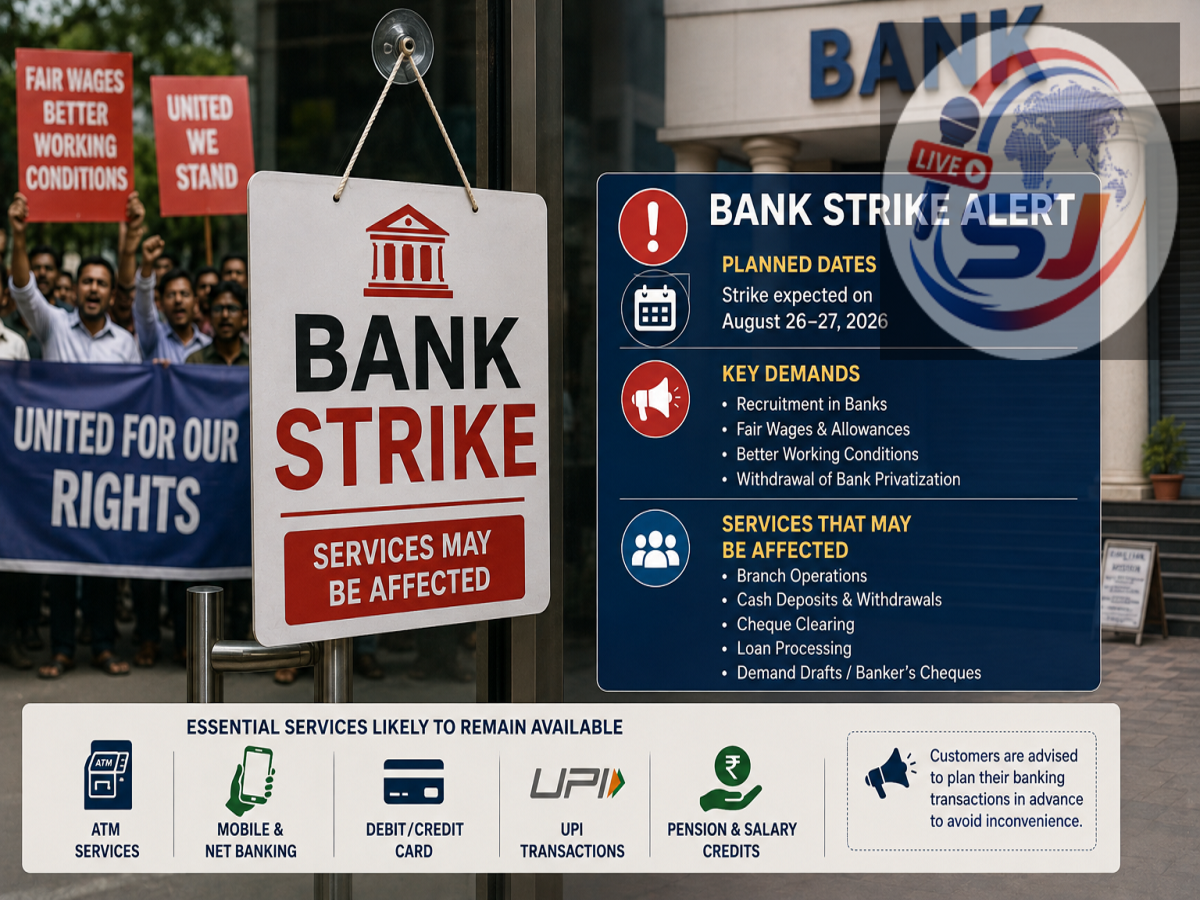
Bank customers may face disruption in branch-based services in September as bank employee unions prepare for nationwide industrial action over several long-pending demands. The United Forum of Bank Unions (UFBU), an umbrella body representing major bank employee and officer unions, has announced a series of proposed strikes, beginning with a nationwide strike on September 11, 2026.
The dispute centres on issues including the implementation of a five-day banking week, differences over Performance Linked Incentive (PLI) arrangements and pending pension-related demands.
Customers who need to complete important branch transactions around the proposed strike dates should plan ahead. However, a strike call does not necessarily mean every bank branch or every banking service will remain completely unavailable, and negotiations could still lead to changes or withdrawal of the action.
Nationwide Bank Strike Planned for September 11
According to the strike programme announced by UFBU, bank employees and officers are preparing for a nationwide strike on September 11.
If the strike goes ahead, operations could be affected at branches across the country, with public-sector banks expected to see a significant impact because of union participation.
Services that depend on employees being physically present at branches could face delays. These may include cash-related counter transactions, cheque clearing, document submission, passbook-related services and certain loan or account requests.
Customers should therefore avoid leaving time-sensitive branch work until the strike date.
Will Banks Remain Closed for Several Days?
Claims of a continuous nationwide bank shutdown for several days need to be treated carefully.
September 11, 2026 falls on a Friday. September 12 is the second Saturday of the month, when banks are normally closed, followed by Sunday, September 13.
This could effectively create three consecutive days without normal branch operations if the September 11 strike goes ahead.
However, reports suggesting that September 14 will automatically be a bank holiday across India are misleading. Bank holidays differ by state and occasion, so customers should check the holiday calendar applicable to their city before assuming branches will remain closed for an additional day.
Will UPI, ATMs and Online Banking Stop?
A bank strike primarily affects employee-dependent operations and does not automatically shut down the country's digital banking infrastructure.
UPI, mobile banking, internet banking, debit and credit card payments and ATMs are generally expected to continue operating because these services are largely technology-driven.
However, prolonged disruption could indirectly affect services such as ATM cash replenishment, cheque processing and customer-support operations.
Customers who expect to need substantial cash around the strike period may therefore want to make arrangements in advance.
Why Are Bank Employees Planning a Strike?
One of the biggest demands concerns the implementation of a five-day banking week.
Bank unions have been seeking Saturdays off for employees, effectively moving the industry to a Monday-to-Friday working schedule.
The Indian Banks' Association and unions reached an understanding on the five-day-week proposal as part of the wage settlement signed in March 2024. Under the proposed arrangement, working hours from Monday to Friday would be increased to compensate for Saturdays becoming holidays.
Unions argue that despite the agreement and subsequent proposal to the government, final approval has remained pending for an extended period.
This delay has become one of the central issues behind the latest industrial action.
What Is the Dispute Over PLI?
Performance Linked Incentive, or PLI, has emerged as another major point of disagreement.
The dispute concerns how performance-linked rewards should be calculated and distributed among different categories of bank employees and officers.
Unions argue that the incentive structure agreed during wage negotiations was linked primarily to the overall performance of the bank and was intended to apply according to the negotiated framework.
They have objected to a separate performance-based incentive structure for senior officers, claiming that it creates significant differences between senior management and other employees.
According to the unions, the proposed structure could allow substantially higher performance-linked payouts for some senior officers while employees and officers at lower scales receive much smaller benefits.
The unions want the incentive framework to remain consistent with the previously negotiated settlement.
Pension Issues Are Also Part of the Demands
Apart from the five-day banking week and PLI, pension-related matters are also part of the dispute.
Bank employee organisations have been raising various retirement and pension demands for years and want pending issues resolved without further delay.
The unions say the latest strike programme follows the absence of satisfactory progress in discussions with the government and bank management.
Three-Day Strike Warning From September 28
The September 11 action may not be the end of the dispute.
UFBU has also warned of a three-day continuous strike beginning September 28 if there is no satisfactory response to its demands.
Such an action could have a greater impact because it would come close to the end of the half-year financial reporting period for banks.
Branch operations, clearing activities and administrative work could face increased pressure if a multi-day strike takes place.
Customers and businesses with important banking requirements during that period should keep track of official announcements from their respective banks.
Indefinite Strike Warning From October 26
The unions have indicated that they could escalate the agitation further if negotiations continue without a resolution.
An indefinite strike has been threatened from October 26.
An indefinite nationwide banking strike would have a much greater impact than a one-day protest, although there is still considerable time for negotiations before that stage is reached.
Customers should therefore treat the October action as a warning rather than assuming that banks will definitely remain shut indefinitely from that date.
What Should Bank Customers Do?
There is no need for customers to panic, but planning important transactions in advance could prevent inconvenience.
People who need to deposit or withdraw large amounts of cash, submit documents, complete KYC formalities, deal with loan paperwork, obtain demand drafts or perform other branch-dependent transactions should preferably finish them before the proposed strike dates.
Digital transactions such as UPI, IMPS, NEFT, internet banking and card payments are likely to remain the easiest alternatives for routine payments if branch services are affected.
Customers should also rely on official communications from their banks for branch availability rather than social-media messages claiming that the entire banking system will remain closed.
Strike Dates Customers Should Keep in Mind
The first major date is September 11, when UFBU has called for a nationwide strike. If unresolved, the agitation could escalate to a three-day strike from September 28 and potentially an indefinite strike beginning October 26.
These are proposed industrial-action dates and the situation can change if the unions, government and banking industry reach an agreement.
For customers, the safest approach is to complete important branch-related work before September 11 and keep checking updates from their bank as the date approaches.
Disclaimer: Strike programmes can be postponed, modified or withdrawn following negotiations. Bank holidays also vary between states. Customers should check the latest official communication from their bank before planning branch visits.