
Bank Re-KYC Update 2026: Changed Your Address or Mobile Number? Know How to Update Your Bank Details
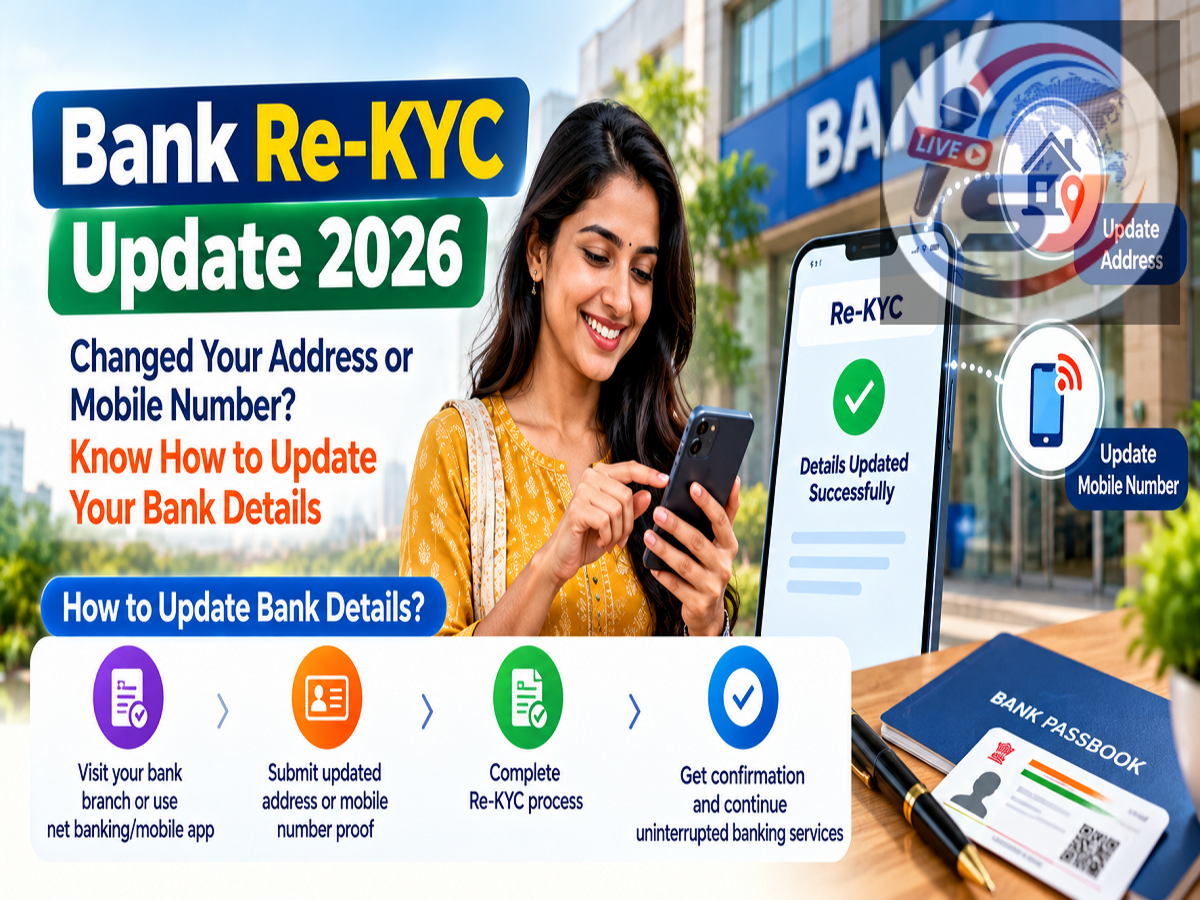
Bank Re-KYC Rules 2026: Have you recently changed your home address, mobile number or other personal details? Even if nothing has changed, your bank may ask you to confirm that its records are accurate. This process is known as Re-KYC, or periodic Know Your Customer updation.
Banks conduct Re-KYC to keep customer information current and comply with regulatory requirements. The process helps financial institutions maintain accurate records and identify customers through authorised verification methods.
An awareness message has reminded customers that Re-KYC is important whether their contact details have changed or remained the same.
However, customers should update or confirm their details when required by their bank, rather than assume that everyone must immediately complete a new verification process.
What Is Bank Re-KYC?
Re-KYC stands for re-verification or periodic updating of Know Your Customer information.
When someone opens a bank account, the bank collects identity and address information under applicable KYC requirements.
Over time, some of these details may change.
For example, a customer may move to a different city, change their registered mobile number or update their email address.
Banks periodically review customer information to ensure their records remain accurate.
This process is commonly called Re-KYC.
Importantly, Re-KYC does not necessarily mean that customers must submit all their documents again.
The requirements depend on the customer's circumstances, risk classification, existing records and applicable RBI guidelines.
Bank Re-KYC 2026: Important Details
| Particulars |
Information |
|---|---|
| Process |
Re-KYC or periodic KYC updation |
| Purpose |
Keep bank customer records current |
| Regulator |
Reserve Bank of India |
| Who may need it? |
Customers due for periodic KYC updation |
| Details involved |
Identity, address and contact information |
| If nothing has changed |
No-change confirmation may be permitted |
| Possible channels |
Branch, digital banking or other authorised methods |
| Official guidance |
RBI and the customer's bank |
Is Re-KYC Required Even if Your Details Have Not Changed?
Yes, a bank may require periodic KYC confirmation even when a customer's personal information remains unchanged.
However, customers with no changes to their KYC information may be able to submit a self-declaration instead of providing the same documents again.
RBI's KYC framework permits banks to use appropriate channels for obtaining such declarations, subject to the applicable requirements.
These channels can include authorised digital services and other methods offered by the bank.
The important distinction is that confirming unchanged details may be simpler than updating information that has changed.
Customers should check their bank's official instructions before submitting documents.
What if You Have Changed Your Address?
A change in residential address is one of the common reasons customers need to update their bank records.
For example, a person who has moved from Jaipur to Delhi may need to update the address associated with their bank account.
Banks may permit an address update through an authorised declaration or require additional verification depending on the applicable rules and circumstances.
Customers should ensure that the new address is recorded correctly.
Incorrect address information can create difficulties when banks need to communicate with customers or verify account-related information.
What if Your Mobile Number Has Changed?
Keeping a registered mobile number current is particularly important for banking services.
Banks may use the registered number to send transaction alerts, security notifications and authentication messages.
If the number is outdated, customers may miss important communications.
A mobile number change may require a separate security verification process.
Depending on the bank, the update may be available through internet banking, mobile banking, an ATM or a branch.
Customers should use only officially supported channels.
How Often Do Banks Require Re-KYC?
Under RBI's risk-based periodic KYC framework, the frequency generally depends on the customer's risk category.
| Customer risk category |
General periodic KYC interval |
|---|---|
| High risk |
At least once every 2 years |
| Medium risk |
At least once every 8 years |
| Low risk |
At least once every 10 years |
These are general regulatory intervals, not a guarantee that every customer will receive a request on the same schedule.
Banks may also need to update records when circumstances require additional verification.
Certain customers may qualify for simplified procedures or regulatory concessions under applicable directions.
Customers should rely on their bank's official communication for their individual requirements.
How to Complete Bank Re-KYC Online
Many banks offer digital facilities for eligible customers.
The exact process varies, but customers may generally follow these steps:
-
Open the bank's official website or mobile banking application.
-
Sign in using the authorised login method.
-
Look for the KYC update, Re-KYC or profile verification section.
-
Review the personal information already available.
-
Confirm that the information is unchanged or select the appropriate update option.
-
Submit any declaration or documents requested through the official process.
-
Complete the required authentication.
-
Save the acknowledgement or reference number, if provided.
Not every bank supports the same digital process for every customer.
Some cases may require additional verification or a branch visit.
Can Re-KYC Be Completed Without Visiting a Bank Branch?
In many situations, yes.
RBI's framework permits banks to use several authorised methods for periodic KYC updation, including appropriate electronic channels.
For customers whose KYC information has not changed, a no-change declaration may be accepted through supported channels.
Banks may also offer Video-based Customer Identification Process (V-CIP) facilities where applicable.
However, the availability of online Re-KYC depends on the bank and the customer's specific situation.
Customers should not assume that a physical branch visit is always compulsory.
What Documents May Be Required for Re-KYC?
The documents required depend on whether the customer's existing information is complete and whether anything has changed.
For certain updates, banks may request an officially valid document or other permitted proof.
Common identity documents recognised under applicable KYC rules include passports, driving licences and other officially valid documents.
Aadhaar-based verification may also be available where legally permitted and appropriately authorised.
Customers should submit only the documents actually required by their bank.
If no information has changed, a declaration may be sufficient in eligible cases.
What Happens if You Do Not Complete Re-KYC?
Banks are required to follow regulatory procedures for periodic KYC updation.
Customers may receive reminders asking them to complete the necessary formalities.
The consequences of an incomplete update depend on the applicable rules and individual circumstances.
It would be incorrect to claim that every account is automatically frozen immediately after a Re-KYC reminder.
RBI has provided safeguards and concessions for certain customer categories, including specified low-risk customers, subject to the applicable conditions.
Customers who receive a genuine Re-KYC request should respond within the communicated timeline or contact their bank for assistance.
Beware of Fake Re-KYC Messages and Banking Scams
Fraudsters sometimes send fake messages claiming that a bank account will be blocked unless the customer completes KYC immediately.
Such messages may contain suspicious links leading to fraudulent websites.
Criminals may also impersonate bank officials and request OTPs, internet banking passwords or card information.
Customers should remember these safety precautions:
-
Never disclose OTPs, UPI PINs or banking passwords to unknown callers.
-
Do not install remote-access applications at the request of an unsolicited caller.
-
Avoid opening KYC links from unverified messages.
-
Use the bank's official application or website.
-
Contact customer support through verified numbers.
-
Report suspected financial cyber fraud promptly.
If money has been lost through cyber fraud, customers can contact the national cybercrime helpline at 1930 or report the incident at cybercrime.gov.in.
Is There a Fee for Re-KYC?
Customers should not assume that a payment is required merely because they receive a Re-KYC reminder.
Banks must follow applicable regulatory requirements and their disclosed service terms.
Any request for payment through an unfamiliar personal UPI ID or suspicious website should be treated as a warning sign.
Customers should verify any claimed charge directly with their bank.
Bank Re-KYC 2026: What Customers Should Remember
Re-KYC is an important banking process that helps institutions maintain accurate and updated customer information.
Whether someone has changed their address, updated their contact number or made no changes at all, the bank may require the customer to review and confirm the relevant details.
The process can often be simpler when the customer's information remains unchanged.
The key takeaway: If your bank asks you to complete Re-KYC, verify the request through an official channel. Update changed details or submit a no-change confirmation where permitted. Never share sensitive banking credentials with unauthorised individuals.
Official reference: Reserve Bank of India — Master Direction on Know Your Customer (KYC), as amended.