
Bank Account Charges Explained: Even an ATM Balance Check May Cost You After the Free Limit
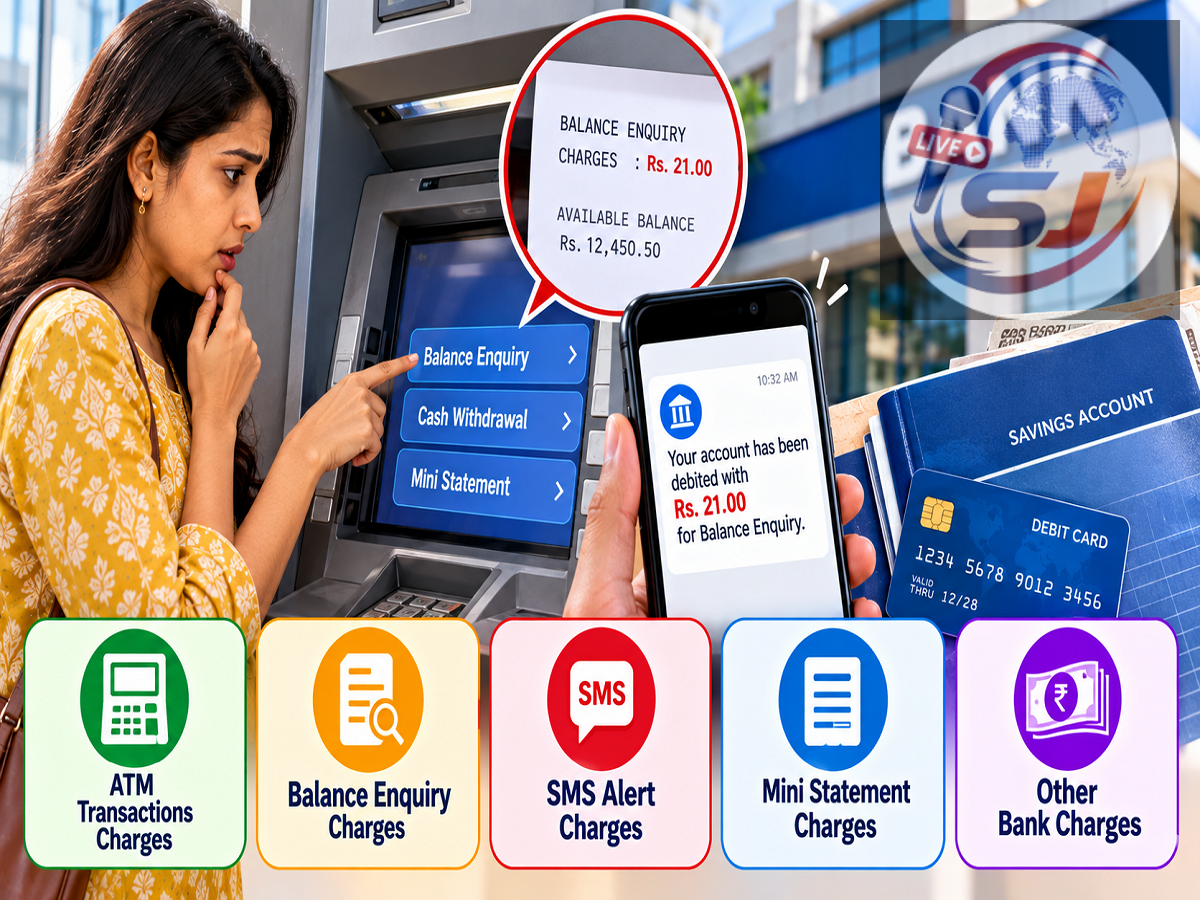
Small deductions from a savings account can easily go unnoticed. You may open your bank statement and find ₹20, ₹50 or another small amount debited even though you do not remember making a purchase or transferring money.
In many cases, such deductions can be related to banking service charges. Banks may levy fees for certain ATM transactions, SMS services, debit cards or account-maintenance facilities depending on the type of savings account and the bank's applicable schedule of charges.
One particularly confusing area is ATM usage. Many customers assume that only cash withdrawals count as ATM transactions. However, services such as checking your balance or requesting a mini statement can also be classified as transactions and may become chargeable after the applicable free limit is exhausted.
Here are some common banking charges savings-account holders should understand.
Can You Be Charged for Checking Your Balance at an ATM?
Yes, it can happen after the applicable free ATM transaction allowance has been used.
ATM activity is broadly divided into financial and non-financial transactions. Cash withdrawal is a financial transaction, while services such as a balance enquiry or mini statement are generally treated as non-financial transactions.
Depending on the bank and applicable ATM rules, both categories can count toward the free monthly transaction allowance.
Once the permitted free transactions have been exhausted, additional ATM activity may attract a fee.
Therefore, repeatedly visiting an ATM only to check your balance may eventually cost money even though no cash has been withdrawn.
Free ATM Limits Are Not Identical for Everyone
The supplied report mentions five free transactions at a customer's own-bank ATMs and three transactions at other-bank ATMs.
However, customers should not assume that these numbers apply identically to every bank account.
The applicable free ATM allowance can depend on the bank, account type, ATM location and prevailing regulatory requirements. Different rules can also apply in certain locations.
Banks publish their current ATM transaction charges and free-use limits in their schedules of charges.
Therefore, checking your own bank's latest rules is more reliable than assuming that a commonly quoted transaction limit applies universally.
How Much Can a Balance Enquiry Cost?
The supplied report states that a balance enquiry after the free ATM limit is exhausted can attract a charge of around ₹8 to ₹10 plus applicable GST in some cases.
This should be treated as an indicative figure rather than a universal fee.
Actual charges can vary from one bank to another and may also change over time.
The easiest way to avoid unnecessary ATM balance-enquiry charges is to check your account through your bank's official mobile application, internet banking or other authorised digital facility.
SMS Alerts May Also Carry a Charge
SMS alerts are another source of small deductions that customers sometimes overlook.
Banks send messages for various account activities, helping customers keep track of deposits, withdrawals, card transactions and other account events.
Depending on the bank and account type, some SMS alert facilities can carry a service charge.
The supplied report refers to some banks charging around ₹15 to ₹25 every three months for certain SMS services.
Again, this is not a standard charge that applies to every savings account in India.
Customers should check their bank's official schedule to determine whether an SMS fee applies and how it is calculated.
Security Alerts and Promotional Messages Are Different
Customers should also distinguish between essential transaction or security communications and optional or promotional messages.
Transaction alerts are an important fraud-prevention mechanism because they can quickly inform customers about activity in their accounts.
If you receive an alert for a transaction you did not authorise, you can contact your bank promptly and take appropriate action.
For this reason, customers should not simply disable all banking alerts to avoid a small fee. Instead, check what type of messaging service is being charged and whether the bank offers another alert option.
Can Bank Charges Make Your Account Balance Negative?
The answer requires an important distinction.
RBI rules provide protection regarding penal charges imposed for failure to maintain the required minimum balance in a savings account. Such charges should not be imposed in a manner that causes the savings-account balance to become negative solely because of the minimum-balance penalty.
For example, if an account has only a small amount left, the bank should not continuously deduct minimum-balance penalties until that balance becomes negative because of those charges.
However, this should not be interpreted as meaning that a bank account can never show a negative amount under any circumstances.
Authorised transactions, overdraft arrangements, linked products or other contractual banking facilities may operate differently.
Customers should therefore identify the exact reason for any negative balance and contact the bank if the deduction appears incorrect.
Minimum-Balance Charges Can Differ by Account
Another common source of deductions is failure to maintain the required balance.
Not every savings account requires the same minimum balance. Some products are designed as zero-balance accounts, while others require customers to maintain a specified average balance.
The requirement may depend on the bank, account category and other conditions.
Customers should check whether their account requires a monthly average balance or another prescribed threshold.
If you consistently struggle to maintain the required amount, you can ask the bank whether an eligible zero-balance or lower-balance account option is available.
Three Banking Charges Worth Checking
Savings-account holders should pay particular attention to these areas:
| Banking Service | When a Charge May Apply |
|---|---|
| ATM balance enquiry or mini statement | After the applicable free ATM transaction allowance is exhausted |
| SMS alert service | Depending on the bank and account type |
| Account/minimum-balance related charges | If applicable account requirements are not satisfied |
The exact amount is not universal. Always refer to your bank's current official schedule of charges.
How to Check Your Balance Without Visiting an ATM
Customers have several alternatives for checking their account balance.
Most banks provide balance information through their official mobile banking apps or internet-banking platforms.
Many banks also offer an authorised missed-call banking facility, SMS banking or WhatsApp banking.
A linked UPI application may also provide a balance-checking option after the user completes the required authentication.
Using these facilities can reduce unnecessary ATM visits and help customers preserve their free ATM transaction allowance.
Check Every Unfamiliar Debit in Your Statement
Small deductions should not simply be ignored because the amount is low.
Review your bank statement periodically and check the transaction description next to any unfamiliar debit.
A charge may relate to ATM usage, SMS services, debit-card fees, account maintenance or another banking service.
If you cannot identify the charge, contact the bank through an official customer-care number, mobile application or branch.
And if you suspect an unauthorised transaction rather than a legitimate service fee, report it to the bank immediately.
Consider Closing Accounts You No Longer Use
Many people maintain multiple savings accounts that they rarely use.
An inactive or unnecessary account can become another financial product that needs to be monitored for service charges, cards, standing instructions and possible fraudulent activity.
If you no longer need an account, first check whether it is linked to any loan EMI, SIP, insurance premium, fixed deposit, government benefit, UPI ID or recurring payment.
Once all linked services have been addressed, you can approach the bank and follow its account-closure procedure.
The Bottom Line for Savings Account Customers
A savings account does not necessarily make every banking service free.
Even something as simple as checking an account balance at an ATM can potentially become chargeable once the applicable free transaction allowance has been exhausted. SMS alerts and certain account-related services may also carry fees depending on the bank.
The easiest way to avoid unexpected deductions is to know your account's rules, use digital balance-checking facilities where appropriate and review your statement regularly.
Most importantly, do not rely on a single quoted fee or ATM limit for every bank. Charges and free transaction allowances can differ according to the bank, account type and applicable regulations.
Note: ATM charges, SMS fees, minimum-balance requirements and other banking service charges can change. Customers should check their bank's latest official schedule of charges and applicable RBI rules for current information.