
After petrol, will gas also be adulterated? Draft ready to blend 5% hydrogen; find out what the impact will be.
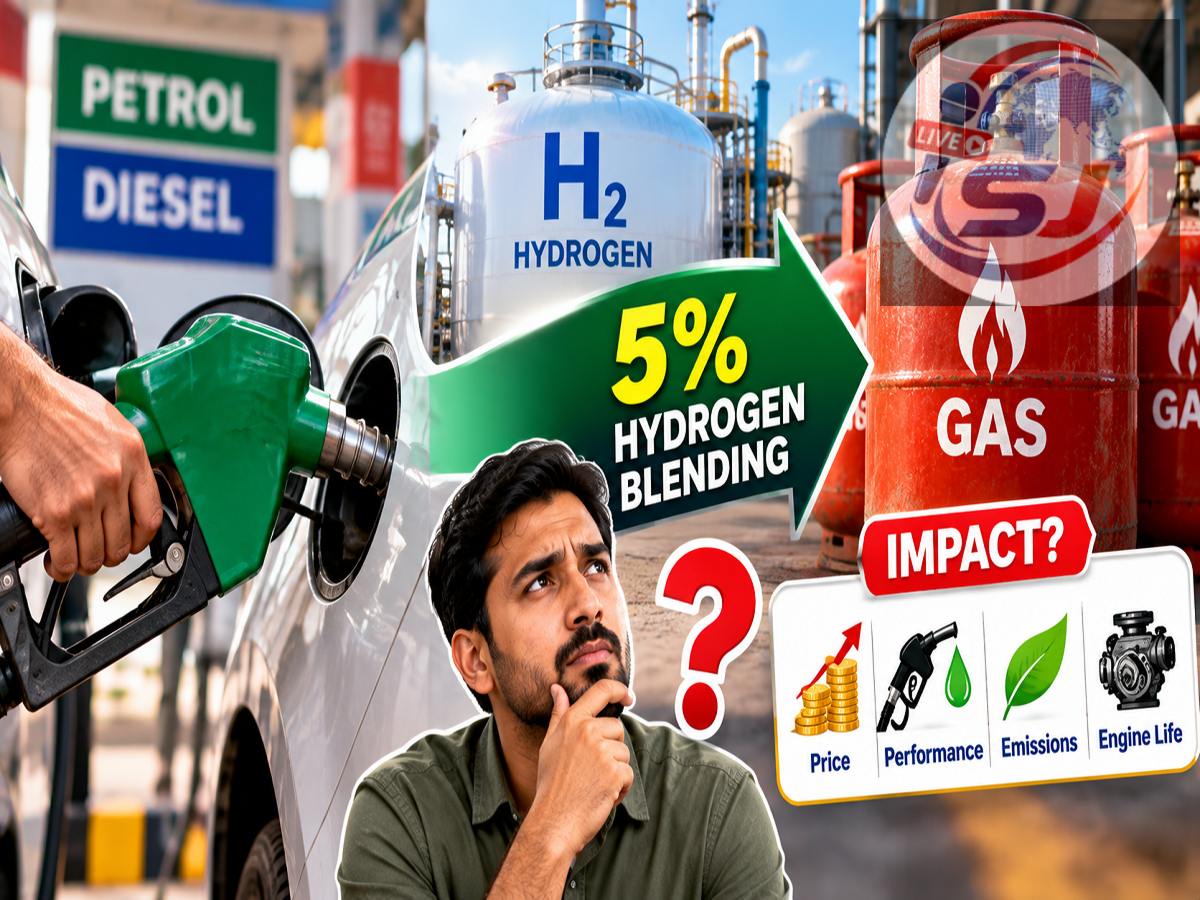
PNG Gas Hydrogen Blending 2026: A significant change could be coming to the piped natural gas (PNG) supplied to Indian households. The Petroleum and Natural Gas Regulatory Board (PNGRB) has reportedly released draft guidelines allowing up to 5% hydrogen to be blended with natural gas in selected domestic distribution networks. The proposal is intended to encourage cleaner energy use and reduce India's dependence on imported natural gas.
However, the proposed system has not been implemented. Gas distribution companies would need to complete extensive safety assessments, obtain regulatory approvals and meet technical requirements before supplying hydrogen-blended PNG to homes.
The development has also raised questions about cooking gas prices, household safety and whether existing kitchen appliances would need modifications.
PNG Gas Rules 2026: What Has PNGRB Proposed?
The Petroleum and Natural Gas Regulatory Board has proposed introducing hydrogen blending in domestic piped natural gas networks.
Under the draft guidelines reported on October 14, 2026, authorized gas distribution companies could be permitted to blend hydrogen with natural gas up to a maximum concentration of 5% in selected networks.
The initiative would initially focus on limited areas rather than introducing hydrogen-blended gas across the country immediately.
Companies interested in participating would have to submit applications to PNGRB and obtain the necessary permissions.
The regulator would assess technical readiness, safety arrangements and compliance with applicable standards before allowing operations.
Importantly, the proposal is still at the draft stage and does not mean that hydrogen has already been added to the PNG supplied to households.
Why Does India Want to Mix Hydrogen With Natural Gas?
India relies on imported energy to meet a substantial portion of its domestic requirements.
Natural gas is widely used in households, industries, transport and power generation.
Introducing hydrogen into existing natural gas networks is being explored as one way to diversify energy sources and support the transition towards lower-carbon fuels.
When produced using renewable electricity, green hydrogen can offer environmental benefits compared with conventional fossil-fuel-based energy sources.
Blending it with natural gas could potentially reduce the quantity of fossil-derived gas required to deliver a given volume of fuel.
However, the actual environmental benefit depends on how the hydrogen is produced, the blending percentage and the energy delivered to consumers.
Hydrogen blending is therefore being considered as a potential transition measure rather than a complete replacement for natural gas.
PNG Hydrogen Blending 2026: Important Details
| Particulars |
Reported Information |
|---|---|
| Regulatory Authority |
Petroleum and Natural Gas Regulatory Board |
| Proposed Hydrogen Blending Limit |
Up to 5% |
| Applicable Gas |
Domestic Piped Natural Gas |
| Initial Coverage |
Selected Local Distribution Networks |
| Implementation Status |
Draft Proposal |
| Public Consultation Deadline |
November 11, 2026 |
| Estimated Initial Rollout |
Around 2–3 Years After the Required Framework Is Finalized |
| Regulatory Approval |
Mandatory Before Implementation |
| CNG and Industrial Gas |
Not Covered by This Draft Without Separate Approval |
Will Hydrogen Blending Make PNG More Expensive?
One of the biggest concerns for household consumers is whether the proposed change could increase monthly cooking gas bills.
The answer is not yet clear.
Hydrogen, particularly green hydrogen produced using renewable energy, can currently be more expensive than conventional natural gas on an equivalent energy basis.
According to the report, green hydrogen prices in certain government-supported tenders have ranged from approximately ₹387 to ₹397 per kilogram, including GST.
For comparison, the domestic natural gas benchmark price for October 2026 was reported at $11.22 per million British thermal units (MMBtu), equivalent to approximately ₹1,067 per MMBtu.
On an energy-equivalent basis, the report estimates green hydrogen costs at approximately ₹2,880 to ₹2,950 per MMBtu.
That is around 2.7 times the cited natural gas benchmark price.
However, this does not mean household PNG bills would automatically increase by 2.7 times.
Only a small proportion of hydrogen is proposed to be blended, and the final cost impact would depend on the actual supply arrangements.
PNG Gas Price Comparison: Hydrogen vs Natural Gas
| Fuel |
Reported Price |
|---|---|
| Green Hydrogen |
₹387–₹397 per Kilogram |
| Green Hydrogen, Energy-Equivalent Cost |
₹2,880–₹2,950 per MMBtu |
| Domestic Natural Gas Benchmark, October 2026 |
₹1,067 per MMBtu |
| Domestic PNG Price in Delhi |
₹50.59 per SCM |
These figures use different pricing units and represent different stages of the fuel supply chain. They should not be compared directly without accounting for energy content, transportation, taxes and distribution costs.
Will Delhi PNG Consumers Pay More?
The report states that domestic PNG in Delhi was priced at approximately ₹50.59 per standard cubic metre (SCM).
However, the regulator has not announced a new household tariff specifically for hydrogen-blended PNG.
Gas distribution companies may face additional costs related to hydrogen procurement, blending equipment, safety assessments and network modifications.
Some of these expenses could potentially be absorbed by the companies, while others might be reflected in consumer tariffs, depending on future pricing decisions.
The impact on household bills will also depend on the proportion of hydrogen blended into the gas.
Because the proposal remains at the consultation stage, it would be premature to calculate a definitive increase in monthly cooking gas expenses.
Will 5% Hydrogen Blending Affect Cooking Performance?
Hydrogen and natural gas have different physical and combustion properties.
Hydrogen has a lower energy content per unit of volume than methane, the main component of natural gas.
Consequently, adding hydrogen can change the energy content and combustion characteristics of the supplied gas.
At relatively low blending levels, the impact on many compatible appliances may be manageable, but it cannot be assumed that every stove, burner or gas installation will operate identically.
The performance of household appliances depends on their design, the characteristics of the blended gas and the applicable technical standards.
This is one reason why compatibility assessments are necessary before hydrogen-blended PNG is introduced.
Consumers should not attempt to modify gas appliances themselves.
Any required inspection or adjustment should be performed by authorized professionals.
Is Hydrogen-Blended PNG Safe for Homes?
Safety is one of the most important aspects of the proposal.
Hydrogen is highly flammable and has properties that differ from conventional natural gas.
Its small molecular size, combustion characteristics and interaction with certain materials can create technical challenges in gas distribution systems.
These characteristics do not automatically make every hydrogen blend unsafe.
However, they mean that pipelines, valves, meters, regulators, joints and other equipment must be evaluated for compatibility.
The proposed regulatory framework is intended to ensure that companies demonstrate adequate safety arrangements before beginning supply.
What Safety Checks Will Gas Companies Need to Complete?
According to the draft guidelines described in the report, companies seeking permission to blend hydrogen with domestic PNG would need to complete several assessments.
These include evaluating the existing pipeline network and determining whether its materials and components are suitable for hydrogen blending.
Companies would also need to examine equipment compatibility and pressure-control arrangements.
Detailed safety reports would have to be submitted to PNGRB.
Independent technical agencies may be required to review operational readiness and safety arrangements.
Companies would also need to obtain applicable statutory permissions and complete pre-commissioning checks.
Only after satisfying the necessary requirements could they begin controlled operations.
Why Will Hydrogen Blending Start in Limited Areas?
Introducing a new gas mixture into an existing distribution network requires careful testing.
A limited rollout allows companies and regulators to monitor the behavior of the blended fuel under actual operating conditions.
It also provides an opportunity to evaluate gas quality, equipment performance, leakage detection and operational procedures.
If technical problems emerge, they can be investigated before the system is expanded.
This approach is particularly important because domestic PNG networks serve residential consumers who depend on gas for everyday cooking.
The proposal therefore focuses on controlled implementation rather than an immediate nationwide transition.
When Will Hydrogen-Blended PNG Reach Indian Homes?
The draft guidelines do not announce an immediate launch date.
According to the report, PNGRB expects that limited initial implementation could take approximately two to three years after the necessary legal and regulatory framework has been finalized.
This timeline is an estimate rather than a confirmed rollout schedule.
The regulator has invited comments and suggestions from stakeholders until November 11, 2026.
After reviewing the feedback, the authority may revise the proposed guidelines.
Even after the framework is finalized, individual gas distribution companies would need to obtain approval and complete the required technical assessments.
Therefore, consumers should not expect hydrogen-blended PNG to become available nationwide immediately.
Will CNG Vehicles Also Receive Hydrogen-Blended Gas?
No automatic change has been proposed for CNG vehicles under these particular draft guidelines.
The reported proposal focuses on domestic piped natural gas supplied to households.
It does not automatically extend to compressed natural gas used in vehicles.
Hydrogen-blended CNG, sometimes referred to as HCNG, involves separate technical and regulatory considerations.
Any changes to vehicle fuel composition would require their own applicable approvals and standards.
Vehicle owners should not assume that the new domestic PNG proposal will affect fuel supplied at CNG stations.
Will Commercial and Industrial Gas Consumers Be Covered?
The draft proposal is reportedly limited to domestic PNG networks.
Commercial and industrial gas supplies are not included unless separately authorized.
The same applies to major natural gas transmission pipelines.
These systems can operate under different technical conditions and serve equipment with different fuel requirements.
Separate evaluations would therefore be necessary before extending hydrogen blending to those networks.
Hydrogen Blending vs LPG: What Is the Difference?
Some consumers may confuse piped natural gas with LPG cylinders used in kitchens.
PNG is primarily natural gas supplied through pipelines directly to homes.
LPG is generally a mixture of propane and butane supplied in cylinders or through specialized distribution systems.
The PNGRB proposal concerns hydrogen blending in domestic PNG networks.
It does not announce hydrogen blending in ordinary household LPG cylinders.
Consumers using standard LPG cylinders should therefore not interpret the draft guidelines as a change to their cylinder's fuel composition.
Can Hydrogen Blending Reduce Pollution?
Hydrogen can contribute to lower carbon emissions when it replaces fossil fuel and is produced through low-emission methods.
However, the environmental impact depends on several factors.
Green hydrogen produced using renewable electricity generally has a different emissions profile from hydrogen produced using fossil fuels without carbon capture.
A 5% hydrogen blend by volume also represents a smaller proportion of the fuel's total energy content because hydrogen contains less energy per unit of volume than natural gas.
As a result, the reduction in fossil gas consumption and associated emissions may be relatively modest at low blending levels.
Hydrogen blending should therefore be viewed as one possible component of a broader clean-energy strategy.
What Should PNG Consumers Do Now?
For now, domestic PNG customers do not need to make any changes based solely on the draft proposal.
Existing gas supply arrangements remain subject to the applicable rules and agreements.
Consumers should continue following normal gas safety practices and use authorized service providers for appliance maintenance.
If hydrogen blending is eventually introduced in a particular area, the relevant gas distribution company should provide official information about any required safety checks or consumer instructions.
Households should avoid relying on unverified messages claiming that gas prices or appliance requirements have already changed.
Conclusion
The Petroleum and Natural Gas Regulatory Board has reportedly proposed allowing up to 5% hydrogen blending in selected domestic PNG networks as part of efforts to support cleaner energy and reduce dependence on conventional natural gas.
The proposal could create new opportunities for hydrogen use in India's household energy system.
However, it also raises important questions about cost, pipeline compatibility, appliance performance and consumer safety.
No nationwide implementation or confirmed PNG price increase has been announced. The proposal remains subject to consultation, technical assessments, regulatory approvals and controlled testing.
The regulator has invited stakeholder feedback until November 11, 2026, and limited implementation may take several years after the necessary framework is finalized.
Disclaimer: This article is based on the supplied October 14, 2026 report. The proposed guidelines have not been independently verified against the full PNGRB draft in this response. Final rules, tariffs and implementation timelines may differ from the proposal.