
Aadhaar Biometric Authentication Fails? Government Allows Alternative Verification for Eligible Scholarship Beneficiaries
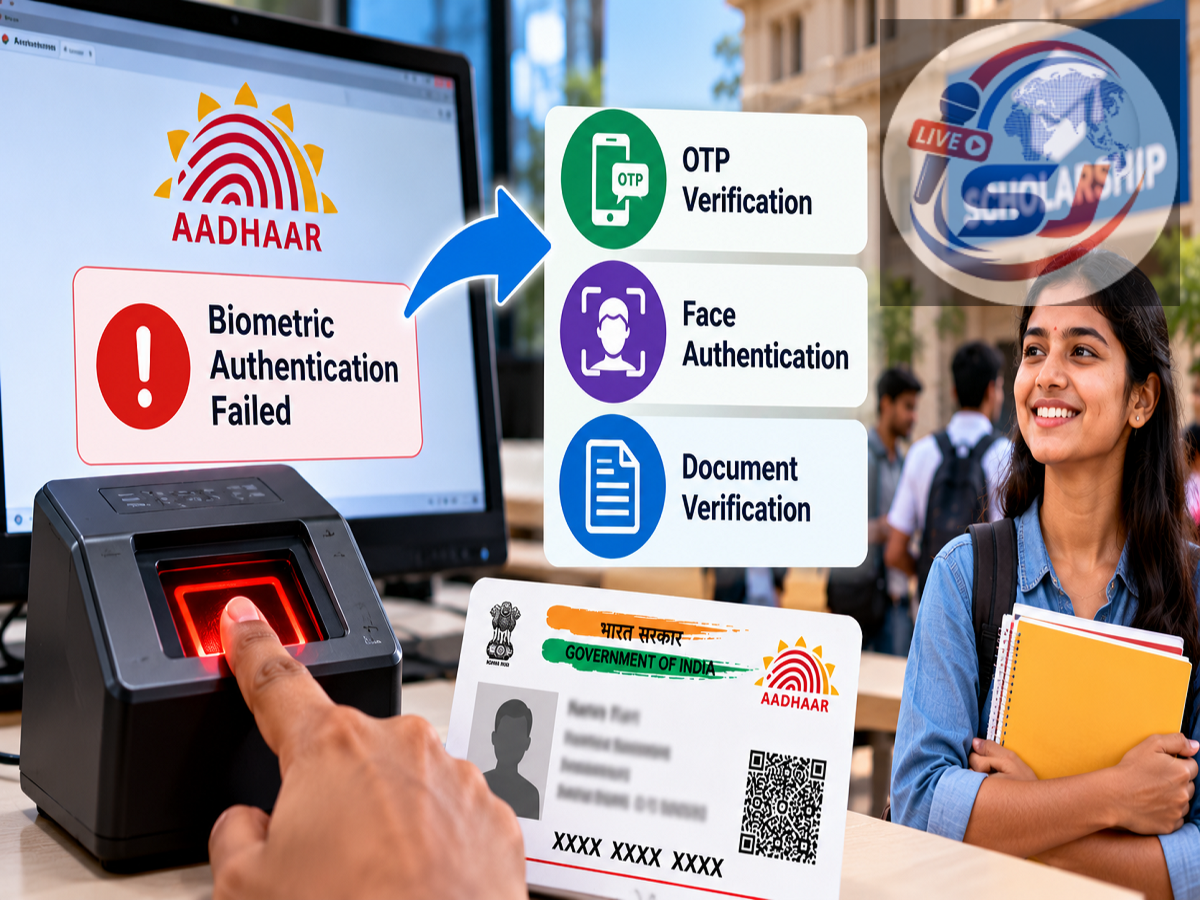
Aadhaar Biometric Authentication Update 2026: Students and other eligible beneficiaries covered by certain government welfare schemes may no longer need to worry about losing their benefits simply because their fingerprints do not match during Aadhaar verification.
The Ministry of Social Justice and Empowerment has reportedly issued a notification outlining alternative identification procedures for beneficiaries who cannot complete Aadhaar authentication or have not yet received an Aadhaar number.
Under the reported provisions, eligible applicants may be verified through facial recognition, iris scanning, OTP authentication or approved offline verification methods when fingerprint authentication fails.
The notification also provides document-based identification options for applicants who have applied for Aadhaar but have not received their numbers.
The important point is that these arrangements apply to the welfare and educational assistance schemes covered by the notification. They should not be interpreted as a blanket exemption from Aadhaar requirements across every government scheme.
Here is what the new verification arrangements mean, which documents may be accepted and how eligible students can continue receiving assistance.
Aadhaar Update 2026: What Has the Government Changed?
Aadhaar authentication is commonly used to verify the identity of beneficiaries applying for government assistance.
However, fingerprint verification does not always work successfully.
Some individuals may experience authentication failures because of worn fingerprints, technical problems or difficulties with biometric devices.
Children and elderly individuals may also encounter practical challenges during identification.
According to the reported notification, officials handling the covered welfare schemes should use approved alternative methods instead of immediately rejecting an eligible beneficiary because fingerprint authentication has failed.
The objective is to ensure that genuine applicants can establish their identity through another permitted procedure.
Which Government Schemes Are Covered?
The supplied report refers to educational and welfare assistance administered through the Ministry of Social Justice and Empowerment.
It discusses arrangements connected with schemes supporting eligible students from Scheduled Caste and Other Backward Class communities, including specified coaching and higher-education assistance programmes.
It also describes provisions relating to educational support under the PM CARES for Children framework.
However, the source combines references to multiple schemes. The exact notification and its schedule of covered benefits should be consulted to determine which provisions apply to a particular applicant.
The arrangements should not be assumed to apply automatically to banking, SIM-card verification, every scholarship programme or all government subsidies.
What Happens if Aadhaar Fingerprint Authentication Fails?
The reported guidelines provide a sequence of alternative authentication methods.
Alternative Aadhaar verification options
-
Face Authentication
Identity may be verified through an approved facial recognition process.
-
Iris Authentication
An iris scan may be used when fingerprint verification is unsuccessful.
-
OTP Authentication
Verification may be completed using an OTP sent to the Aadhaar-registered mobile number, where supported.
-
Offline Aadhaar Verification
Approved QR-code or offline eKYC verification may be used, subject to verification of the UIDAI digital signature and applicable requirements.
These methods are intended to provide flexibility where the standard fingerprint process cannot be completed.
Their availability will depend on the particular scheme, the verification system and the relevant official instructions.
What if a Student Does Not Have an Aadhaar Number?
The reported notification also addresses applicants who have not yet been allotted an Aadhaar number.
Such applicants may be required to provide proof of Aadhaar enrolment along with other acceptable identity or eligibility documents.
The notification is intended to prevent otherwise eligible beneficiaries from being denied assistance solely because Aadhaar enrolment or authentication has not been completed successfully.
However, applicants must still satisfy the scheme's underlying eligibility requirements.
Alternative identification does not mean that identity checks or eligibility verification have been removed.
Documents Accepted for Beneficiaries Below 18 Years
For applicants younger than 18, the reported provisions describe several possible supporting documents.
These may include an Aadhaar enrolment acknowledgement showing the enrolment ID, a birth certificate or an educational certificate issued by a recognised board.
In certain cases, a date-of-birth certificate issued by a recognised child protection institution may also be accepted.
Documents belonging to a parent or legal guardian may be relevant when the authorities need to establish the child's identity and relationship with the responsible adult.
Depending on the circumstances, such documents may include a ration card, residence certificate, caste certificate, passport or other prescribed records.
Where legal guardianship is involved, an order issued by a competent authority or court may be required.
The supplied report also refers to specific documentation arrangements for certain foreign nationals, subject to applicable rules.
Documents Mentioned for Applicants Under 18
| Document Category |
Examples |
|---|---|
| Aadhaar Enrolment Proof |
Enrolment acknowledgement with ID |
| Birth and Age Proof |
Birth certificate |
| Educational Records |
Class 10 or Class 12 certificate |
| Child Protection Records |
Recognised institution's age certificate |
| Parent or Guardian Documents |
Ration card, residence or caste certificate, passport |
| Legal Guardianship |
Competent authority or court order |
The exact documents required depend on the applicant's situation and the notification's conditions. Not every document is necessarily interchangeable for every purpose.
Alternative Documents for Applicants Aged 18 and Above
Adult applicants who do not yet have an Aadhaar number may also be permitted to establish their identity through specified documents.
According to the report, the verification process may require an Aadhaar enrolment acknowledgement together with an accepted identification document.
Examples mentioned include a voter identity card, passport, driving licence, government employee identity card or pensioner identity document.
Certain educational certificates, disability certificates, medical or insurance identity documents and other prescribed records may also be considered.
Applicants should confirm which documents are acceptable for their specific scheme rather than assuming that any document will automatically be sufficient.
What Does Section 7 of the Aadhaar Act Say?
Section 7 of the Aadhaar Act, 2016, deals with Aadhaar authentication or proof of Aadhaar possession in connection with certain subsidies, benefits and services funded from the Consolidated Fund of India or a state.
The law also provides for alternative and viable means of identification in specified circumstances, including where an Aadhaar number has not been assigned.
The principle behind these provisions is that an eligible individual should have an appropriate means of establishing identity while the applicable Aadhaar requirements are fulfilled.
The detailed procedure for each benefit depends on the relevant government notification and scheme rules.
PM CARES for Children: Can Benefits Continue Without Successful Aadhaar Authentication?
The supplied report highlights a provision concerning educational assistance under the PM CARES for Children framework.
It states that an eligible child should not be denied the specified assistance merely because Aadhaar authentication fails or an Aadhaar number has not yet been allotted.
In such circumstances, the responsible authorities may verify the child's identity through approved documents and establish the relationship with a parent or legal guardian where required.
Children who have not been enrolled for Aadhaar may still need to complete the enrolment process.
For minors, enrolment must follow the applicable parental or legal guardian consent requirements.
This distinction is important: an alternative verification arrangement allows eligible beneficiaries to access assistance while identification requirements are addressed; it does not necessarily eliminate the enrolment requirement.
What Should You Do if Aadhaar Authentication Keeps Failing?
Applicants experiencing repeated fingerprint failures should first inform the official responsible for processing their application.
They can ask whether the scheme permits facial authentication, iris scanning or OTP-based verification.
If these methods are unavailable or unsuccessful, they should request information about the approved offline identification procedure.
Applicants should keep their Aadhaar enrolment acknowledgement, identity documents and relevant educational or eligibility records ready.
If the problem concerns outdated biometric information, they may also enquire at an authorised Aadhaar enrolment or update centre about the appropriate biometric update process.
Students should not share Aadhaar OTPs or personal documents with unknown agents offering guaranteed scholarship approval.
Why Are Alternative Aadhaar Verification Methods Important?
Aadhaar-based verification can help streamline the delivery of government assistance, but technical authentication failures can create difficulties for genuine beneficiaries.
Alternative verification methods are especially relevant for students who depend on scholarships or educational assistance to continue their studies.
A delay in identity verification can affect applications, disbursements and access to essential benefits.
Providing a documented alternative process can help reduce the risk of eligible applicants being excluded solely because a biometric device cannot authenticate them.
At the same time, identity checks remain necessary to prevent impersonation and ensure that benefits reach the intended recipients.
Aadhaar Biometric Failure Rules 2026: Key Takeaway
The reported government notification provides an important safeguard for eligible beneficiaries under specified welfare and educational assistance schemes.
When fingerprint authentication fails, alternative methods such as face recognition, iris scanning, OTP authentication and approved offline verification may be used.
Applicants who have not received an Aadhaar number may also be able to establish their identity through prescribed documents while completing the required enrolment formalities.
The central message is that an eligible beneficiary should not automatically lose access to a covered benefit solely because Aadhaar biometric authentication fails.
However, the precise procedure depends on the scheme and the official notification. Applicants should contact the relevant department or educational institution for the approved verification process.
Disclaimer: This article is based on the supplied October 19, 2026 report. The exact notification, covered schemes and document requirements have not been independently verified. Beneficiaries should follow the applicable ministry notification and official scheme instructions.