8th Pay Commission: Will OPS Return or NPS Continue? Employee Groups Push for Guaranteed Pension
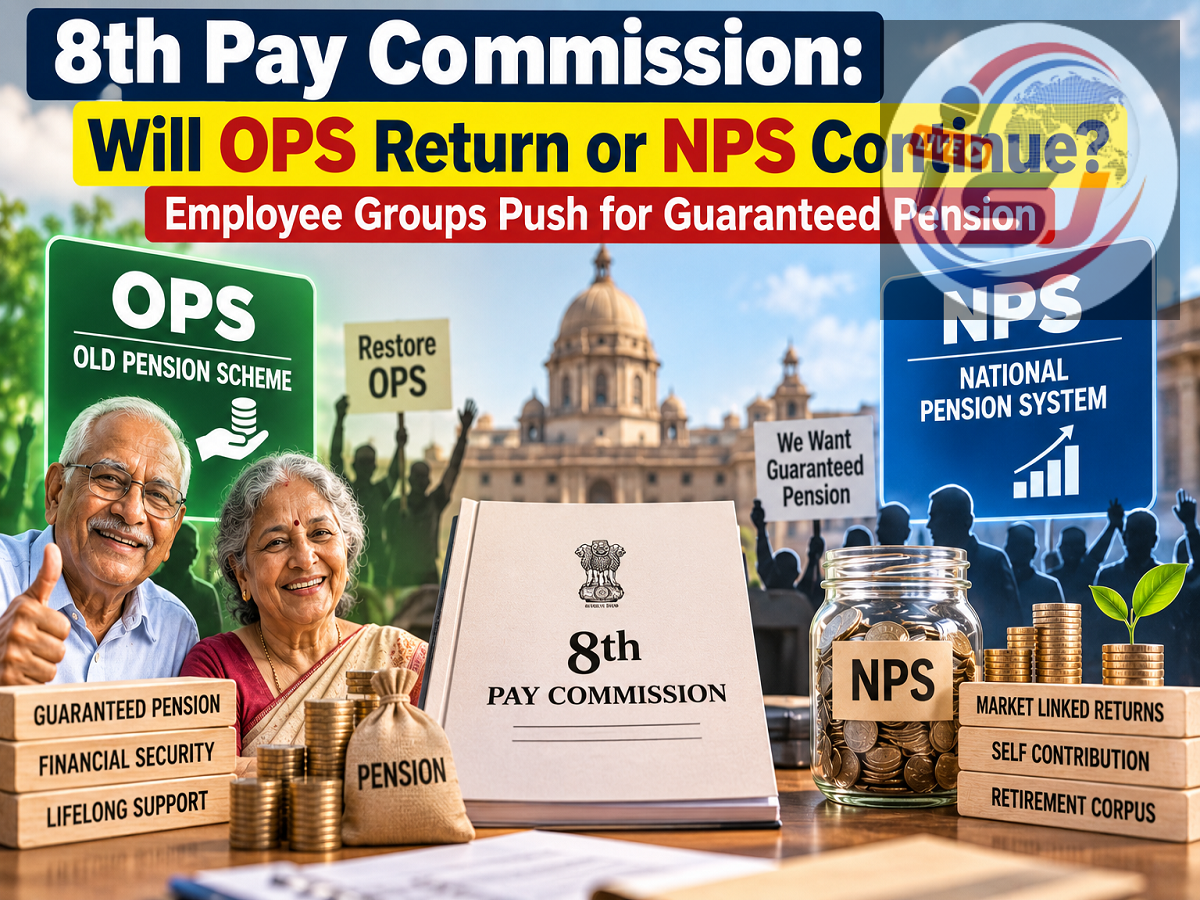
The debate over retirement benefits for Central Government employees is gaining attention as the 8th Central Pay Commission works toward its recommendations. Employee and pensioner organisations are raising several pension-related demands, with some groups calling for the restoration of the Old Pension Scheme (OPS) or seeking stronger assured retirement benefits.
The issue primarily revolves around three pension arrangements—Old Pension Scheme (OPS), National Pension System (NPS) and Unified Pension Scheme (UPS).
While employee organisations can submit their demands to the Pay Commission, there is currently no basis to treat restoration of OPS as an approved outcome of the 8th Pay Commission process. Any recommendation would still need to go through the applicable government decision-making process.
The debate is therefore about what employees and pensioner groups are seeking, rather than a confirmed change in the pension system.
Why Are Employee Groups Demanding OPS?
NPS has applied to Central Government employees entering service from January 1, 2004, subject to the applicable rules and categories.
Unlike the earlier OPS framework, NPS is a contributory retirement system. Employees and the government contribute toward retirement savings, and retirement benefits are linked to the applicable NPS framework and accumulated corpus.
Some employee organisations argue that this creates greater uncertainty about retirement income compared with the defined-benefit characteristics associated with OPS.
For this reason, sections of employee organisations have continued to demand restoration of the Old Pension Scheme.
Their key argument is retirement-income predictability. They want employees to have greater certainty about the pension they will receive after leaving service.
However, a demand raised before the Pay Commission should not be confused with a government decision to restore OPS.
Where Does UPS Fit Into the Pension Debate?
The pension landscape changed further with the introduction of the Unified Pension Scheme (UPS).
UPS became operational from April 1, 2025 as an option under NPS for eligible Central Government employees.
One of its major features is an assured payout linked to basic pay and qualifying service.
Under the applicable UPS provisions, an employee completing at least 25 years of qualifying service can be eligible for a full assured payout equivalent to 50% of the average basic pay drawn during the final 12 months before superannuation, subject to the prescribed conditions.
For qualifying service between 10 and 25 years, the assured payout is proportionate.
UPS also provides for a minimum guaranteed payout of ₹10,000 per month after at least 10 years of qualifying service, subject to the scheme's applicable conditions.
These provisions were introduced to provide greater predictability to retirement income while retaining the scheme within the NPS architecture.
OPS, NPS and UPS Are Not the Same
Understanding the difference between the three systems is important.
OPS refers to the earlier defined-benefit pension framework applicable under the relevant government service rules.
NPS is a contributory pension system in which retirement outcomes are linked to contributions, investment and the applicable withdrawal and annuity rules.
UPS, meanwhile, operates as an option within the NPS framework and provides an assured payout based on qualifying service and prescribed conditions.
Therefore, UPS should not simply be described as a restoration of OPS. The two have different structures and rules.
Why Are Some Groups Still Seeking Changes?
Despite the introduction of UPS, some employee organisations continue to seek pension arrangements that they believe would provide stronger or simpler guaranteed retirement benefits.
According to the demands cited in the report, some groups want OPS restored, while there have also been demands for employees currently covered under NPS to receive an opportunity to move to an OPS-type arrangement after completing a specified period of service.
These remain demands from employee organisations unless and until they are accepted and formally notified by the government.
The 8th Pay Commission consultation process gives employee and pensioner organisations an opportunity to place such issues before the Commission.
Has the Government Decided to Restore OPS?
As of the information currently available, there is no announced decision restoring OPS for Central Government employees generally.
This is the most important point for employees following reports about the 8th Pay Commission.
Discussions, memoranda submitted by unions and demands raised during consultations do not themselves change pension rules.
A recommendation by the Pay Commission, if one is eventually made on a pension-related issue within its remit, would also need to be considered through the government's subsequent decision-making process.
Employees should therefore be cautious about claims suggesting that OPS has already been approved merely because the issue is being discussed.
What Is the 8th Central Pay Commission Doing?
The Union Cabinet approved the Terms of Reference for the 8th Central Pay Commission on October 28, 2025.
According to the official Terms of Reference, the Commission is a temporary body and is expected to submit its recommendations within 18 months from the date of its constitution.
The Commission can also consider submitting interim reports where necessary.
Its work covers issues affecting Central Government employees, including pay and related matters. The official Terms of Reference specifically state that while framing recommendations, the Commission must consider factors including the country's economic conditions, fiscal prudence, resources required for development and welfare expenditure, and the unfunded cost of non-contributory pension schemes.
What Should Central Government Employees Watch Now?
The current pension debate is likely to remain important during the 8th Pay Commission process, but employees should separate three different stages: demands made by organisations, recommendations eventually made by the Commission, and final decisions taken by the government.
At present, OPS restoration is being raised as a demand by sections of employee organisations. It should not be presented as an approved policy change.
Meanwhile, UPS is already operational as an option under NPS for eligible Central Government employees and provides assured-payout features under specified conditions.
The eventual position will become clearer only after the 8th Pay Commission completes its work and the government takes decisions on its recommendations.
Until then, reports claiming that the 8th Pay Commission has confirmed the return of OPS or decided to discontinue NPS should be treated cautiously unless supported by an official government notification.