8th Pay Commission Update: Employee Benefits and Facilities Come Under Review as Data Collection Begins
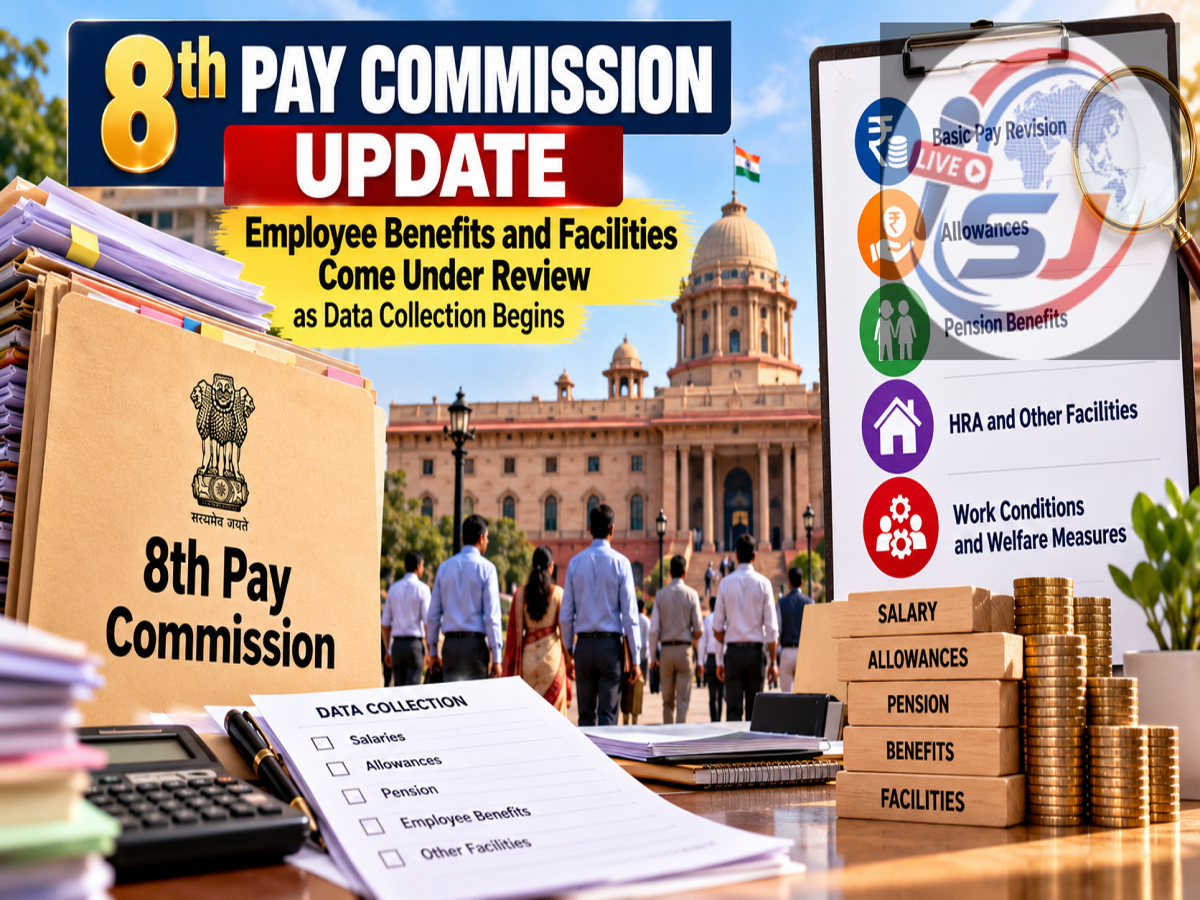
A fresh development related to the 8th Pay Commission has emerged for central government employees. According to the information provided in the report, the Commission has begun the process of collecting details about the different benefits and facilities currently available to employees.
The development is significant because the Pay Commission's work is not limited to examining basic salary and pension. Various allowances, facilities, service-related benefits and other components of the compensation structure can also form part of the broader review.
For central government employees waiting for clarity on the next salary revision, this data-collection exercise indicates that information related to the existing employee-benefit structure is being compiled for examination.
However, employees should not interpret this development as confirmation of a particular salary increase, fitment factor or implementation date. Those issues require separate recommendations and government decisions.
What Is the Latest 8th Pay Commission Update?
According to the report, the 8th Pay Commission has started gathering information regarding the benefits and facilities provided to central government employees.
This exercise can help establish a clearer picture of the existing compensation and benefit framework across government departments.
Government employees receive different forms of financial and non-financial support depending on their service conditions, department, posting and eligibility.
Collecting such information can therefore be an important part of assessing the overall remuneration structure rather than looking only at basic pay.
Why Is Employee Benefit Data Important?
A central government employee's total compensation is not restricted to the amount shown as basic salary.
Depending on applicable rules and eligibility, employees may receive various allowances and facilities linked to housing, travel, healthcare, children's education, difficult postings and other service conditions.
Retirement-related benefits are another major part of the overall framework.
Before recommending changes, a Pay Commission needs detailed information about the existing system so that different components can be examined together.
The latest reported exercise should therefore be viewed as part of the groundwork surrounding the Commission's broader review.
Salary Is Only One Part of the Pay Commission Exercise
Public discussion around the 8th Pay Commission has largely focused on questions such as how much basic salary could increase and what fitment factor might eventually be used.
But a Pay Commission can examine a much wider range of issues.
Allowances and employee facilities can materially affect take-home pay and the overall value of government employment.
For example, changes in an allowance may have a different impact on employees depending on their basic pay, posting location and eligibility.
This is why information gathering about existing benefits is an important development even though it does not immediately reveal the size of any future salary revision.
Allowances Could Be an Important Area of Review
The allowance structure is likely to remain closely watched by employees.
Under the existing framework, different categories of central government employees may receive allowances depending on their circumstances and service conditions.
A future review could examine whether particular benefits remain relevant, whether their structure needs modification or whether some amounts need revision.
However, employees should distinguish between information being collected for review and a decision to increase an allowance.
At this stage, data collection itself does not mean that every existing allowance will be increased.
Employee Facilities May Also Be Examined
Apart from direct salary and allowances, facilities available to employees can also be important.
Healthcare arrangements, travel-related provisions, education support and other service benefits can have a substantial financial value for employees and their families.
Pensioner organisations and employee unions have also been raising demands concerning medical treatment, pension protection, family pension, gratuity and career progression.
Whether all such demands will eventually be accepted is a separate question.
The Commission may examine representations and available data before making recommendations, after which the government would decide what to accept.
What About the 8th Pay Commission Fitment Factor?
The fitment factor remains one of the most discussed aspects of the 8th Pay Commission because it could play an important role in determining revised basic pay.
Several numbers have circulated in media reports, employee-union discussions and unofficial calculations.
Employees should be cautious about treating any such number as the final fitment factor unless it is formally recommended and subsequently accepted by the government.
For example, calculations circulating with fitment factors such as 2.57, 2.86 or other values are scenarios rather than proof of what employees will actually receive.
A hypothetical salary calculation can be useful for understanding possible outcomes, but it is not the same as an approved salary structure.
Will Basic Salary Increase Soon?
The latest development does not by itself establish when revised salaries will start being paid.
Data collection is part of the review process. Recommendations, consideration by the government and formal implementation are separate stages.
Therefore, reports claiming an exact revised salary or a guaranteed payment date should be treated carefully unless supported by an official decision.
The same caution applies to claims about arrears.
Employees may eventually become eligible for revised payments according to whatever effective date and implementation mechanism the government approves, but the latest data-collection update alone does not settle those questions.
Employee Organisations Are Raising Multiple Demands
The discussion surrounding the 8th Pay Commission has expanded beyond salary revision.
Employee and pensioner organisations have raised issues such as the pension system, cashless medical treatment, Children's Education Allowance, gratuity, family pension, changes to the Modified Assured Career Progression system and risk-related allowances.
These demands demonstrate why the Commission's examination of benefits and facilities can be important.
But demands made by unions or associations should not be described as approved government benefits.
A proposal may ultimately be accepted, modified or rejected.
What Should Central Government Employees Watch Next?
For employees, the next important developments will be those that provide greater clarity about the scope of the Commission's review and the recommendations that eventually emerge.
Information regarding basic pay, allowances, pensions, employee facilities and the fitment mechanism will be particularly important.
Employees should rely on formal government announcements for final figures rather than social-media posts promising a specific minimum salary or guaranteed fitment factor.
8th Pay Commission Process Moves Ahead
The latest reported development suggests that work connected with the 8th Pay Commission is moving into a detailed information-gathering phase, with data being collected about benefits and facilities available to central government employees.
This matters because the eventual review could cover considerably more than basic salary.
Allowances, facilities, retirement-related benefits and other components of employee compensation can all influence the final financial impact of a new pay structure.
For now, however, the beginning of data collection should not be interpreted as confirmation of a particular salary hike, fitment factor, revised minimum basic pay or payment date.
Central government employees and pensioners will need to wait for formal recommendations and subsequent government decisions before the financial impact of the 8th Pay Commission becomes clear.