
8th Pay Commission Salary List 2026: Peon ₹45,000, Inspector ₹1.20 Lakh? Truth Behind Viral Pay Chart
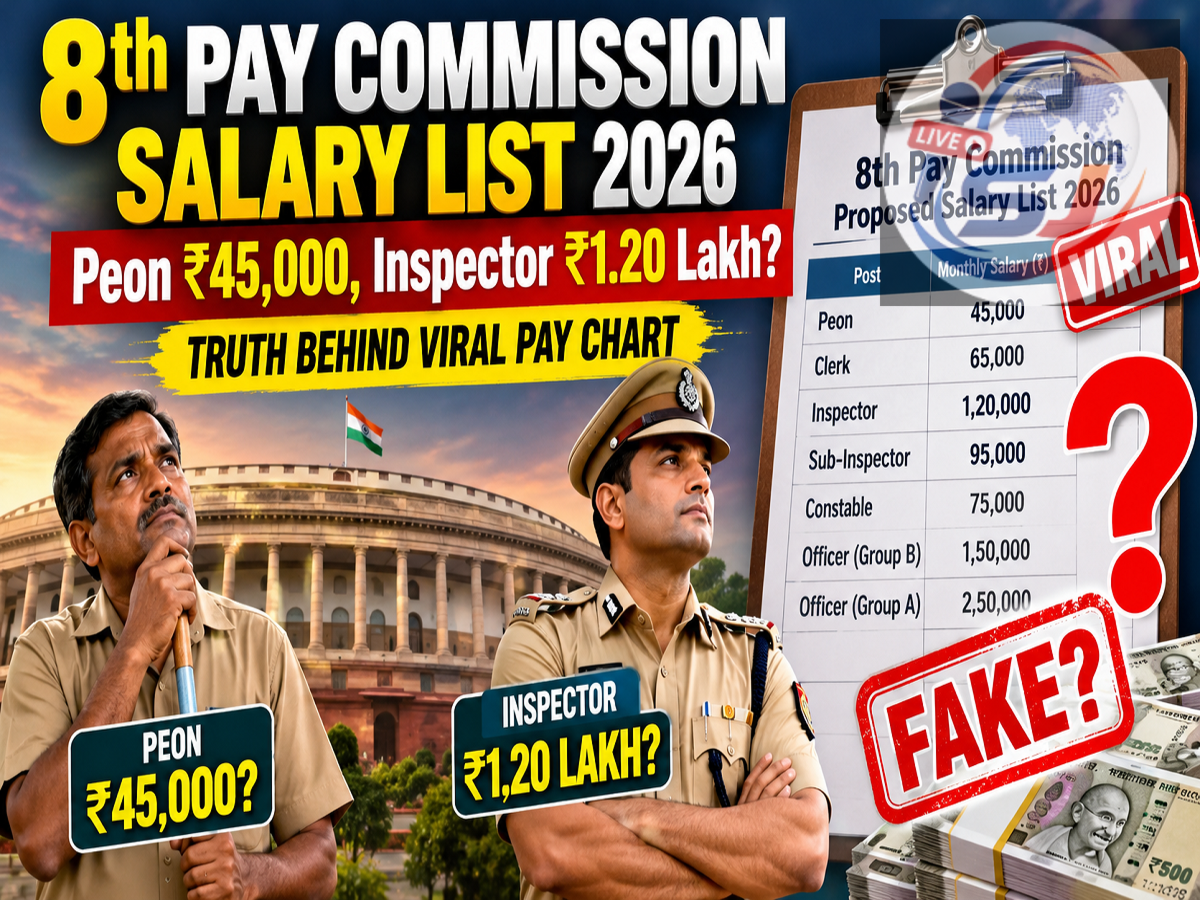
8th Pay Commission Latest News, October 15, 2026: A salary chart claiming to reveal the revised monthly salaries of central government employees under the 8th Pay Commission is circulating widely on social media. The list suggests that employees working in different government departments could receive substantial salary increases, with a peon's monthly pay reaching ₹45,000 and an inspector's salary rising to ₹1.20 lakh.
The viral chart also claims that teachers could receive ₹85,000, doctors ₹1.30 lakh, scientists ₹1.40 lakh and senior government secretaries as much as ₹3 lakh per month.
These figures have generated considerable interest among government employees and pensioners waiting for updates on the next pay revision.
However, the viral salary chart is not an officially approved 8th Pay Commission pay structure. The figures circulating online are unverified estimates and should not be treated as confirmed salaries.
Here is a detailed explanation of the viral claims, the current status of the 8th Pay Commission and the factors that will determine employees' revised salaries.
8th Pay Commission Salary Chart 2026: What Does the Viral List Claim?
A chart shared on social media platform X lists estimated monthly salaries for 17 government positions, ranging from entry-level employees to senior administrative officials.
According to the circulating list, employees could receive the following monthly salaries after implementation of the 8th Pay Commission.
| Government Position |
Monthly Salary Claimed in Viral Chart |
|---|---|
| Teacher |
₹85,000 |
| Doctor |
₹1,30,000 |
| Judge |
₹1,50,000 |
| Scientist |
₹1,40,000 |
| Peon |
₹45,000 |
| Clerk |
₹50,000 |
| Postman |
₹55,000 |
| Sub-Inspector (SI) |
₹80,000 |
| Head Constable |
₹69,000 |
| Assistant Sub-Inspector (ASI) |
₹76,000 |
| Junior Engineer |
₹92,000 |
| Inspector |
₹1,20,000 |
| Section Officer |
₹1,29,000 |
| IAS/IPS/IFS Officer |
₹1,55,000 |
| IAS/IPS Officer — Senior Scale |
₹2,10,000 |
| Secretary to the Government of India |
₹3,00,000 |
| Secretary |
₹3,00,000 |
Important: Every figure in this table is taken from the viral social media claim. These amounts have not been announced, recommended or approved as final salaries under the 8th Pay Commission.
Is the 8th Pay Commission Salary List Real or Fake?
The viral salary chart is misleading because it presents speculative figures without an officially approved pay structure.
As of October 15, 2026, the final revised salary matrix under the 8th Pay Commission has not been announced.
The commission's recommendations and the government's subsequent decisions are essential before any revised salary figures can be treated as official.
Reports indicate that the commission is engaging with employee organisations and pensioner representatives to gather views on pay, allowances and retirement benefits.
The report is expected to be submitted around May 2027, according to the timeline mentioned in the source report. However, this should be treated as a reported expectation rather than a guaranteed implementation date.
Until the final recommendations are accepted and formally notified by the government, claims about exact salaries for specific posts remain speculative.
Will a Peon's Salary Really Increase to ₹45,000?
One of the most widely discussed claims in the viral list concerns entry-level government employees.
The chart suggests that a peon could receive a monthly salary of ₹45,000 under the revised pay structure.
However, no official decision has confirmed this amount.
Under the existing 7th Pay Commission structure, the minimum basic salary at Pay Level 1 is ₹18,000 per month.
Any future revision will depend on the pay structure recommended by the 8th Pay Commission and approved by the central government.
For example, applying a hypothetical fitment factor of 2.5 to a basic salary of ₹18,000 produces a revised basic pay of ₹45,000.
But this is only a mathematical illustration.
It does not mean the government has approved a 2.5 fitment factor or confirmed ₹45,000 as the new minimum basic salary.
Can an Inspector's Monthly Salary Reach ₹1.20 Lakh?
The viral chart also claims that an inspector could receive ₹1,20,000 per month.
This figure cannot be verified as an approved salary under the 8th Pay Commission.
Government inspectors work in different departments, and their salary structures can vary depending on the service, post, pay level and applicable allowances.
Even employees with similar designations may receive different amounts because of differences in seniority, posting location and other service conditions.
Therefore, assigning one fixed monthly salary to every inspector would be misleading.
The same issue applies to teachers, doctors, engineers, scientists and other positions mentioned in the viral list.
How Will Salaries Be Calculated Under the 8th Pay Commission?
The final revised salary of a central government employee will depend on several factors.
These include the employee's existing basic pay, pay level, the approved fitment formula and any changes introduced to the pay matrix.
A fitment factor is a multiplier used in pay revision calculations.
For illustration, consider an employee with a current basic salary of ₹30,000.
| Hypothetical Fitment Factor |
Illustrative Revised Basic Pay |
|---|---|
| 2.00 |
₹60,000 |
| 2.28 |
₹68,400 |
| 2.50 |
₹75,000 |
| 2.57 |
₹77,100 |
| 2.86 |
₹85,800 |
| 3.00 |
₹90,000 |
These calculations are examples only. None of the multipliers shown should be interpreted as an officially finalised 8th Pay Commission fitment factor.
The government will need to accept the relevant recommendations before a new pay matrix can take effect.
Basic Salary vs Gross Salary: Why the Difference Matters
One major problem with viral salary charts is that they often fail to explain whether the quoted amounts represent basic salary, gross monthly salary or take-home pay.
These are three different figures.
Basic salary is the fixed component determined by the employee's pay level and position in the pay matrix.
Gross salary includes basic pay along with applicable allowances, such as Dearness Allowance, House Rent Allowance and Transport Allowance.
Take-home salary is the amount received after deductions, which may include pension contributions, income tax and other applicable recoveries.
For example, two employees with the same basic pay may receive different gross salaries if they are posted in cities with different HRA entitlements.
Similarly, their take-home salaries can differ because of individual deductions.
This is why a single figure based only on a job title cannot accurately represent the salary of every employee holding that position.
What About the Minimum Salary and Pension Under the 8th Pay Commission?
Apart from the viral salary chart, discussions are continuing about possible revisions to minimum basic pay and pensions.
Employee organisations have reportedly raised demands concerning higher minimum salaries, pension benefits and other service-related matters.
Some reports have referred to proposals involving a minimum salary of ₹69,000 and a minimum pension of ₹34,470.
However, such figures represent demands or proposals rather than confirmed government decisions.
The final amounts will depend on the commission's recommendations and their acceptance by the government.
Employees and pensioners should distinguish between union demands, media estimates and formally notified government decisions.
When Will the 8th Pay Commission Be Implemented?
The implementation date remains an important question for central government employees.
January 1, 2026, has frequently appeared in discussions about the next pay revision because previous central pay commissions have followed roughly ten-year cycles.
However, the effective date used for salary calculations and the date on which revised salaries are actually paid may not necessarily be the same.
The government will need to examine the commission's recommendations, decide which provisions to accept and issue the necessary orders.
Any decision regarding arrears will also depend on the approved effective date and implementation instructions.
Therefore, employees should avoid assuming that revised salaries or arrears will automatically be credited on a particular date.
How to Identify Fake 8th Pay Commission Salary Charts
Government employees should exercise caution when they encounter salary tables on WhatsApp, Facebook, X or other social media platforms.
A genuine government pay revision should be supported by an official notification, Cabinet decision or other authorised communication.
Charts that promise precise salaries for dozens of positions without explaining the pay level, calculation method or official approval should be treated with caution.
It is also important to check whether a report describes a proposed figure, an employee union demand, an analyst's estimate or a confirmed government decision.
These categories are not interchangeable.
8th Pay Commission Latest Update: What Is Confirmed?
The most important development is that discussions surrounding the next pay revision are continuing, but the salary figures circulating in the viral chart are not officially approved.
Claims that a peon will receive ₹45,000, an inspector ₹1.20 lakh, a scientist ₹1.40 lakh or a government secretary ₹3 lakh per month remain unverified.
The eventual salary structure will depend on the final pay matrix, applicable allowances and government decisions.
Central government employees should not treat the viral chart as an official salary list or make financial commitments based on these figures.
The next meaningful update will come from the commission's formal recommendations and subsequent government announcements.
Disclaimer: This article explains claims circulating on social media and does not endorse the salary figures. All hypothetical pay calculations are for illustration only. No final 8th Pay Commission salary chart has been established by the information provided in the source report.