
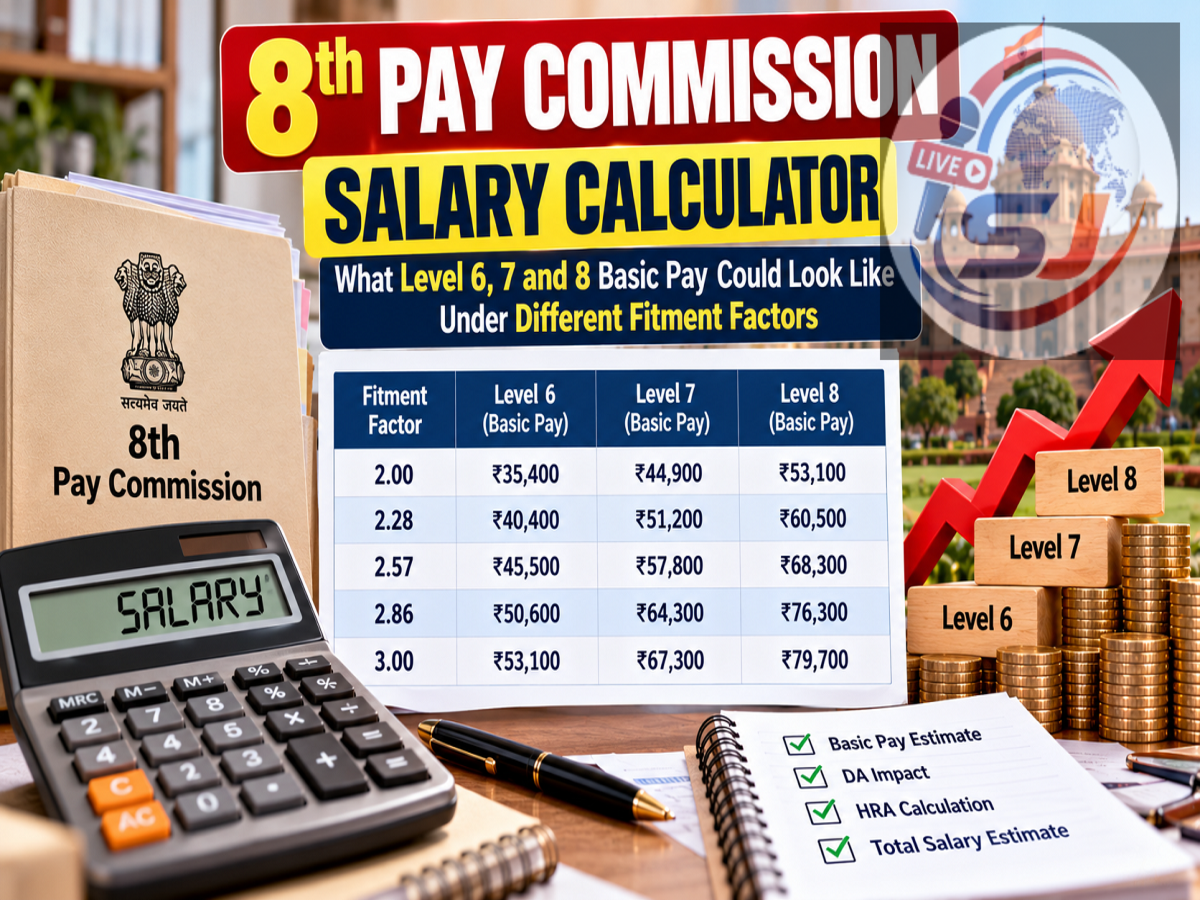
8th Pay Commission Salary Calculator: What Level 6, 7 and 8 Basic Pay Could Look Like Under Different Fitment Factors
Central government employees are closely watching developments surrounding the 8th Pay Commission, particularly the possible revision in basic pay. According to the information provided in the report, the Commission's next meetings are scheduled to begin in Bengaluru, Karnataka, from October 7, 2026, while information is also being collected from different government departments and ministries.
The Central Public Works Department (CPWD) has reportedly sought information from subordinate offices relating to the Central Government Employees Group Insurance Scheme (CGEGIS). Data collected from departments is expected to form part of the broader exercise as the Commission examines the existing salary, pension and employee-benefit structure.
For employees, however, one question continues to dominate the discussion: How much could basic salary increase?
Different employee organisations have proposed different fitment factors, while several other numbers are being discussed as possible scenarios. Since no final fitment factor has yet been approved by the government, salary calculations based on these numbers remain estimates rather than confirmed revised pay.
What Is the Latest 8th Pay Commission Update?
The latest development indicates that the process of collecting information from government departments is moving forward.
According to the report, meetings related to the 8th Pay Commission are scheduled to begin in Bengaluru from October 7.
At the same time, departments and ministries are being asked to provide employee-related information that could help the Commission understand the existing compensation and benefit structure.
The final recommendations could eventually address salaries and pensions as well as other service-related benefits.
However, data collection and meetings should not be confused with final approval of a new salary structure.
What Fitment Factor Are Employee Organisations Demanding?
The fitment factor is important because it can be used as one of the elements in determining revised basic pay when a new pay structure is introduced.
According to the report, the National Council of JCM (NC-JCM) has demanded a fitment factor of 3.833.
Other organisations, including AIDEF, FNPO and AINPSEF, have also reportedly supported a 3.833 factor.
If ₹18,000 — the existing minimum basic pay under the 7th Pay Commission — were simply multiplied by 3.833, the mathematical result would be approximately:
₹18,000 × 3.833 = ₹68,994
That is roughly ₹69,000.
However, this should not be interpreted as confirmation that the minimum basic salary will become ₹69,000. The 3.833 figure represents a demand from employee organisations, not an approved government fitment factor.
IRTSA Has Suggested a Different Range
The report also states that the Indian Railways Technical Supervisors' Association (IRTSA) has proposed fitment factors ranging from approximately 2.92 to 4.38 for different employee levels.
This demonstrates how widely the proposals can vary.
A higher fitment factor naturally produces a much larger theoretical basic salary, but the final pay structure will depend on the Commission's methodology and the government's eventual decision.
Employees should therefore avoid treating the highest figure proposed by any organisation as the likely or guaranteed outcome.
Why Is a 2.1 Fitment Factor Being Discussed?
AINPSEF National President Manjeet Singh Patel has reportedly said that, considering the existing Dearness Allowance and other pay-related factors, a fitment factor of around 2.1 could be a possibility.
Again, this is an assessment rather than an official decision.
Other figures such as 2.0, 2.15, 2.28 and 2.57 are also frequently used in hypothetical salary calculations to demonstrate how revised basic pay could change under different scenarios.
Until the 8th Pay Commission makes its recommendations and the government accepts a final formula, these numbers remain illustrative.
Level 6 Salary: How Much Could Basic Pay Become?
Under the 7th Pay Commission, the minimum basic pay at Level 6 is ₹35,400.
If different hypothetical fitment factors were applied directly to this amount, the calculations would look like this:
| Fitment Factor | Current Level 6 Basic Pay | Illustrative Revised Basic Pay |
|---|---|---|
| 2.00 | ₹35,400 | ₹70,800 |
| 2.15 | ₹35,400 | ₹76,110 |
| 2.28 | ₹35,400 | ₹80,712 |
| 2.57 | ₹35,400 | ₹90,978 |
This means that under a simple multiplication exercise, Level 6 basic pay could range from ₹70,800 at a factor of 2.0 to ₹90,978 at 2.57.
These figures do not represent approved 8th Pay Commission salaries.
Level 7 Salary Calculation
Employees at Level 7 currently have a minimum basic pay of ₹44,900 under the 7th Pay Commission.
Applying the same hypothetical factors gives the following results:
| Fitment Factor | Current Level 7 Basic Pay | Illustrative Revised Basic Pay |
|---|---|---|
| 2.00 | ₹44,900 | ₹89,800 |
| 2.15 | ₹44,900 | ₹96,535 |
| 2.28 | ₹44,900 | ₹1,02,372 |
| 2.57 | ₹44,900 | ₹1,15,393 |
Under these assumptions, a 2.0 factor would produce a basic-pay figure of ₹89,800, while a 2.57 factor would produce ₹1,15,393.
The actual revised figure could differ because the new pay matrix and fitment methodology have not yet been finalised.
Level 8 Salary Calculation
The existing minimum basic pay for Level 8 is ₹47,600.
Here is how the calculation changes across the four hypothetical fitment factors:
| Fitment Factor | Current Level 8 Basic Pay | Illustrative Revised Basic Pay |
|---|---|---|
| 2.00 | ₹47,600 | ₹95,200 |
| 2.15 | ₹47,600 | ₹1,02,340 |
| 2.28 | ₹47,600 | ₹1,08,528 |
| 2.57 | ₹47,600 | ₹1,22,332 |
A 2.57 multiplication would therefore take the theoretical Level 8 basic pay above ₹1.22 lakh.
But this is a mathematical scenario, not a government-approved pay scale.
Level 6 to Level 8: Salary Comparison
For easier comparison, here is how all three levels look under the different scenarios:
| Fitment Factor | Level 6 | Level 7 | Level 8 |
|---|---|---|---|
| 2.00 | ₹70,800 | ₹89,800 | ₹95,200 |
| 2.15 | ₹76,110 | ₹96,535 | ₹1,02,340 |
| 2.28 | ₹80,712 | ₹1,02,372 | ₹1,08,528 |
| 2.57 | ₹90,978 | ₹1,15,393 | ₹1,22,332 |
The table illustrates how strongly the selected fitment factor can affect theoretical basic-pay calculations.
Does This Mean Take-Home Salary Will Double?
Not necessarily.
Basic pay and take-home salary are different.
An employee's final salary can include components such as Dearness Allowance, House Rent Allowance and other applicable benefits, while deductions can include pension-related contributions, taxes, insurance and other items.
Moreover, when a new Pay Commission structure takes effect, the treatment of existing DA and the structure of allowances can change.
Therefore, multiplying the existing basic pay by a hypothetical fitment factor does not provide a complete estimate of future take-home salary.
What Happens to DA Under a New Pay Structure?
When a new pay structure is implemented, accumulated Dearness Allowance is typically considered as part of the broader pay-revision methodology, after which DA starts being calculated under the new framework.
This is one reason why claims such as “basic salary will double, and the existing DA will simply continue on top of it” can produce misleading salary estimates.
The exact treatment under the 8th Pay Commission will depend on its recommendations and the government's final implementation decision.
Is the 2.57 Fitment Factor Confirmed?
No.
The figure 2.57 attracts attention because it was associated with the 7th Pay Commission's pay-revision framework, but its appearance in 8th Pay Commission salary calculators does not mean it will automatically be used again.
Similarly, 2.0, 2.1, 2.15, 2.28, 2.57, 2.92, 3.833 and 4.38 should not be presented as an approved 8th Pay Commission fitment factor at this stage.
Some represent demands, some are estimates and others are simply useful scenarios for illustrating possible salary outcomes.
When Will Employees Know Their Actual Revised Salary?
The actual financial impact will become clearer only after the Commission completes its examination, recommends a pay structure and the government takes a final decision.
The new pay matrix will be particularly important because employees across different levels need to know how their existing basic pay will be mapped into the revised structure.
The treatment of allowances, pension calculations and other benefits will also determine the final impact.
Until these elements are formally settled, salary calculators can show possible scenarios but cannot predict an employee's exact future salary.
Level 6, 7 and 8 Employees Should Treat These Figures as Estimates
The ongoing information-gathering exercise and the reported Bengaluru meetings indicate continued movement in the 8th Pay Commission process.
For Level 6, Level 7 and Level 8 employees, hypothetical calculations show how dramatically basic pay can vary depending on the fitment factor ultimately selected.
For example, Level 6 could mathematically move from the existing ₹35,400 to ₹70,800 under a 2.0 scenario or ₹90,978 under a 2.57 scenario. Level 8 could similarly range from ₹95,200 to ₹1,22,332 under those two assumptions.
But none of these calculations should be mistaken for a confirmed salary chart.
The final revised basic pay, fitment mechanism, pay matrix and treatment of allowances will become known only after the 8th Pay Commission's recommendations and the government's subsequent approval.