
8th Pay Commission Salary Calculator: How 2.25 Fitment Factor Could Change Basic Pay and Gross Salary
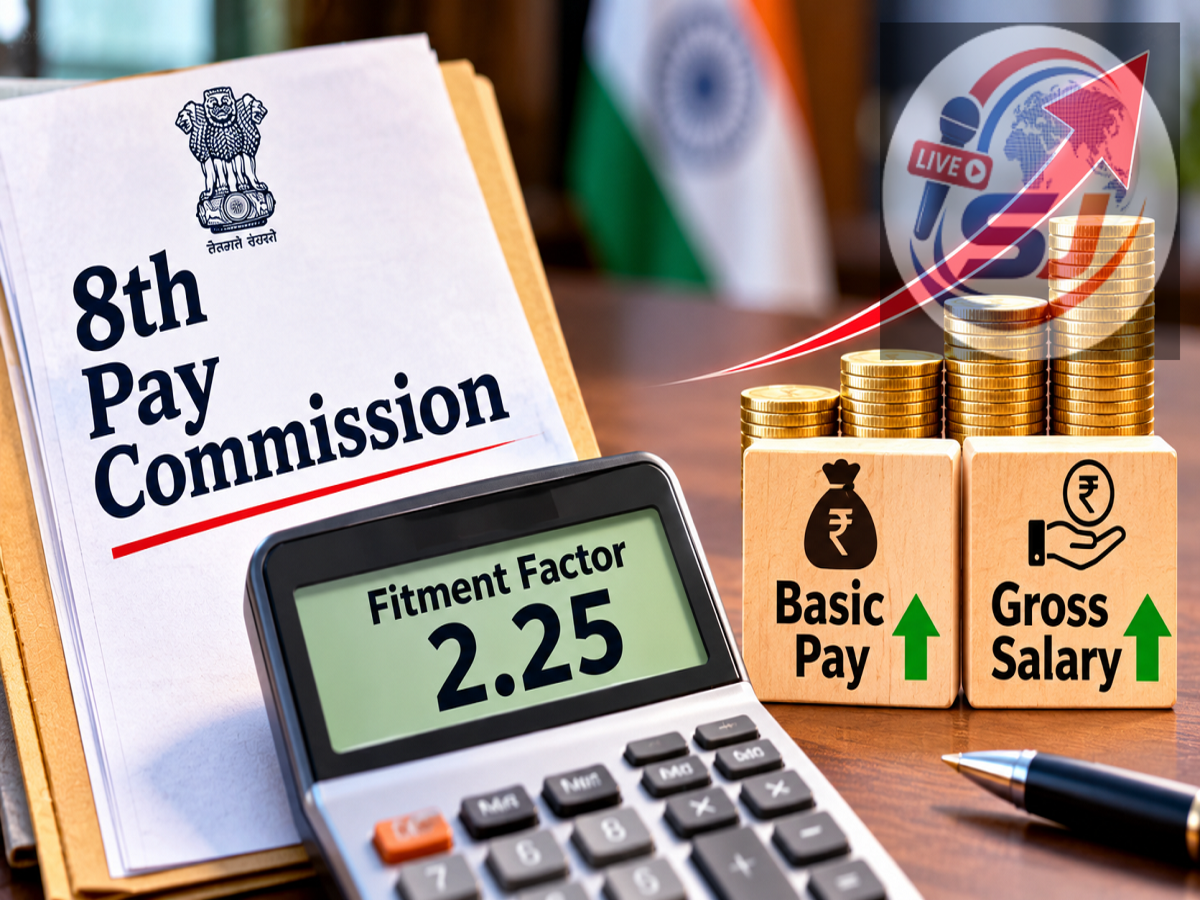
8th Pay Commission Salary Update 2026: Central government employees are closely following discussions surrounding the 8th Central Pay Commission (8th CPC), particularly the possible fitment factor that could be used to revise salaries. While different fitment factors, including 2.00, 2.25, 2.50 and 3.00, are being discussed, one important question remains: Will a 2.25 fitment factor increase an employee's entire salary by 125%?
The answer is no. A fitment factor is primarily used to calculate revised basic pay, not to multiply the employee's complete gross salary.
According to a report published by Live Hindustan on November 17, 2026, the actual increase in gross salary could be significantly lower than the percentage increase in basic pay because Dearness Allowance (DA), House Rent Allowance (HRA) and other benefits may be recalculated under the new salary structure.
Understanding this difference is especially important for employees in Pay Levels 6, 7 and 8.
What Does a 2.25 Fitment Factor Mean?
The fitment factor is a multiplier used to determine revised basic salaries when a new pay commission's recommendations are implemented.
For example, if an employee currently receives a basic salary of ₹35,400 and a fitment factor of 2.25 is adopted, the revised basic salary would be calculated as follows:
Revised Basic Pay = Existing Basic Pay × Fitment Factor
₹35,400 × 2.25 = ₹79,650
This calculation shows that basic pay would increase from ₹35,400 to ₹79,650.
The increase would amount to ₹44,250, representing a 125% rise in basic pay.
However, this does not mean the employee's total monthly earnings would also increase by 125%.
The final gross salary would depend on the allowances applicable under the revised pay structure.
Important: The 2.25 fitment factor is a hypothetical scenario, not an officially approved multiplier for the 8th Pay Commission.
Why Will Gross Salary Not Increase by the Same Percentage?
A central government employee's gross salary generally includes several components, such as basic pay, DA, HRA, transport allowance and other applicable benefits.
When a new pay commission is implemented, these components may be revised separately.
For example, the existing DA may be absorbed into the revised pay structure, with the new DA cycle beginning from a revised base.
Similarly, HRA percentages may be adjusted according to the new pay rules.
Therefore, even if basic pay increases substantially, the percentage increase in gross salary can be much smaller.
This distinction was also relevant during the implementation of the Seventh Pay Commission, when the fitment factor of 2.57 did not mean every employee's total salary increased by 157%.
Historical Salary Increases Under Previous Pay Commissions
The following figures were presented in the source report to illustrate historical changes in minimum basic salaries and pay revisions.
| Pay Commission | Reported Real Increase | Fitment Factor | Minimum Basic Pay |
|---|---|---|---|
| 2nd CPC | 14.20% | — | ₹70 |
| 3rd CPC | 20.60% | — | ₹185 |
| 4th CPC | 27.60% | — | ₹750 |
| 5th CPC | 31.00% | — | ₹2,550 |
| 6th CPC | 54.00% | 1.86 | ₹7,000 |
| 7th CPC | 14.30% | 2.57 | ₹18,000 |
These historical figures are reproduced from the supplied report for comparison. The percentages should not be treated as directly comparable salary increases for every employee because pay structures, allowances and calculation methods have changed over time.
8th Pay Commission: Level 6 Salary Calculation
Consider a Level 6 employee with an existing basic salary of ₹35,400.
The source report uses a current gross salary of ₹68,322 and assumes the following conditions:
-
Existing DA: 63%
-
Existing HRA for an X-category city: 30%
-
Revised DA at the beginning of the hypothetical new pay structure: 0%
-
Revised HRA for an X-category city: 24%
Under these assumptions, the revised gross salary is calculated as basic pay plus 24% HRA, without adding transport allowance or other benefits.
Level 6 Salary Estimates Under Different Fitment Factors
| Fitment Factor | Revised Basic Pay | Estimated Gross Salary | Basic Pay Increase | Gross Salary Increase |
|---|---|---|---|---|
| 2.00 | ₹70,800 | ₹87,792 | 100% | 28.5% |
| 2.25 | ₹79,650 | ₹98,766 | 125% | 44.6% |
| 2.50 | ₹88,500 | ₹1,09,740 | 150% | 60.6% |
| 2.75 | ₹97,350 | ₹1,20,714 | 175% | 76.7% |
| 3.00 | ₹1,06,200 | ₹1,31,688 | 200% | 92.7% |
These are illustrative calculations, not official salary projections.
What Happens With a 2.25 Fitment Factor?
For this Level 6 example:
-
Current basic salary: ₹35,400
-
Revised basic salary: ₹79,650
-
Increase in basic salary: ₹44,250
-
Current gross salary used in the example: ₹68,322
-
Estimated revised gross salary: ₹98,766
-
Increase in gross salary: ₹30,444
The basic salary rises by 125%, but the estimated gross salary increases by approximately 44.6%.
This demonstrates why employees should avoid estimating their future earnings by simply multiplying their current gross salary by the proposed fitment factor.
8th Pay Commission: Level 7 Salary Calculation
For Level 7 employees, the report refers to an existing basic salary of ₹44,900.
Using the same hypothetical DA and HRA assumptions, a fitment factor of 2.25 would produce the following result:
₹44,900 × 2.25 = ₹1,01,025
If the revised HRA is assumed to be 24%, the estimated gross salary, excluding other allowances, would be:
₹1,01,025 + ₹24,246 = ₹1,25,271
For comparison, the report's simplified current gross salary calculation uses 63% DA and 30% HRA:
₹44,900 × 1.93 = ₹86,657
The hypothetical increase in gross salary would therefore be ₹38,614, or approximately 44.6%.
Level 7 Salary Estimates
| Fitment Factor | Revised Basic Pay | Estimated Gross Salary |
|---|---|---|
| 2.00 | ₹89,800 | ₹1,11,352 |
| 2.25 | ₹1,01,025 | ₹1,25,271 |
| 2.50 | ₹1,12,250 | ₹1,39,190 |
| 2.75 | ₹1,23,475 | ₹1,53,109 |
| 3.00 | ₹1,34,700 | ₹1,67,028 |
These figures assume 24% revised HRA and zero DA. Actual gross salaries could differ depending on the final recommendations and applicable allowances.
8th Pay Commission: Level 8 Salary Calculation
The supplied report also presents an illustrative salary calculation using a current basic pay of ₹47,600.
At a fitment factor of 2.25, the revised basic salary would become ₹1,07,100.
With hypothetical HRA of 24%, the estimated gross salary would reach ₹1,32,804.
Level 8 Salary Estimates Under Different Fitment Factors
| Fitment Factor | Revised Basic Pay | Estimated Gross Salary | Basic Pay Increase | Gross Salary Increase |
|---|---|---|---|---|
| 2.00 | ₹95,200 | ₹1,18,048 | 100% | 28.5% |
| 2.25 | ₹1,07,100 | ₹1,32,804 | 125% | 44.6% |
| 2.50 | ₹1,19,000 | ₹1,47,560 | 150% | 60.6% |
| 2.75 | ₹1,30,900 | ₹1,62,316 | 175% | 76.7% |
| 3.00 | ₹1,42,800 | ₹1,77,072 | 200% | 92.7% |
The comparison uses a current gross salary of ₹91,868, calculated from the assumed existing DA and HRA percentages.
At a 2.25 fitment factor, the estimated increase in gross salary would be ₹40,936.
Compare Salary Changes at a 2.25 Fitment Factor
The following comparison shows how the same multiplier could affect employees at three different basic salary levels.
| Pay Level | Existing Basic Pay | Revised Basic Pay | Estimated Revised Gross |
|---|---|---|---|
| Level 6 | ₹35,400 | ₹79,650 | ₹98,766 |
| Level 7 | ₹44,900 | ₹1,01,025 | ₹1,25,271 |
| Level 8 | ₹47,600 | ₹1,07,100 | ₹1,32,804 |
All three examples assume a 2.25 fitment factor, zero DA under the revised structure and 24% HRA.
The figures exclude other allowances and deductions.
Will Dearness Allowance Be Reset to Zero?
The illustrative calculations assume that DA would restart from zero after implementation of a new pay structure.
This assumption reflects the broad approach used during earlier pay revisions, where accumulated DA was taken into account when determining revised salaries.
However, the actual treatment of DA under the Eighth Pay Commission will depend on the final recommendations and the government's implementation decisions.
Employees should not assume that the existing DA rate will automatically continue unchanged on top of the revised basic salary.
Similarly, the HRA rates used in these examples are assumptions rather than confirmed Eighth Pay Commission rates.
Is the 2.25 Fitment Factor Officially Confirmed?
No. The 2.25 multiplier is one of several figures being discussed in connection with the Eighth Pay Commission.
Employee organisations have raised different demands concerning salary revisions, minimum basic pay and fitment factors.
However, the final multiplier, revised pay matrix, allowances and implementation details will depend on the Commission's recommendations and subsequent government decisions.
Until an official announcement is made, salary estimates based on 2.00, 2.25, 2.50 or higher fitment factors should be treated as hypothetical calculations.
What Should Central Government Employees Remember?
The most important point is that a fitment factor directly affects basic pay, while gross salary depends on the complete revised compensation structure.
A higher basic salary can also influence other benefits that are linked to basic pay, but the overall financial impact cannot be determined from the fitment factor alone.
Employees should consider the revised DA framework, HRA rules, transport allowance, other applicable benefits and deductions before estimating their future take-home salary.
Gross salary and take-home salary are also different. Deductions such as pension contributions, taxes and other recoveries can affect the amount actually credited to an employee's bank account.
Conclusion
A hypothetical 2.25 fitment factor under the Eighth Pay Commission would increase existing basic pay by 125%, but it would not necessarily produce a corresponding increase in gross salary.
Under the simplified assumptions used in the source report, a Level 6 employee earning ₹35,400 in basic pay could see revised basic pay of ₹79,650 and estimated gross salary of ₹98,766.
Similarly, the illustrative revised gross salaries for employees with basic pay of ₹44,900 and ₹47,600 would be ₹1,25,271 and ₹1,32,804, respectively.
These estimates help explain the relationship between fitment factors and salary components. However, they are not official projections, and actual salary changes will depend on the government's final decisions.
Disclaimer: All Eighth Pay Commission calculations in this article are illustrative. The 2.25 fitment factor, revised DA assumptions and proposed HRA percentages have not been presented as officially approved rates. The examples also exclude several allowances and deductions that may affect actual salary payments.