
8th Pay Commission Pension Calculator: How Much Could ₹25,000–₹75,000 Basic Pension Increase?
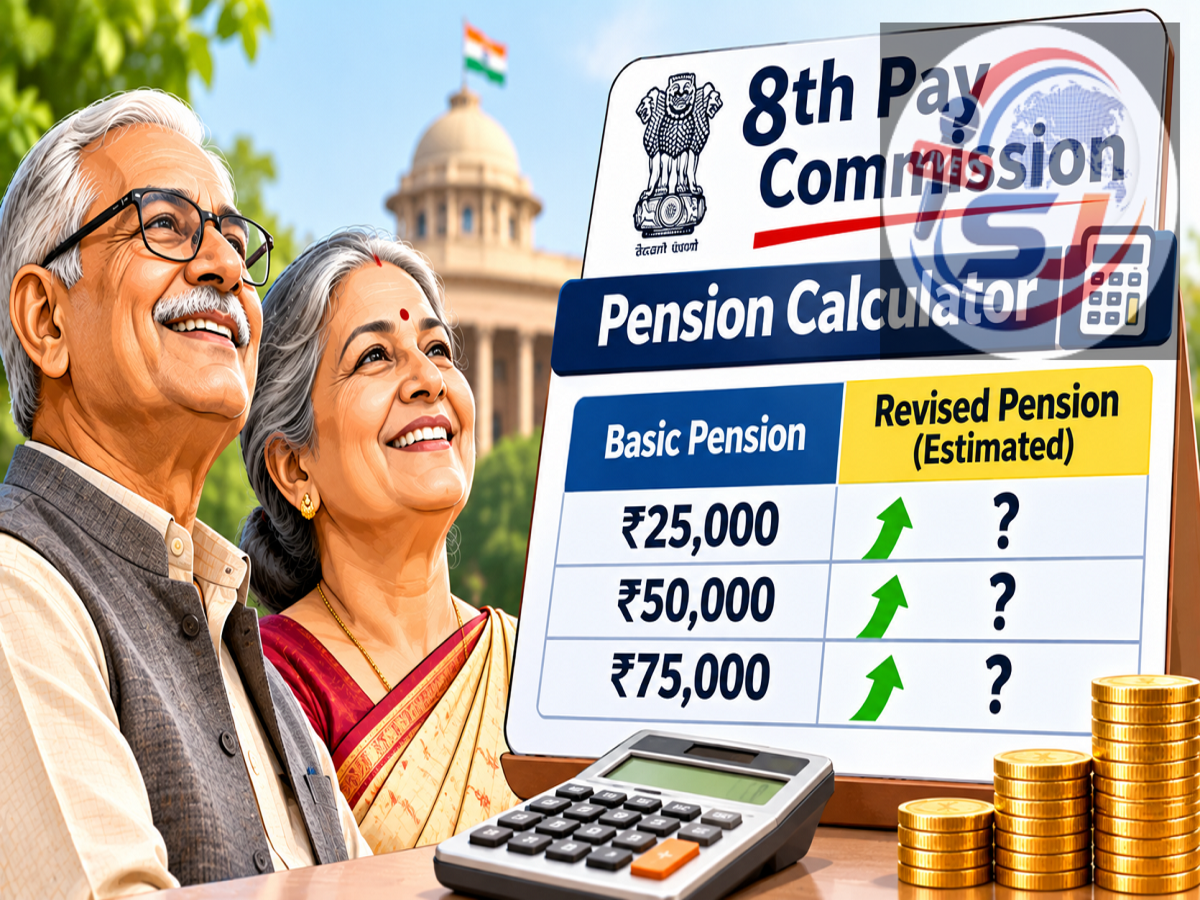
8th Pay Commission Pension Update 2026: Central government pensioners are closely watching developments surrounding the Eighth Central Pay Commission, which is expected to review salaries, allowances and pension-related benefits. One of the biggest questions among retired employees is how much their monthly basic pension could increase under a revised pay structure.
Pensioners currently receiving basic pensions between ₹25,000 and ₹75,000 are particularly interested in the possible impact of different fitment factors.
According to a Live Hindustan report published on November 16, 2026, illustrative calculations using fitment factors of 2.10, 2.57 and 2.75 show how pension amounts could change if the government adopts a similar multiplication-based revision method.
For example, a pensioner currently receiving ₹25,000 in basic pension could see the amount rise to ₹52,500 under a hypothetical 2.10 fitment factor, ₹64,250 under 2.57 or ₹68,750 under 2.75.
However, none of these fitment factors has been officially approved for the Eighth Pay Commission. The calculations are hypothetical and should not be treated as confirmed pension increases.
When Will the 8th Pay Commission Submit Its Report?
The Eighth Central Pay Commission was constituted on November 3, 2025.
According to the source report, the three-member commission is chaired by former Supreme Court judge Justice Ranjana Prakash Desai.
Its responsibilities include reviewing the compensation structure of central government employees and making recommendations concerning salaries, allowances and pension-related matters.
The commission has reportedly been given approximately 18 months to complete its work.
Based on this timeline, its report could be submitted around May or June 2027.
However, submission of the report does not automatically mean that revised salaries and pensions will become payable immediately.
The central government must examine the recommendations and decide which proposals to accept, along with their implementation dates and conditions.
How Is Basic Pension Calculated Under the Old Pension Scheme?
Before examining possible pension increases, it is important to understand how basic pension is generally determined under the Old Pension Scheme (OPS).
For eligible central government employees covered by the applicable pension rules, basic pension is generally calculated at 50% of the last qualifying emoluments or the average qualifying emoluments for the final 10 months, whichever is more beneficial, subject to the relevant conditions.
For example:
| Qualifying Salary Used for Illustration | Illustrative Basic Pension at 50% |
|---|---|
| ₹50,000 | ₹25,000 |
| ₹60,000 | ₹30,000 |
| ₹80,000 | ₹40,000 |
| ₹1,00,000 | ₹50,000 |
| ₹1,20,000 | ₹60,000 |
| ₹1,50,000 | ₹75,000 |
These examples show only the basic pension component.
Eligible pensioners may also receive Dearness Relief (DR) and other benefits according to the applicable rules.
Therefore, the basic pension amount should not be confused with the total monthly pension payment credited to a pensioner's bank account.
What Is a Fitment Factor in Pension Revision?
A fitment factor is a multiplier that may be used when revising existing pay or pension amounts under a new pay commission.
The simplified calculation is:
Illustrative Revised Basic Pension = Existing Basic Pension × Assumed Fitment Factor
For example, if a pensioner currently receives ₹40,000 in basic pension and a multiplier of 2.10 is assumed:
₹40,000 × 2.10 = ₹84,000
Similarly, under a hypothetical 2.57 multiplier:
₹40,000 × 2.57 = ₹1,02,800
These calculations demonstrate how different multipliers affect the revised amount.
However, the actual pension revision formula may involve additional conditions, including notional pay fixation and the applicable pension rules.
8th Pay Commission: Pension Calculation at 2.10 Fitment Factor
A fitment factor of 2.10 would multiply the existing basic pension by 2.10.
Under this hypothetical scenario, a pensioner receiving ₹25,000 would have a revised basic pension of ₹52,500.
A pensioner receiving ₹50,000 would see the illustrative amount rise to ₹1,05,000.
Pension Estimates With 2.10 Fitment Factor
| Existing Basic Pension | Illustrative Revised Basic Pension |
|---|---|
| ₹25,000 | ₹52,500 |
| ₹30,000 | ₹63,000 |
| ₹35,000 | ₹73,500 |
| ₹40,000 | ₹84,000 |
| ₹45,000 | ₹94,500 |
| ₹50,000 | ₹1,05,000 |
| ₹55,000 | ₹1,15,500 |
| ₹60,000 | ₹1,26,000 |
| ₹65,000 | ₹1,36,500 |
| ₹70,000 | ₹1,47,000 |
| ₹75,000 | ₹1,57,500 |
A multiplier of 2.10 represents a 110% increase over the existing basic pension amount in this simplified calculation.
However, it does not mean that the pensioner's total current payment, including DR, would necessarily increase by 110%.
8th Pay Commission: Pension Calculation at 2.57 Fitment Factor
The 2.57 multiplier has attracted attention because it was used under the Seventh Central Pay Commission.
If a similar multiplier were adopted for pension revision under the Eighth Pay Commission, the illustrative amounts would be higher than those calculated using 2.10.
For instance, an existing basic pension of ₹25,000 would become ₹64,250.
Similarly, ₹50,000 would become ₹1,28,500, while ₹75,000 would rise to ₹1,92,750.
Pension Estimates With 2.57 Fitment Factor
| Existing Basic Pension | Illustrative Revised Basic Pension |
|---|---|
| ₹25,000 | ₹64,250 |
| ₹30,000 | ₹77,100 |
| ₹35,000 | ₹89,950 |
| ₹40,000 | ₹1,02,800 |
| ₹45,000 | ₹1,15,650 |
| ₹50,000 | ₹1,28,500 |
| ₹55,000 | ₹1,41,350 |
| ₹60,000 | ₹1,54,200 |
| ₹65,000 | ₹1,67,050 |
| ₹70,000 | ₹1,79,900 |
| ₹75,000 | ₹1,92,750 |
Under this mathematical scenario, the revised basic pension would be 157% higher than the existing basic pension.
However, the final increase in the overall pension payment would depend on how DR and other applicable components are treated.
8th Pay Commission: Pension Calculation at 2.75 Fitment Factor
Another multiplier being discussed is 2.75.
This scenario would produce a higher illustrative revised basic pension.
For example, a pensioner receiving ₹25,000 could see the calculated amount rise to ₹68,750.
For a pensioner currently receiving ₹50,000, the corresponding amount would be ₹1,37,500.
A pensioner with an existing basic pension of ₹75,000 would have an illustrative revised pension of ₹2,06,250.
Pension Estimates With 2.75 Fitment Factor
| Existing Basic Pension | Illustrative Revised Basic Pension |
|---|---|
| ₹25,000 | ₹68,750 |
| ₹30,000 | ₹82,500 |
| ₹35,000 | ₹96,250 |
| ₹40,000 | ₹1,10,000 |
| ₹45,000 | ₹1,23,750 |
| ₹50,000 | ₹1,37,500 |
| ₹55,000 | ₹1,51,250 |
| ₹60,000 | ₹1,65,000 |
| ₹65,000 | ₹1,78,750 |
| ₹70,000 | ₹1,92,500 |
| ₹75,000 | ₹2,06,250 |
This represents a 175% increase in basic pension under the simplified multiplication method.
It remains only a hypothetical calculation and does not indicate that the government has agreed to adopt a 2.75 fitment factor.
Compare All Three Fitment Factors: ₹25,000 to ₹75,000 Pension
The following comparison brings all three scenarios together.
| Existing Basic Pension | At 2.10 | At 2.57 | At 2.75 |
|---|---|---|---|
| ₹25,000 | ₹52,500 | ₹64,250 | ₹68,750 |
| ₹30,000 | ₹63,000 | ₹77,100 | ₹82,500 |
| ₹35,000 | ₹73,500 | ₹89,950 | ₹96,250 |
| ₹40,000 | ₹84,000 | ₹1,02,800 | ₹1,10,000 |
| ₹45,000 | ₹94,500 | ₹1,15,650 | ₹1,23,750 |
| ₹50,000 | ₹1,05,000 | ₹1,28,500 | ₹1,37,500 |
| ₹55,000 | ₹1,15,500 | ₹1,41,350 | ₹1,51,250 |
| ₹60,000 | ₹1,26,000 | ₹1,54,200 | ₹1,65,000 |
| ₹65,000 | ₹1,36,500 | ₹1,67,050 | ₹1,78,750 |
| ₹70,000 | ₹1,47,000 | ₹1,79,900 | ₹1,92,500 |
| ₹75,000 | ₹1,57,500 | ₹1,92,750 | ₹2,06,250 |
Note: These are calculations based solely on assumed multipliers. They do not represent officially announced Eighth Pay Commission pension rates.
How Much Could a Pensioner Receiving ₹50,000 Gain?
Consider a retired central government employee whose current basic pension is ₹50,000.
Under the three hypothetical scenarios, the revised basic pension and the difference from the existing amount would be:
| Fitment Factor | Illustrative Revised Pension | Increase in Basic Pension |
|---|---|---|
| 2.10 | ₹1,05,000 | ₹55,000 |
| 2.57 | ₹1,28,500 | ₹78,500 |
| 2.75 | ₹1,37,500 | ₹87,500 |
These figures demonstrate the mathematical effect of the different multipliers.
They should not be interpreted as increases in the pensioner's total current monthly receipts, because those receipts may already include Dearness Relief.
Why Does Dearness Relief Matter?
Dearness Relief is an important component of pension payments for eligible retired government employees.
It is intended to provide relief against rising living costs.
When a new pay commission's recommendations are implemented, the treatment of accumulated DR may influence the revised pension structure.
Consequently, a pensioner should not simply multiply the current total pension payment, including DR, by a proposed fitment factor.
The simplified tables in this article multiply only the existing basic pension.
The actual revised pension and total monthly payment will depend on the final formula approved by the government.
What Are Pensioner Organisations Demanding?
Employee and pensioner associations have submitted various proposals concerning pension revision, minimum pension and family pension.
According to the source report, organisations including the National Council-Joint Consultative Machinery (NC-JCM) and the All India Defence Employees' Federation (AIDEF) have raised pension-related demands.
Among the proposals discussed are:
-
Increasing the full pension calculation from 50% to 67% of the relevant last pay.
-
Raising the family pension percentage from 30% to 50%.
-
Increasing the minimum pension to ₹45,000, as demanded by Bharat Pensioners Samaj.
-
Improving financial protection for pensioners in view of inflation and healthcare expenses.
These are demands and proposals, not officially accepted Eighth Pay Commission recommendations.
The commission may examine representations from different organisations before submitting its report.
Could the Pension Calculation Method Be Different?
Yes. The final pension revision method may be more complex than multiplying the existing basic pension by a single fitment factor.
Under the Seventh Pay Commission, pension revision for eligible pre-2016 pensioners involved two methods.
One approach was based on notional pay fixation using the revised pay structure.
The other approach involved multiplying the existing basic pension by 2.57.
The more beneficial amount was applicable under the relevant government provisions.
This historical arrangement is important because the Eighth Pay Commission may recommend a different approach to pension revision.
Until the government announces the final methodology, it is not possible to determine the exact pension payable to an individual retiree.
Will Family Pension Also Increase Under the 8th Pay Commission?
Family pension is another important subject in discussions surrounding the Eighth Pay Commission.
The source report states that some employee and pensioner organisations have demanded an increase in the family pension percentage from 30% to 50%.
Such a change, if recommended and approved, could affect eligible family pension beneficiaries.
However, the applicable pension amount would depend on the final government rules and individual eligibility.
No such increase has been confirmed in the supplied report.
Is a ₹45,000 Minimum Pension Confirmed?
No. The proposal to raise the minimum pension to ₹45,000 is among the demands attributed to Bharat Pensioners Samaj.
It has not been approved as the minimum pension under the Eighth Pay Commission.
Pensioners should distinguish between demands made by representative organisations and decisions formally announced by the central government.
The final minimum pension, if revised, will become clear only after the recommendations are examined and the relevant government orders are issued.
Will the 2.57 Fitment Factor Be Repeated?
The 2.57 multiplier was used during the Seventh Pay Commission revision, but this does not guarantee that it will be selected again.
Different figures are being discussed in connection with the Eighth Pay Commission.
The final fitment factor, if adopted as part of the revision methodology, will depend on the commission's recommendations and government approval.
Pensioners should therefore treat calculations based on 2.10, 2.57 and 2.75 as planning illustrations rather than assured future benefits.
What Should Central Government Pensioners Do Now?
Pensioners should follow official developments concerning the Eighth Pay Commission and avoid relying on unverified messages promising specific pension increases.
They should also understand the difference between basic pension, Dearness Relief and the total pension credited to their accounts.
Keeping pension payment orders and other relevant retirement records accessible may be helpful when future revision procedures are announced.
The official Department of Pension and Pensioners' Welfare website can be accessed at https://doppw.gov.in/.
Conclusion
The Eighth Pay Commission has generated considerable interest among central government pensioners, particularly those receiving basic pensions between ₹25,000 and ₹75,000.
Illustrative calculations suggest that a ₹25,000 basic pension would become ₹52,500 under a 2.10 multiplier, ₹64,250 under 2.57 or ₹68,750 under 2.75.
Similarly, a ₹75,000 basic pension would mathematically increase to ₹1,57,500, ₹1,92,750 or ₹2,06,250 under the respective scenarios.
However, these amounts are not confirmed pension entitlements.
The final outcome will depend on the Eighth Pay Commission's recommendations, the pension revision formula selected and the central government's approval.
Disclaimer: All pension calculations are hypothetical and based on assumed fitment factors. No 2.10, 2.57 or 2.75 multiplier has been officially approved for the Eighth Pay Commission. Actual pension revisions may depend on notional pay fixation, Dearness Relief treatment, eligibility and government orders.