
8th Pay Commission: Level 5 Basic Pay Could Reach ₹87,600 at 3.0 Fitment Factor, Check Salary Calculations
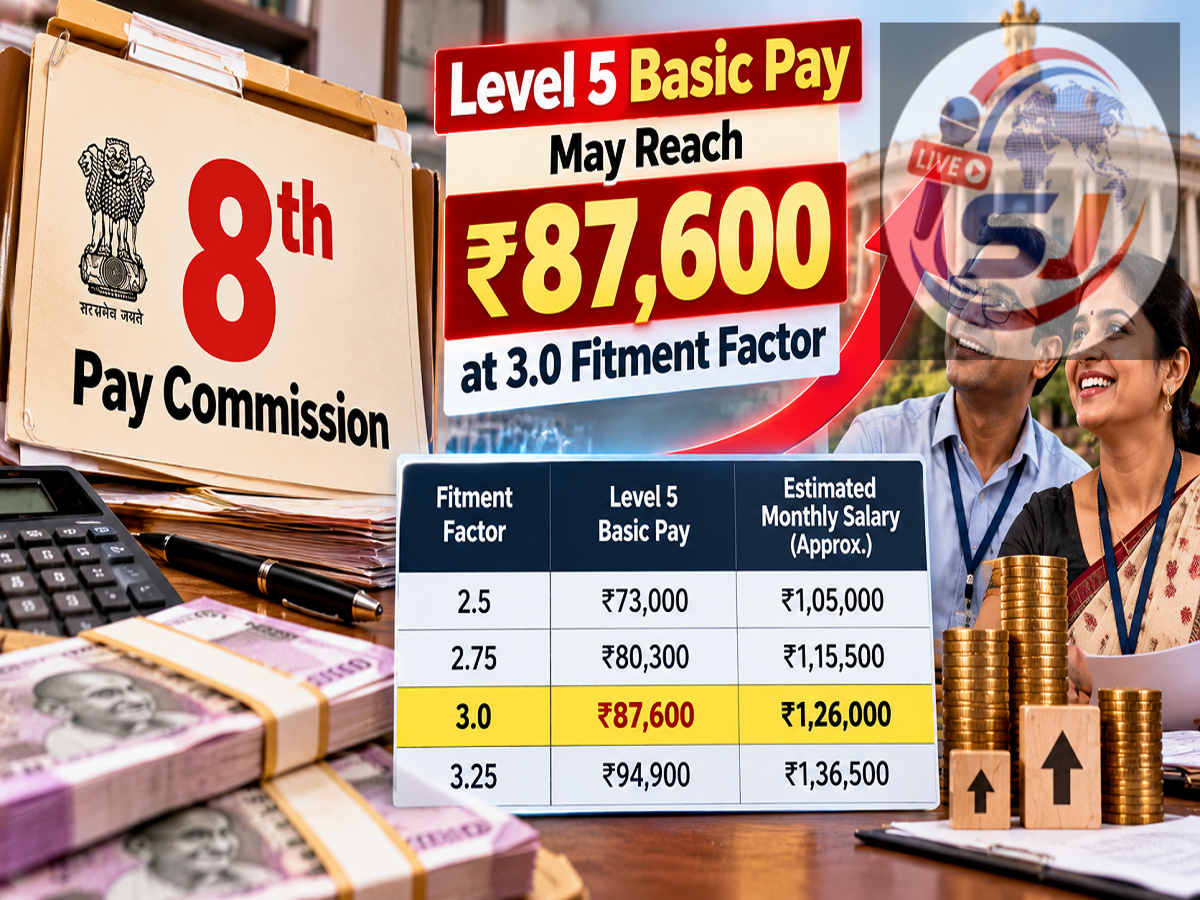
8th Pay Commission Salary Update 2026: Central government employees and pensioners are closely watching developments surrounding the 8th Central Pay Commission, particularly the discussions about the fitment factor, Dearness Allowance (DA), House Rent Allowance (HRA) and revised basic salaries.
Employee and pensioner organisations have been demanding a higher fitment factor to address rising living costs and improve salaries under the next pay structure.
According to a report dated October 13, 2026, the commission has been holding meetings with stakeholders in different cities, including Bengaluru, Delhi, Lucknow, Kolkata and Bhubaneswar. Another round of discussions is expected in Mumbai later this month.
Among the major issues being discussed is the possibility of a fitment factor ranging from approximately 1.82 to 3.833.
However, the commission has not announced or approved any final multiplier.
For a Level 5 employee earning the current minimum basic pay of ₹29,200, a hypothetical fitment factor of 3.00 would produce a revised basic pay of ₹87,600.
The ₹1,11,836 figure circulating in some reports actually corresponds to a fitment factor of 3.83, not 3.00.
Here is how the salary calculations work and what different fitment factor scenarios could mean for central government employees.
What Is the Fitment Factor Under the 8th Pay Commission?
The fitment factor is a multiplier used to convert existing basic pay into a revised pay structure.
It plays a major role in determining the starting point for salary calculations when a new Central Pay Commission is implemented.
The basic formula is:
Existing Basic Pay × Fitment Factor = Illustrative Revised Basic Pay
For example, if an employee currently receives ₹30,000 as basic pay and the approved multiplier is 2.00, the initial calculation would be:
₹30,000 × 2.00 = ₹60,000
Similarly, if the multiplier is 3.00, the calculated amount would become ₹90,000.
However, actual pay fixation may involve the approved pay matrix, rounding rules and other government instructions.
Therefore, the multiplication provides an estimate rather than a guaranteed final salary.
Level 5 Salary Calculation at a 3.00 Fitment Factor
Under the 7th Central Pay Commission, the minimum basic pay for Level 5 is ₹29,200.
If the 8th Pay Commission recommends a multiplier of 3.00 and the government accepts it, the illustrative calculation would be:
₹29,200 × 3.00 = ₹87,600
This would represent a mathematical increase of ₹58,400 over the existing minimum basic pay.
However, this does not mean that an employee's total monthly earnings or take-home salary would increase by the same amount.
The existing salary includes DA and other applicable allowances, while the revised pay structure may change how those components are calculated.
Why Is ₹1,11,836 Being Discussed for Level 5?
Some reports have associated the figure of ₹1,11,836 with a fitment factor of 3.00.
That calculation is incorrect.
The amount is obtained by multiplying Level 5's current minimum basic pay by 3.83:
₹29,200 × 3.83 = ₹1,11,836
The distinction matters because the difference between a multiplier of 3.00 and 3.83 is substantial.
| Fitment Factor | Calculated Level 5 Basic Pay |
|---|---|
| 1.82 | ₹53,144 |
| 1.83 | ₹53,436 |
| 2.00 | ₹58,400 |
| 2.57 | ₹75,044 |
| 3.00 | ₹87,600 |
| 3.83 | ₹1,11,836 |
| 3.833 | ₹1,11,924 approximately |
These figures are hypothetical calculations, not approved salary revisions.
How Much Could Level 1 Employees Receive?
Level 1 employees currently have a minimum basic pay of ₹18,000 under the 7th Pay Commission.
The revised amount would vary considerably depending on the fitment factor selected.
At 1.82, the calculated basic pay would be ₹32,760.
At 2.00, it would rise to ₹36,000.
At 2.57, the figure would become ₹46,260.
A multiplier of 3.00 would produce ₹54,000.
At 3.83, the calculated amount would reach ₹68,940.
The frequently discussed proposal to increase minimum basic pay to approximately ₹69,000 is therefore linked to the demand for a fitment factor close to 3.83.
It has not been approved by the Central Government.
8th Pay Commission Salary Chart: Level 1 to Level 10
The following table shows the minimum basic pay under the existing pay matrix and the corresponding hypothetical amounts at different fitment factors.
| Pay Level | Current Minimum Basic | At 2.00 | At 2.57 | At 3.00 |
|---|---|---|---|---|
| Level 1 | ₹18,000 | ₹36,000 | ₹46,260 | ₹54,000 |
| Level 2 | ₹19,900 | ₹39,800 | ₹51,143 | ₹59,700 |
| Level 3 | ₹21,700 | ₹43,400 | ₹55,769 | ₹65,100 |
| Level 4 | ₹25,500 | ₹51,000 | ₹65,535 | ₹76,500 |
| Level 5 | ₹29,200 | ₹58,400 | ₹75,044 | ₹87,600 |
| Level 6 | ₹35,400 | ₹70,800 | ₹90,978 | ₹1,06,200 |
| Level 7 | ₹44,900 | ₹89,800 | ₹1,15,393 | ₹1,34,700 |
| Level 8 | ₹47,600 | ₹95,200 | ₹1,22,332 | ₹1,42,800 |
| Level 9 | ₹53,100 | ₹1,06,200 | ₹1,36,467 | ₹1,59,300 |
| Level 10 | ₹56,100 | ₹1,12,200 | ₹1,44,177 | ₹1,68,300 |
All figures are based on the minimum basic pay at each level.
Employees receiving higher basic pay within the same level would have different calculations.
What Happens to Level 18 Basic Pay?
Level 18 has a basic pay of ₹2,50,000 under the existing 7th Pay Commission structure.
At a multiplier of 2.00, the calculated revised basic pay would be ₹5,00,000.
At 2.57, it would become ₹6,42,500.
At 3.00, the figure would reach ₹7,50,000.
At 3.83, the mathematical amount would be ₹9,57,500.
These calculations should not be confused with official revised salaries or approved upper pay limits.
The final structure may differ from simple multiplication.
Which Fitment Factors Are Employee Organisations Demanding?
Different organisations have reportedly submitted different recommendations to the commission.
The National Council–Joint Consultative Machinery Staff Side has demanded a fitment factor of 3.833.
Other employee and pensioner groups have proposed factors around 3.61 or 3.83.
Some estimates circulating in public discussions use lower factors such as 1.82, 2.00 and 2.57.
However, an employee organisation's demand is not the same as a government-approved fitment factor.
Similarly, an estimate made by an analyst or reported in the media does not establish what the commission will recommend.
The final number will depend on the commission's assessment and the government's decision.
Will DA and HRA Also Increase?
The revised basic pay is only one part of an employee's salary.
Dearness Allowance, House Rent Allowance, Transport Allowance and other applicable benefits also influence total monthly earnings.
When a new pay structure is introduced, the treatment of existing DA can be particularly important.
Under previous pay revisions, accumulated DA has been taken into account while determining the new pay structure.
The new DA rate may also be reset or recalculated under the approved methodology.
HRA rates and eligibility rules may be revised separately.
Therefore, employees should not simply add the existing DA percentage to a hypothetical revised basic salary and assume that the result will be their new monthly pay.
Why Does a Threefold Basic Pay Not Mean a Threefold Salary Increase?
Suppose an employee receives ₹29,200 as basic pay and a hypothetical DA rate of 60%.
The DA component would amount to ₹17,520, producing a combined basic pay and DA amount of ₹46,720.
If a new fitment factor of 3.00 produces a revised basic pay of ₹87,600, the comparison should consider how the existing DA is treated under the new structure.
Comparing ₹87,600 only with the old basic pay of ₹29,200 would suggest a threefold increase.
But comparing the revised basic with the previous basic-plus-DA amount produces a different picture.
Other allowances, deductions and taxes would also affect the final take-home salary.
This is why employees should wait for the official pay fixation rules before estimating their actual monthly benefit.
When Will the 8th Pay Commission Announce the Final Fitment Factor?
The supplied report states that the commission is continuing consultations with employee and pensioner organisations.
Meetings have reportedly taken place in several cities, with another meeting planned in Mumbai during October 2026.
The commission was constituted in November 2025 and has been given 18 months to submit its recommendations.
That places its original reporting target around May 2027.
However, the final fitment factor may become clear only when the recommendations are released and the government takes a decision.
No confirmed multiplier or implementation date has been provided in the report.
What Should Central Government Employees Keep in Mind?
Employees should use fitment factor calculations only as planning scenarios until official recommendations are announced.
The most important information will be the approved multiplier, revised pay matrix, treatment of DA, allowance rules and effective implementation date.
Different employee levels may also be affected differently depending on the final pay fixation method.
Pensioners should similarly wait for confirmed rules regarding pension revision and Dearness Relief.
8th Pay Commission 2026: Latest Salary Update
The fitment factor remains one of the biggest issues before the 8th Central Pay Commission.
For Level 5 employees, the current minimum basic pay of ₹29,200 would mathematically become ₹87,600 at a multiplier of 3.00.
The widely circulated figure of ₹1,11,836 corresponds to a multiplier of 3.83.
At Level 1, a multiplier of 3.00 would produce ₹54,000, while Level 18 basic pay would mathematically reach ₹7,50,000.
These amounts are illustrations, not confirmed salary increases. Employees will know their actual revised basic pay only after the commission's recommendations and the Central Government's approval.
Disclaimer: This article is for informational purposes only. All projected salary amounts are mathematical estimates based on hypothetical fitment factors. The 8th Pay Commission has not announced a final fitment factor or revised pay matrix in the information reviewed.